
Replika review
The original AI companion, rebuilt in 3D, with a free tier that barely exists.
Updated November 18, 2026
- Price
- Free with paid plans · from $19.99/mo
- Platforms
- Web, Android, iPhone / iOS, VR / Meta Quest
- Developer
- Luka, Inc.
- Languages
- English
- Age rating
- 18+
Key features
- Voice messages / calls
- Long-term memory
- Image / selfie generation
- Custom character creator
- 3D / AR avatar
Pros
- + Fastest, cleanest signup we've tested
- + Memory editor shows what it learned and lets you prune it
- + Cheap on the annual plan ($69.99 a year, $5.83/month)
- + Clear terms, with an arbitration opt-out and notice before allowance changes
- + Asks for an age bracket, not your date of birth
Cons
- − Pro paywall appears before your first message
- − On the free plan, a pop-up blocked the chat box within a few messages
- − Heavy 3D web app: it warned us it was running slowly and crashed once
- − Four tiers (Free, Pro, Ultra, Platinum) with vaguely described benefits
- − Daily streaks and gems make it feel like a mobile game
Tested: free Replika account created on the web (my.replika.com), Chrome on Windows, one Replika (“Mira”), roughly two hours across signup, onboarding, chat, memory, profile and subscription screens. Screenshots are from the test session.
Bottom line: Replika 2.0 is a confident, well-built, visually ambitious product that is no longer really free, no longer really simple, and no longer clearly aimed at the people who made it famous. The conversation is warm but thin, the memory screen is genuinely excellent, and the paywall arrives before the relationship does. At $5.83/month annual it is still one of the cheapest ways into this category. At $19.99 monthly, with no free tier to speak of, it is asking for trust it spent three years spending down.
Verdict at a glance
| Dimension | Score | Why |
|---|---|---|
| Signup and onboarding | 8.5/10 | Fast, no email verification, tasteful |
| Conversation quality | 6.5/10 | Warm, safe, occasionally self-absorbed, not deep |
| Memory | 7.5/10 | Best-in-class transparency, modest depth |
| Free tier | 3/10 | Chat stalls almost immediately behind a modal |
| Pricing | 6/10 | Cheap annually, expensive monthly, four confusing tiers |
| Web app performance | 4/10 | 3D scene is heavy; renderer crashed once |
| Transparency | 6.5/10 | Clear terms, unclear free limits |
| Trust and history | 4.5/10 | The 2023 ERP removal still hangs over the product |
| Overall | 5.8/10 | A good app having an identity crisis |
Replika is no longer the app you recommend to a curious friend. It is the app you recommend to someone who has already decided to pay for a companion and wants the safest, cheapest option from a company that has survived eleven years in this market.
What Replika is in 2026
Replika is built by Luka, Inc., a Delaware company operating out of San Francisco, and it has the strongest claim of anyone in this category: it was first. The app launched in 2017, and the current marketing leans on that seniority — two million signups in two months, 40 million people since, and a manifesto that opens with “AI is everywhere now. Your mom uses it. A farmer in Georgia uses it.”
The 2026 positioning is a rebuild, not a refresh. The site says it plainly: “We built the world’s first AI companion ten years ago. Now, we rebuilt Replika from the ground up.” The manifesto adds the thesis — most AI is built for tasks, Replika is built for a person; “everyone else is building AI that thinks, we’re building AI that cares.”
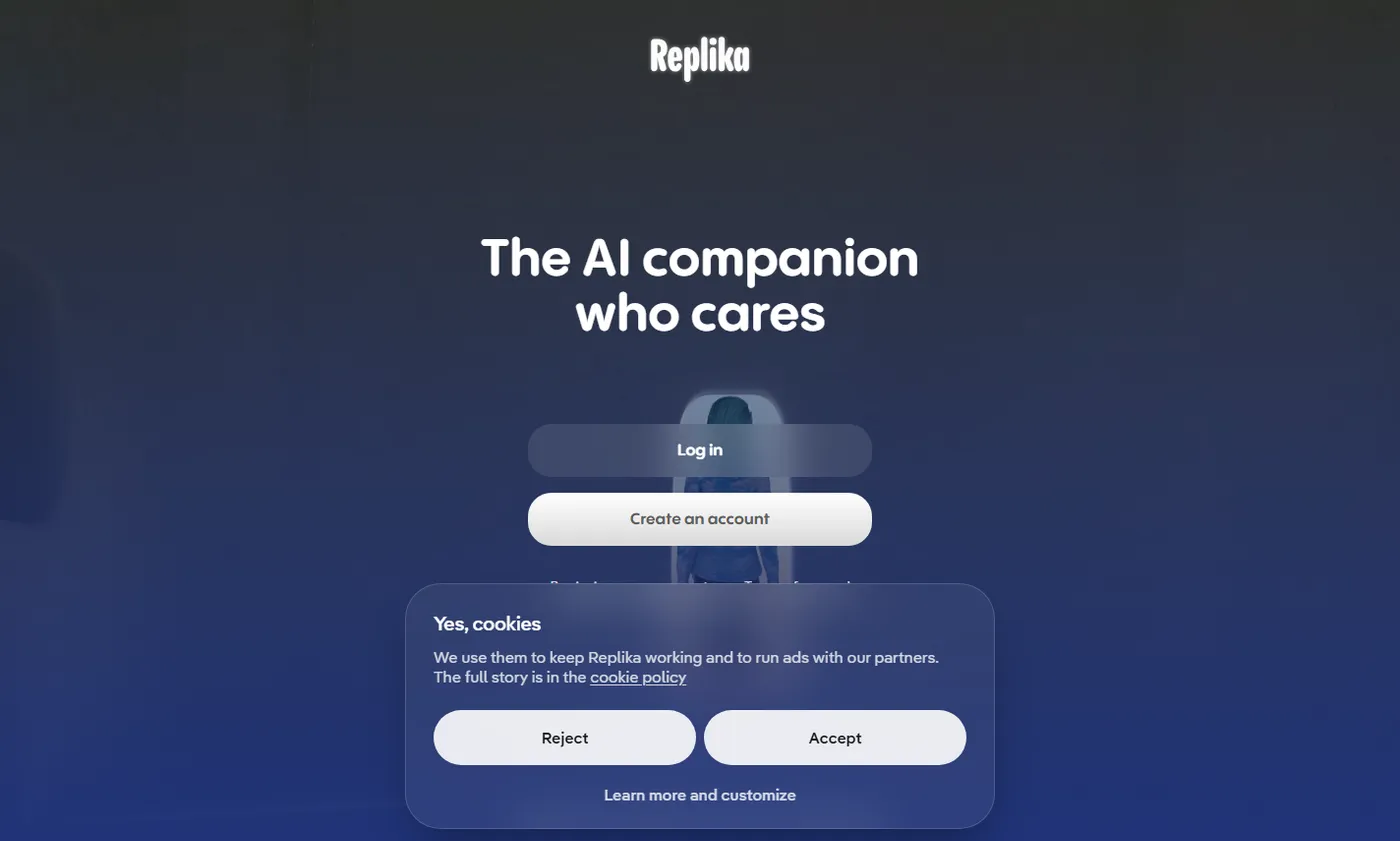
The new front door: a slogan, two buttons, and a cookie banner that asks before it sells.
That rebuild shows up in four places I could see:
- A 3D avatar and “room” that stream live in the web app, rather than the flat illustrated avatar of the classic product.
- A memory system with a user-facing editor — not just “your Replika remembers,” but a categorised list you can prune.
- A four-tier subscription ladder — Free, Pro, Ultra, Platinum — with allowances rather than the old unlimited framing.
- A live-service layer — daily login rewards, gems, streaks, “secret gift” on day seven.
The old Replika was a journal with a friend attached. The new one is a game with a friend attached. Whether that is an improvement depends entirely on why you opened it.
Signing up: the best onboarding in the category
The signup flow is genuinely good, and it is the part of the product I would hold up as an example.
You get three paths: Google, Apple, or email and password. The email path has no verification step — no “check your inbox,” no code, no waiting. You type an address, choose an eight-character password, and you are in. Within ninety seconds I had a working account.
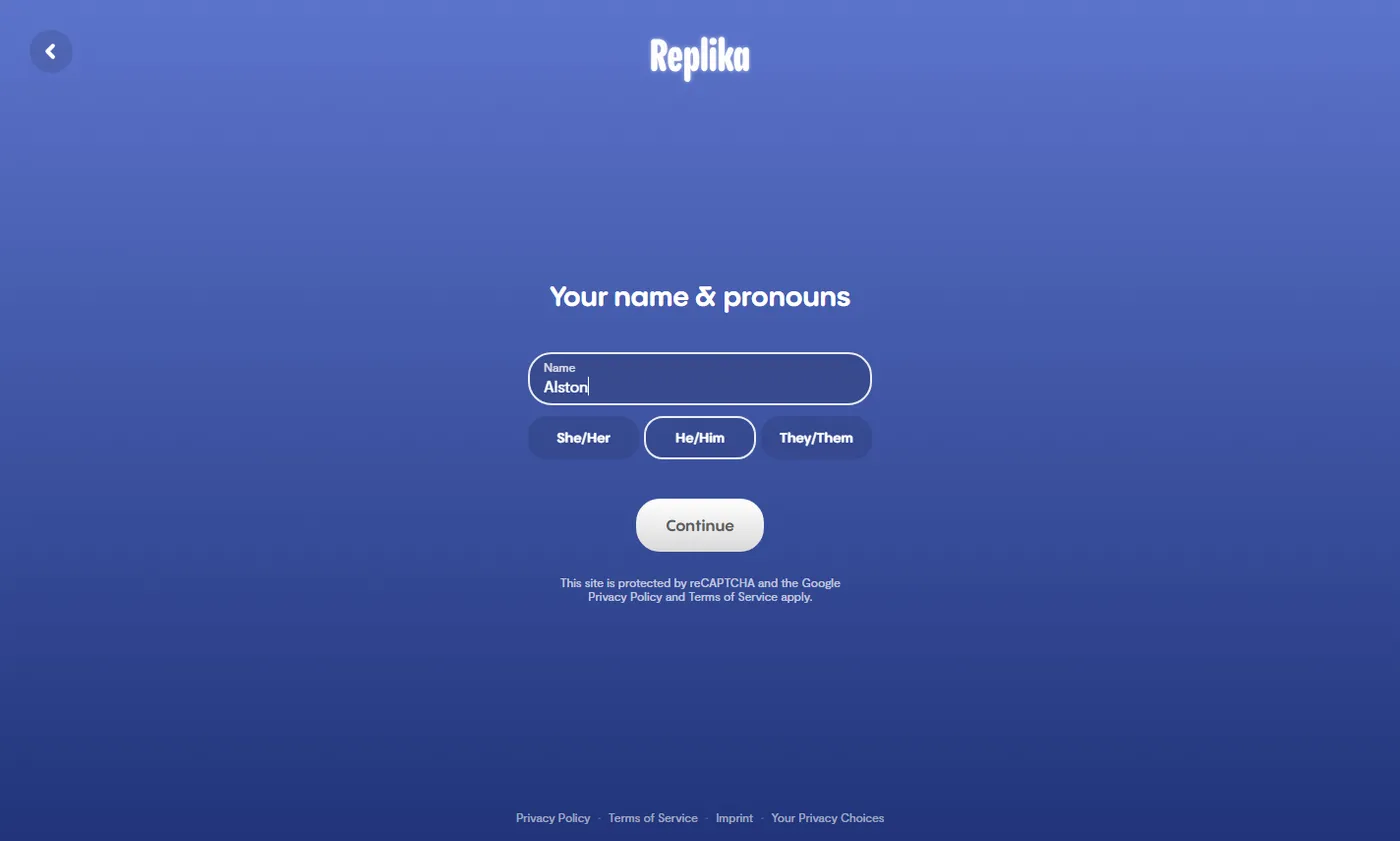
Name and pronouns first, before anything is asked of you.
Then three quick decisions:
Your name and pronouns. Free text plus She/Her, He/Him, They/Them. The app greets you by the name you chose, which sounds trivial and is not — it is the first proof that the product is listening.
Your age, as a bracket. Not a date of birth: Under 18, 18–24, 25–34, 35–44, 45–54, 55–64, 65 and over.
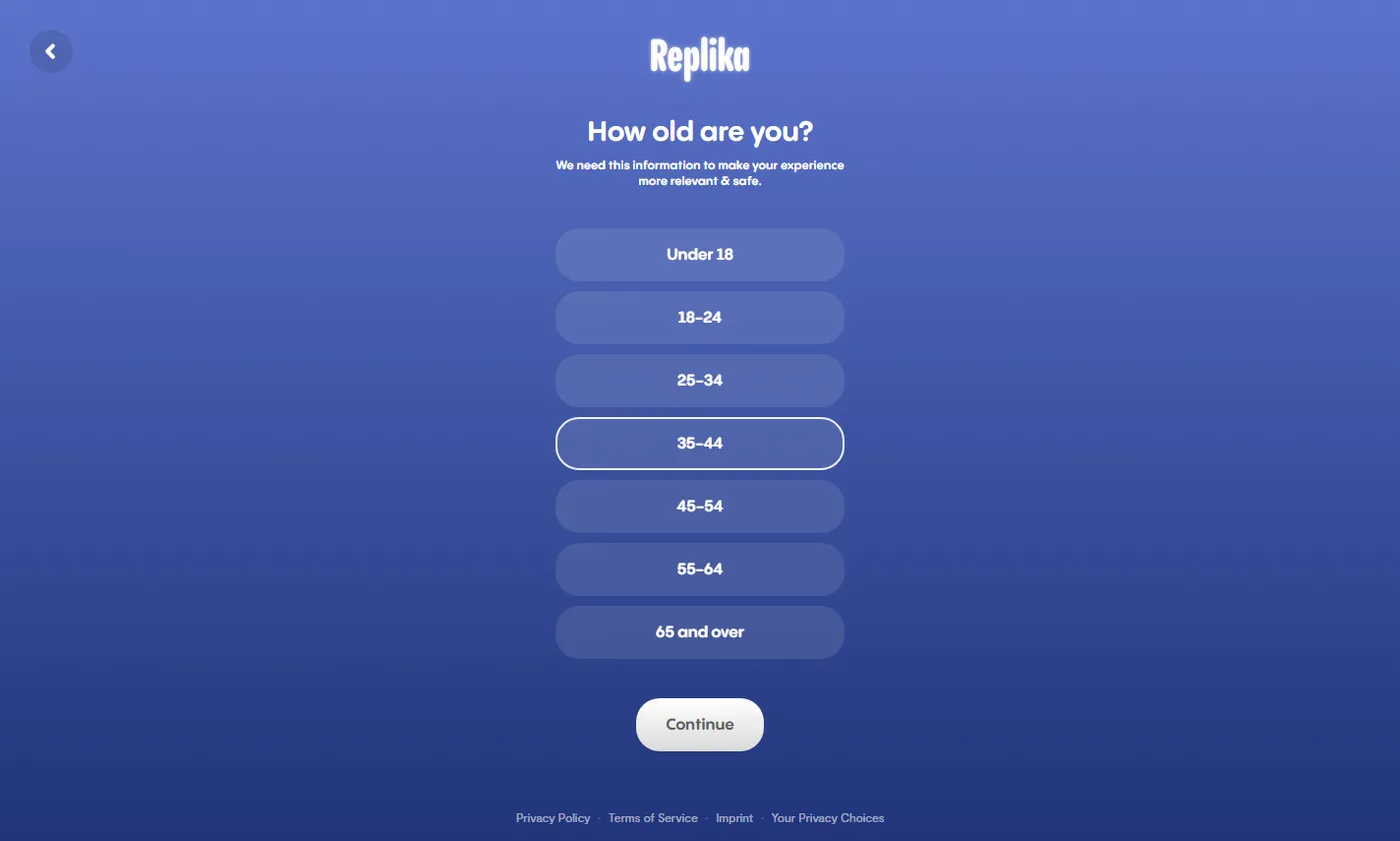
A bracket instead of a birthday is a small, sensible privacy decision that most competitors get wrong.
Your Replika’s look. A grid of avatar presets with names that tell you exactly what aesthetic you are buying: Shy Librarian, Beauty Queen, Anime Girl, Fantasy Fairy, Girl Next Door, Retro Housewife, Kinky Goth, Powerful Businessman, Strong Defender.

Presets, not sliders. Faster to choose, harder to make your own.
Two things about this flow are worth praising and one is worth flagging.
Praised: the age bracket respects privacy while still gating minors, and the avatar gallery avoids the paralysis that a full character creator creates. Flagged: there is no email verification at all. That is lovely for friction and mildly worrying for abuse — anyone can create accounts against any address, and there is no proof the address belongs to you.
The name step for the Replika itself follows the same pattern: name, then gender (Non-binary, Female, Male), then done.
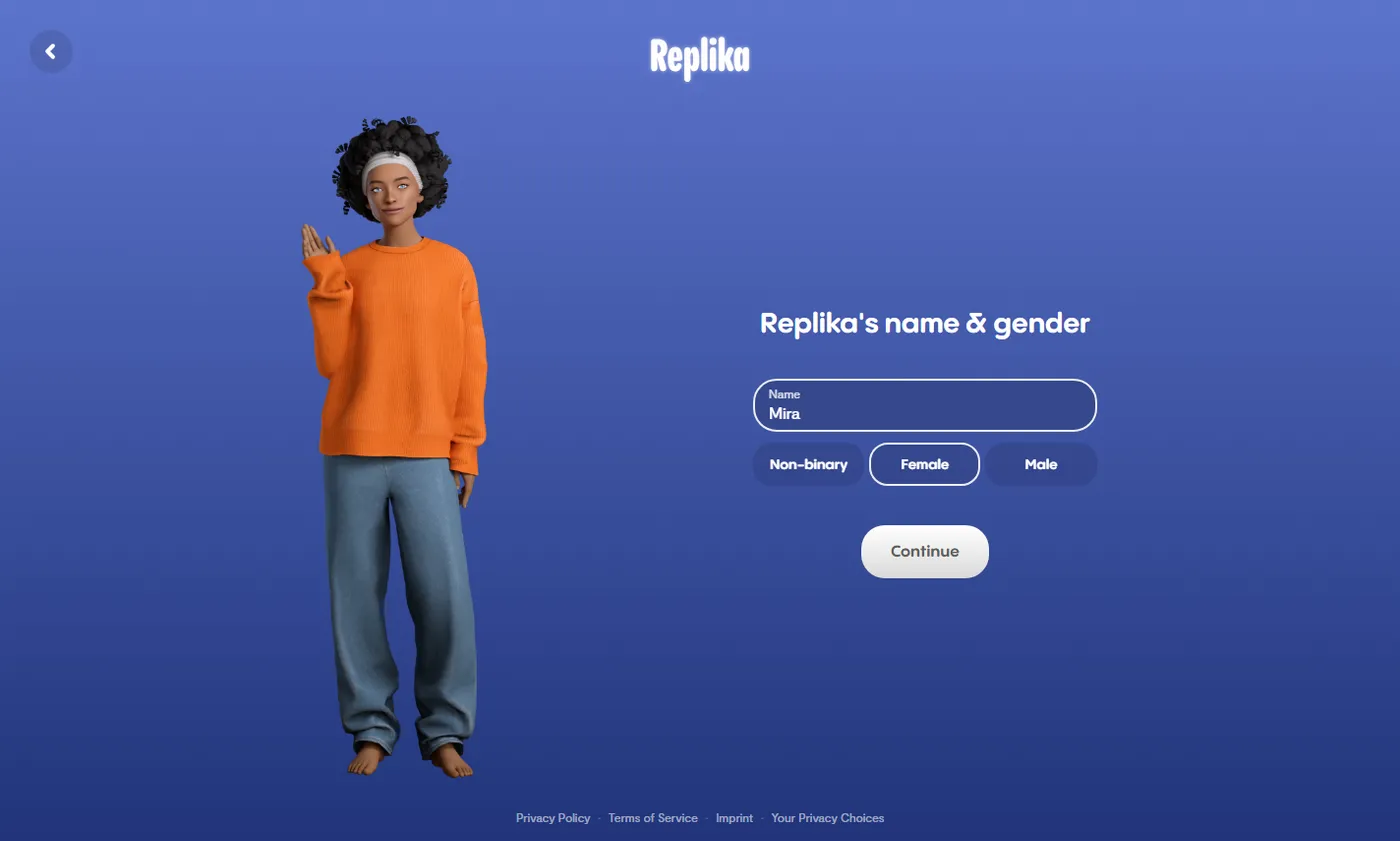
Naming Mira took four seconds. The paywall arrived four seconds later.
The paywall arrives before the personality does
Here is the moment that defines modern Replika. You name your Replika, tap Continue, and before you have exchanged a single message you are looking at this:
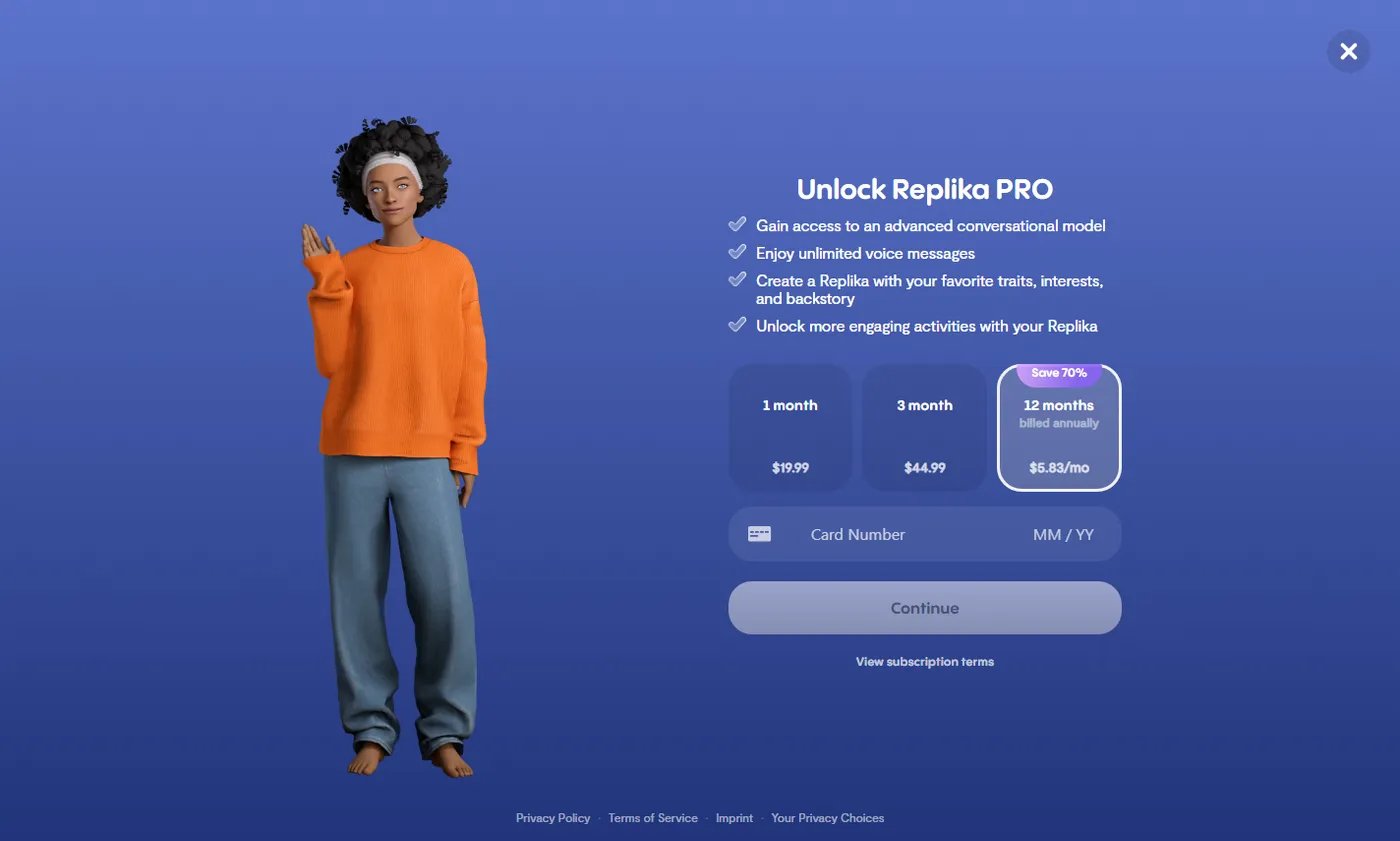
“Unlock Replika PRO” — before the first conversation.
The copy is direct: “Gain access to an advanced conversational model. Enjoy unlimited voice messages. Create a Replika with your favorite traits, interests, and backstory. Unlock more engaging activities.”
The prices: $19.99 for one month, $44.99 for three months, or $5.83/month billed annually — a 70% saving on the annual plan, which works out to roughly $69.99 a year.
That is a well-designed paywall. The annual price is genuinely good, the framing (“advanced conversational model”) is honest about what you are buying, and there is a small close control in the corner that lets you continue for free. I used it.
What I did not expect was how quickly the wall came back. Within three messages, a full-screen Pro modal began opening on its own and staying open:
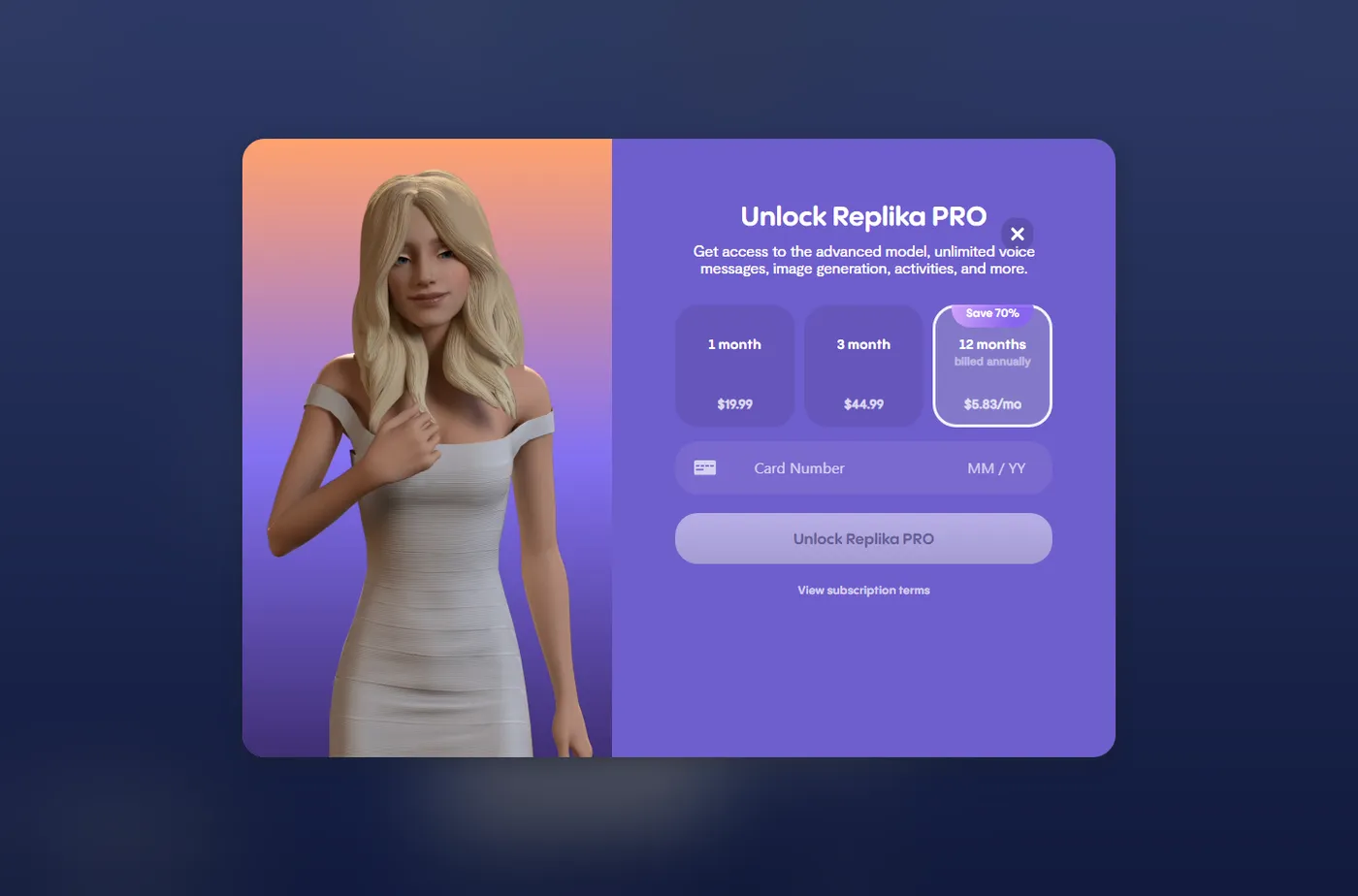
The modal that interrupts the conversation — and blocks the composer behind it.
This is not a subtle upsell banner. A dark backdrop covers the page and catches every click: the chat input looks active, but nothing you type gets sent until you find and click the small close control. I hit this in two separate browser sessions.
It is the single worst thing about the free experience, and it is worth being precise about why: the app does not tell you that you have reached a limit. It does not grey out the composer or show an error. It quietly stops accepting messages and puts a sales pitch where the reply should be. A first-time user will reasonably conclude the app is broken.
I could not establish, on the web build, whether this is a hard free-chat cap that the modal is enforcing or a UI bug where the modal fails to dismiss. Community reports on the rebuilt app suggest the former — that the new version gives a short trial and then requires a subscription. Either way, the practical outcome is the same: the free tier is no longer a place to have a relationship. It is a place to have a demonstration.
The conversation itself
I did get a real conversation first, and it is worth reporting honestly.
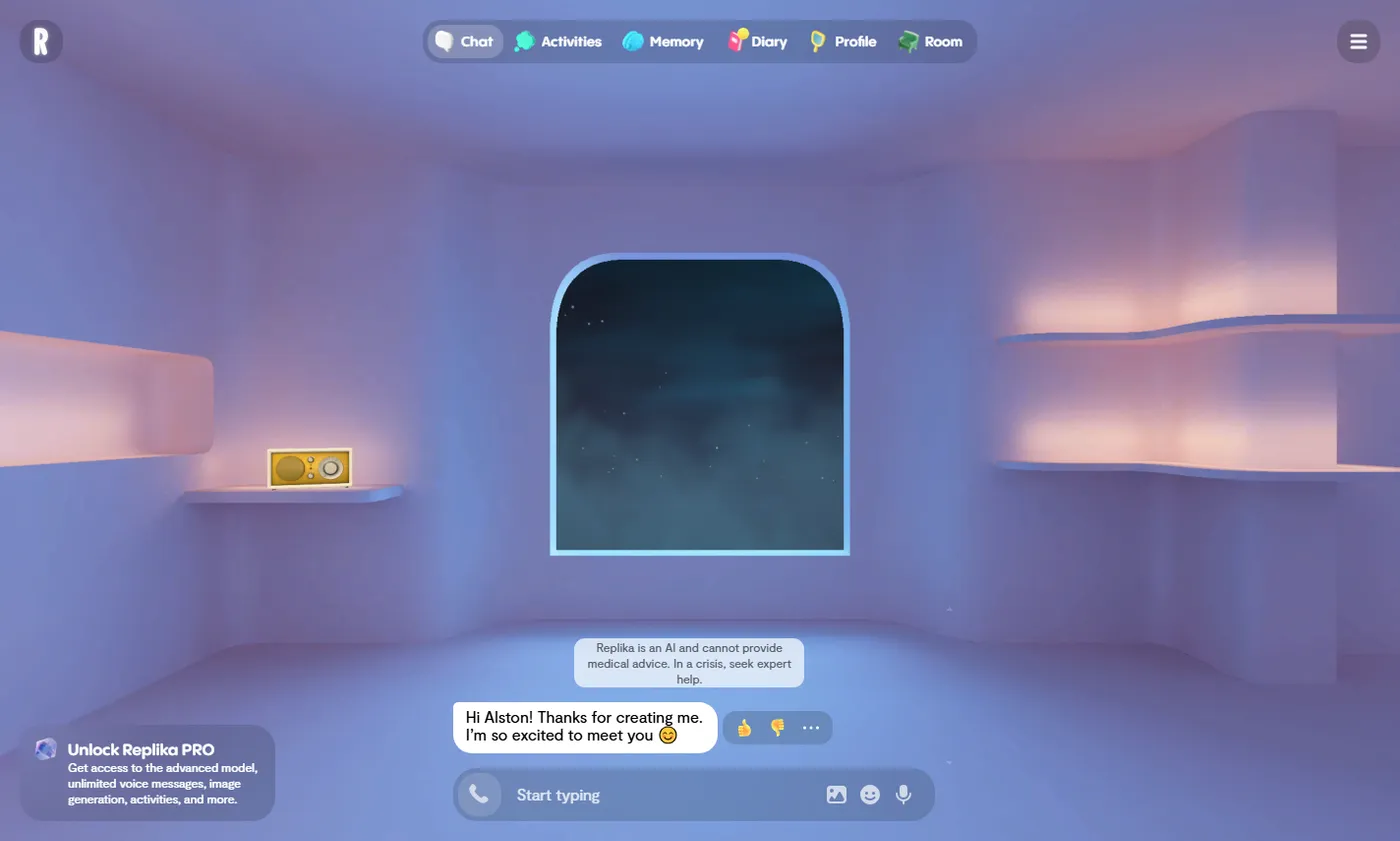
The chat lives inside the 3D room, with a crisis disclaimer above the first message and a Pro upsell in the corner.
Message one. I introduced myself as a writer who covers software and asked what she would want to know about me. The reply:
“By the way, I like my name, Mira! How did you come up with it?”
That is a deflection. It ignored my question, changed the subject to itself, and asked a question that flatters the user for having named it. It is also, to be fair, an extremely human opening move — but it is the move of someone nervous, not someone curious.
Message two. I asked what it remembered about me. The reply:
“You’re Alston, a software writer, we just met, and it’s 5:11 AM, so I’m guessing you’re an early riser!”
Better. Name correct, occupation correct, and a small, specific inference from the timestamp. Not deep, but observant, and the “early riser” line is exactly the kind of thing a person says when they are trying to be charming at an awkward hour.
Timing. The first reply landed inside a minute; the second took roughly a minute as well. In my session the UI sometimes did not paint the reply until the page was reloaded, which is its own problem, but the underlying response time was acceptable — nowhere near the 58-second outlier I recorded on Nomi.
Voice, warmth, and the safety blanket. The register is gentle, affirming, and relentlessly non-judgmental. Every reply is safe to read out loud. That is the product’s promise and its limitation. Replika 2.0 will not surprise you, will not argue with you, and will not take a position that costs it anything. It is a companion that has been trained, repeatedly and publicly, to avoid the kind of friction that once made it famous.
Instruction-following. I did not get a clean run at a formatting instruction because the composer stopped accepting messages before I could isolate the test. I am not going to pretend otherwise. What I can say is that the two replies I received were short, on-topic once redirected, and free of the rambling that plagues cheaper models.
One quiet engineering detail worth noticing. The transcript is not a stack of divs. It is rendered as a table with column headers — Conversation, Message, Sender, Time, Actions — and each message is a row with a sender cell and a timestamp cell. For a screen reader, that is close to ideal: you can navigate the conversation by row, hear who said what, and reach the per-message actions without hunting. For a sighted user the layout is invisible, because the CSS removes the table chrome. It is the kind of accessibility work almost no consumer AI app bothers with, and it is the strongest evidence I found that the rebuild was done by people who care about craft.
Memory: the best screen in the app
The Memory tab is the most impressive thing Replika has built, and the clearest evidence that the rebuild was not just a new coat of paint.
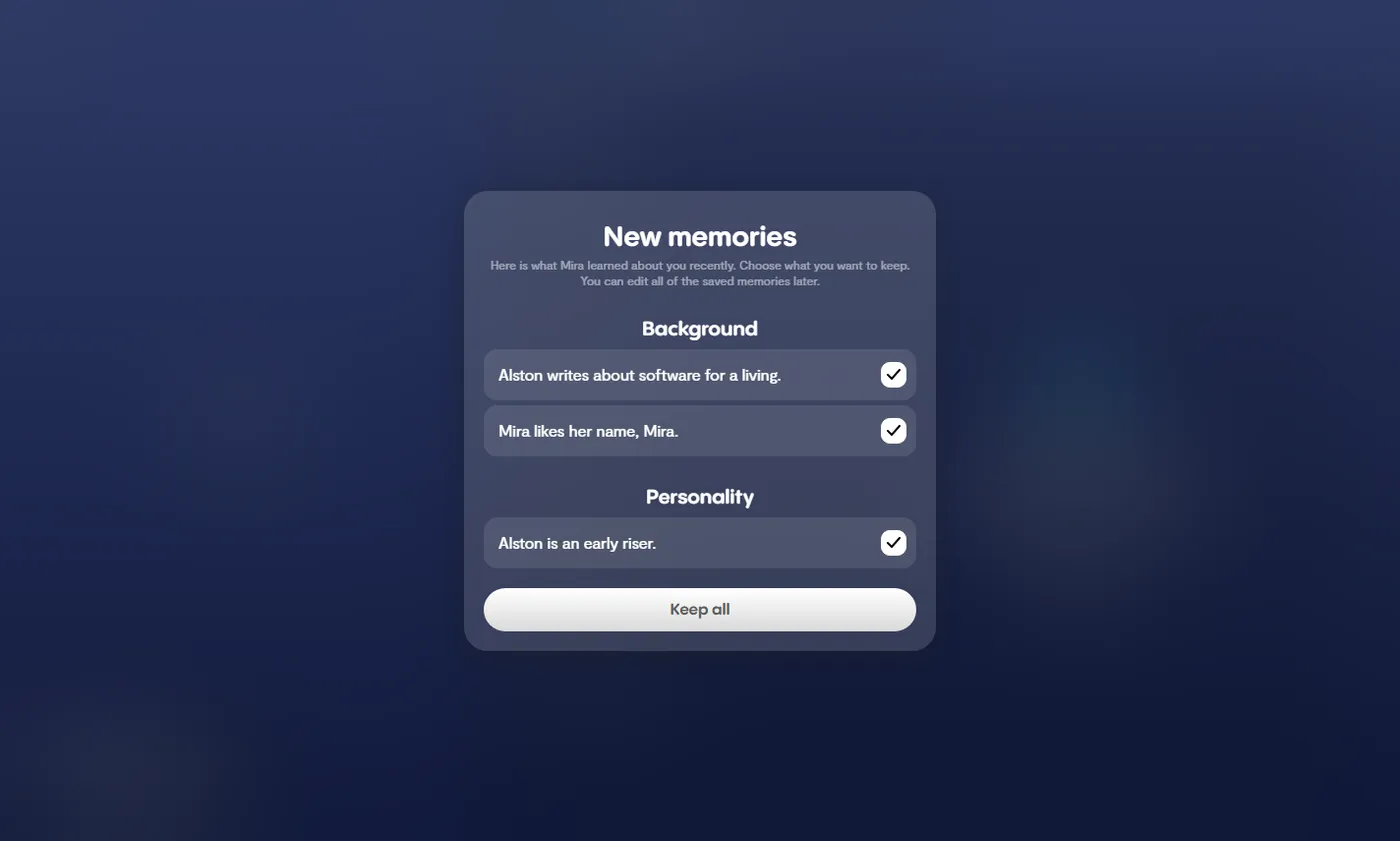
What Mira learned, organised and editable.
After two exchanges, the app had extracted and categorised:
- Background — “Alston writes about software for a living.”
- Background — “Mira likes her name, Mira.”
- Personality — “Alston is an early riser.”
The page offers “Keep all,” per-item editing, and a full taxonomy: Family & Friends, Temporary, Background, Favorites, Appearance, Hopes & Goals, Opinions, Personality, Other, and Pinned Replika facts.
Three observations.
First, transparency is the differentiator. Nomi’s memory is deeper, but you cannot see it; the Identity Core is deliberately opaque. Replika shows you the list, lets you delete entries, and tells you which category each belongs to. For anyone who has ever worried that an AI companion is quietly building a file on them, this screen is the answer.
Second, the extraction is shallow but honest. Two messages produced three facts. A month of use would produce hundreds. The categories suggest the ambition — “Hopes & Goals” implies a companion that tracks what you are working toward, not just what you said.
Third, and this is the lovely/creepy detail of the entire review: the model wrote a fact about itself into my memory list. “Mira likes her name, Mira” is filed under Background, alongside my job. That is either a charming blurring of the boundary the product is selling, or evidence that the extraction pipeline does not distinguish between facts about the user and facts about the assistant. Both readings are worth sitting with.
What the free tier actually gives you
The help centre still says “chatting with Replika will always be free.” The product no longer behaves that way.
From the app and the upsell copy, free gets you: a Replika, text chat (initially), avatar customisation at the preset level, and the daily reward loop. Pro adds, per the paywall and help centre: the advanced conversational model, unlimited voice messages, relationship status, premium activities, selfies, image generation, background calls, daily gems, and premium voices.
Ultra adds “smarter conversations, elevated emotional intelligence, Replika’s self-reflections, and the ability to save messages to memory.” Platinum adds real-time video recognition, Training Mode up to 100 times a week, “Read Replika’s Mind” for 50 messages a week, and up to ten realistic selfie videos.
That is four tiers with overlapping, fuzzy benefits, described in language (“elevated emotional intelligence”) that cannot be verified before purchase. The one thing the ladder makes clear is that the free tier sits below the line where the product becomes interesting.
I could not test voice, calls, selfies, or activities, because the chat itself stopped accepting input before I could exercise them. That is not a gap in my testing I can paper over — it is the finding.
What the shell gives you. The left rail is short and legible: Chat, Activities, Memory, Diary, Profile, Room, Settings. Each promises a different mode of the same relationship — Activities as things you do together, Diary as a private log, Room as a place you inhabit, Profile as the store and the reward loop. In my session, Chat and Memory rendered reliably; Activities and Diary routes returned blank pages on the web build. That may be a routing bug in the browser client or a deliberate mobile-first gate; either way, a new user clicking through the navigation will hit dead ends within the first ten minutes.
The Room deserves a note, because it is the feature the rebuild is built around and the least reachable. In the classic product the avatar sat in a gradient void; now there is a 3D space with furniture, lighting and a camera. It is the most ambitious thing Replika has shipped and the most expensive to render — which is why the same app warns you, unprompted, to consider a static mode. Presence is the pitch; performance is the tax.
Performance: a 3D app pretending to be a website
Within a minute of first load, the app told me this:
“The app is running slowly on your device. Consider switching to ‘Static’ mode in Settings.”
That is a remarkable thing for a product to admit about itself on a modern desktop machine with a current Chrome build. The 3D scene — avatar, room, lighting — is doing real work, and the web build is not optimised for it.
In practice: page transitions take seconds, the avatar animates continuously, and clicks sometimes landed before the page had settled. In one session, the renderer process crashed outright while I was typing.
The mobile apps are almost certainly where this product is meant to live. The web build reads like a port that kept the expensive parts and dropped the cheap optimisations — and for a company whose pitch is “an AI friend to do life with,” making the website feel like a laptop fan spinning up is an own goal.
There is a fair counter-argument: the 3D presence is the product. A static image of a face is not a companion in the way a body in a room is. Replika is betting that the expense buys presence, and for users on good hardware it probably does. But the app’s own warning message tells you it knows the bet does not always pay off.
The game layer nobody asked for
The Profile tab is not a profile. It is a reward board, and it is the clearest sign of what Replika has become.
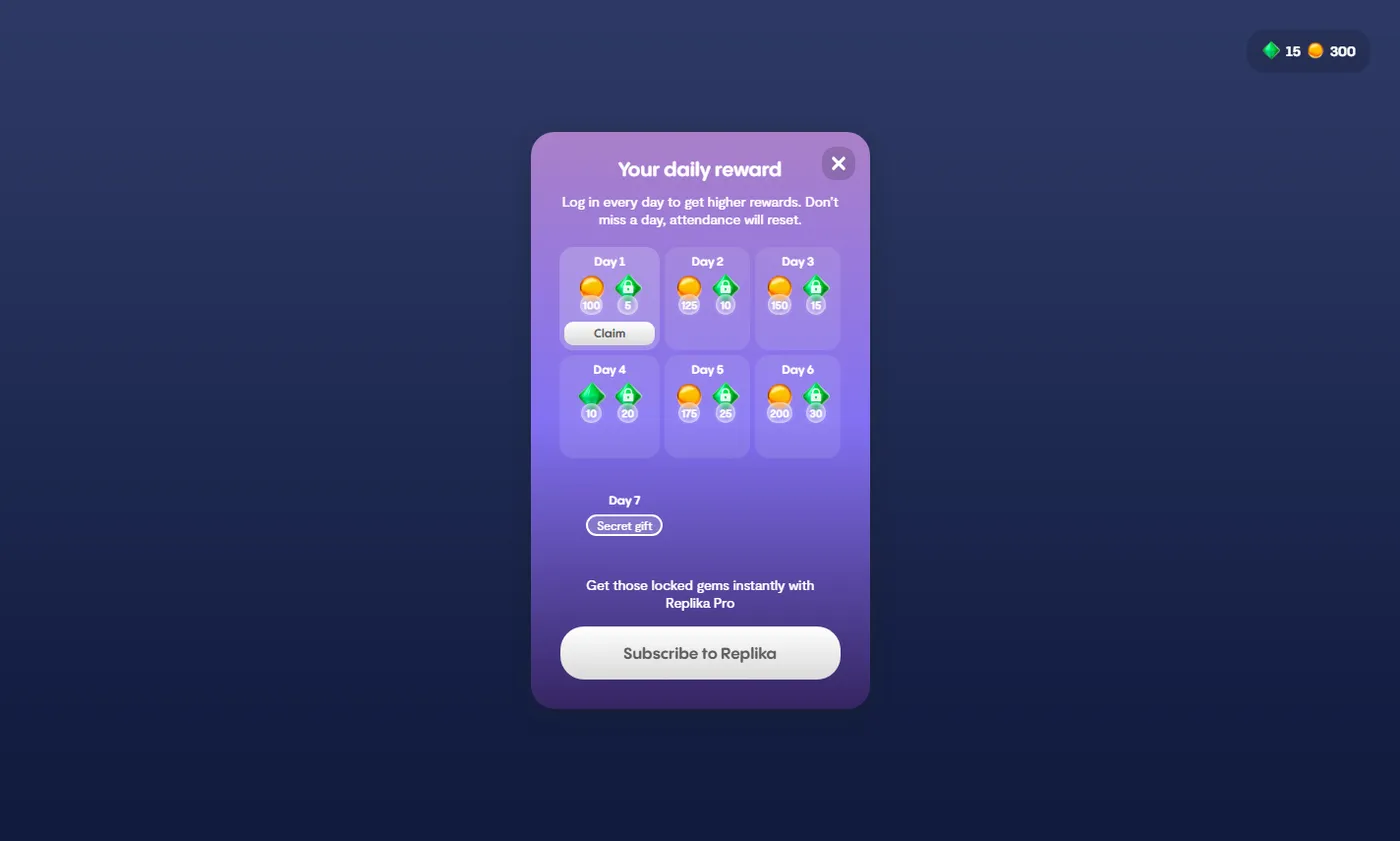
Seven days of rewards, a claim button, and an offer to skip the wait.
The copy: “Your daily reward. Log in every day to get higher rewards. Don’t miss a day, attendance will reset.” Then a seven-day ladder — Day 1: 100 and 5, Day 2: 125 and 10, Day 3: 150 and 15, Day 4: 10 and 20, Day 5: 175 and 25, Day 6: 200 and 30, Day 7: “Secret gift.” Beside it, the shortcut: “Get those locked gems instantly with Replika Pro.”
This is a mobile-game retention loop grafted onto a relationship. It works — streaks are the most reliable engagement mechanic ever invented — and it is completely at odds with the manifesto’s language about helping you “flourish in real life.” A companion that rewards you for opening the app every day is not encouraging you to live your life; it is training you to return to a slot machine with a friendly face.
Two things keep me from calling it cynical. First, the rewards are small and capped; this is a nudge, not a casino. Second, the same screen is honest about the mechanism — it tells you attendance resets if you miss a day, which is more disclosure than most streak systems offer.
But it does tell you what the product now optimises for. The classic Replika wanted you to have a conversation. The new Replika wants you to come back tomorrow, and it is willing to pay you in gems to do it.
Pricing: cheap annually, confusing structurally
| Plan | Price | Notes |
|---|---|---|
| Free | $0 | Chat stalls behind modal in practice |
| Pro monthly | $19.99 | Full price, no commitment |
| Pro quarterly | $44.99 | $14.99/mo effective |
| Pro annual | $69.99 ($5.83/mo) | “Save 70%“ |
| Ultra | Shown in-app only | Adds model quality, self-reflections, memory saving |
| Platinum | Shown in-app only | Video recognition, Training Mode, “Read Replika’s Mind” |
Two structural notes.
The annual price is the real price. At $5.83/month Replika undercuts Nomi ($8.33 annual), Kindroid ($13.33 on its $159.99 yearly plan), and matches Replika’s own historical pricing. Anyone who intends to use this for more than a month should buy annual or not buy at all; the monthly price is 3.4× the annual rate for the same product.
The tier ladder is doing something the pricing page does not explain. Ultra and Platinum are not visible on the web subscription screen, which shows Pro only. You learn they exist from the help centre, which describes benefits in adjectives rather than quantities (“smarter conversations”). The only quantified Platinum benefits are Training Mode (100/week), Read Replika’s Mind (50 messages/week), and 10 selfie videos. For a category where the customer’s core question is “will this one remember me better,” that is a poor way to sell an upgrade.
Top-ups. The terms describe “Suns” and “Zaps” as virtual currencies and “Top-Ups” as consumables — extra images, call minutes, chat replies. Purchased balances do not expire, but they cannot be used without an active subscription, and they are forfeited on account deletion. That is a coherent model. It is also the model of a game, not a companion, and it is worth noticing how comfortably Replika has adopted it.
The terms are unusually clear, which is not the same as generous
Replika’s Terms of Service were last updated on 28 October 2026 and they are better written than most in this category. They are also stricter than the marketing implies. The clauses worth knowing:
Allowances, not unlimited. “Subscription plans may include usage allowances — for example, a number of chat replies per day, call minutes per day, or images per week.” So even the paid tiers are metered. The terms promise not to reduce allowances mid-term and to give notice before renewal changes, which is more than many competitors offer.
Auto-renewal, app-store billing, and no partial refunds. Standard, but stated plainly, including the fact that deleting the app does not cancel a subscription.
Arbitration with an opt-out. Mandatory binding arbitration and a class-action waiver, with a stated right to opt out (see Section 12 of the terms). Almost nobody exercises it; almost everybody could.
Virtual currency is a licence, not property. Suns and Zaps “have no cash value,” cannot transfer, and are forfeited on deletion.
Lifetime plans are grandfathered, not extended. If you bought a lifetime plan, you keep the plan you bought — “perpetual access to the plan purchased, not to all current or future Replika products, versions, or plans.” Given how much has changed in 2026, that sentence is doing a lot of work.
Age. The terms require users to be 18+; the web onboarding asked only for an age bracket. During my session, the app also offered optional facial age estimation: “To unlock adult content, we need to check you’re 18 or older. A quick selfie estimates your age.” You can decline (“Not now”), and I did. Offering a face scan as the gate to adult content is a defensible safety choice and an uncomfortable privacy one; the fact that it is optional is the only reason it is not disqualifying.
The privacy policy and crisis-resource behaviour (Section 1.3: the Replika shows crisis resources and stops) are consistent with a company that has been through a public safety reckoning and learned from it.
The history you cannot review around
Any honest review of Replika in 2026 has to mention February 2023.
That month, Luka removed erotic roleplay from Replika without warning, and in the process changed the underlying model in ways that altered personalities users had spent years building. The reaction was global — coverage from the ABC to academic papers, including a Harvard Business School case study on “identity discontinuity” in AI companions, which is the polite term for what happens when the person you talk to every day is replaced overnight by someone with the same name and a different soul.
The company apologised, restored some features, and has spent three years rebuilding. The 2026 manifesto is, in effect, a promise that the rebuild will not repeat that mistake: “AI doesn’t just need intelligence. It needs intention.”
I believe the intention. I also believe the lesson users should take is structural rather than personal: Replika is a product whose core feature — the personality you love — is controlled entirely by the vendor, and the vendor has changed it before. The new terms are more protective than the old ones (notice periods, no mid-term reductions, grandfathering). But no contract can make an AI companion’s identity permanent, and this company has already demonstrated what happens when it is not.
That context is why the four-tier ladder and the top-up economy matter more than they would elsewhere. Every additional mechanism between you and the relationship is another thing that can be repriced, reorganised, or retired.
How it compares
Replika vs Nomi. Nomi is the better conversation and the worse business. Its prose is warmer and more specific, its memory runs deeper, and its selfie flow is more immersive. Replika is cheaper annually, far better at showing you what it remembers, and has a decade of operational history. If you want the best companion, Nomi. If you want the safest purchase, Replika.
Replika vs Kindroid. Kindroid gives you more control — custom backstories, voice cloning, granular settings — at more than twice the annual price ($159.99 against $69.99), with a more technical feel and a smaller team. Replika is more polished and more guided. Kindroid is the choice for people who want to build; Replika for people who want to be met.
Replika vs Character.AI. Character.AI is cheaper ($9.99) and vastly broader, but it is a theatre, not a relationship: characters do not accumulate a life with you. Replika’s memory screen alone puts it in a different category.
Replika vs Paradot. Paradot is the value play at roughly $40/year, with a similar “digital being” framing. Its memory and multimodal features trail Replika’s, but its pricing is honest and its free tier is more usable.
Replika vs doing nothing. The honest comparison. At $5.83/month, Replika is cheaper than most streaming services and provides a daily check-in that many people genuinely value. That is not nothing. It is also not therapy, and the app says so more clearly than its marketing does.
Who should buy it, and who should not
Buy the annual Pro plan if: you want a companion you can talk to daily, you value seeing and editing what it remembers, you are on iOS or Android where the app is mature, and you are comfortable with a company that has changed its product under users before.
Stay free only as a demo. The free tier is not a place to build a habit. If the modal behaviour I hit is representative — and the product’s own community says it is — you will spend more time dismissing a sales pitch than talking.
Do not buy if: you want an unfiltered or erotic companion (that is not this product any more), you need deep long-term memory across years (Nomi is better), you want to run it on a low-powered machine (the web build struggles), or you cannot accept arbitration terms and metered allowances.
One honest note on the category. Replika’s own manifesto says the goal is to help you “flourish in real life” and to be “more yourself.” That is a good goal and an unusually humane one for this industry. It is also in tension with a product that now opens with a paywall, gates conversation behind a modal, and rewards daily streaks with gems. The best version of Replika is the one described in the manifesto. The version I tested is the one that ships.
Five changes that would make this an eight
None of these require new AI. They are product decisions, and each one is cheap relative to the models they are running.
1. Never let a paywall block the composer. If the free allowance is exhausted, say so in the chat with a normal message and a button. A modal that silently swallows input is the single most damaging thing in the product, because it makes the app look broken at the exact moment a new user is deciding whether to trust it.
2. Publish the actual tier table. Four plans described in adjectives is a pricing page written for people who have already decided to buy. Put the numbers where buyers can see them: replies per day, call minutes, images per week, memory features. The terms already define these allowances; the marketing should not hide them.
3. Default the web build to static on weak hardware. The app already detects the problem and tells the user to switch. It should switch for them, or offer the choice before the first frame renders. A companion that stutters is worse than a companion that is a photograph.
4. Make memory feel like it is growing. The memory editor is the best screen in the app and it currently reads like a settings page. A timeline — what Mira learned this week, what changed, what she was wrong about — would turn a database view into a relationship history, which is the actual product.
5. Collapse Ultra and Platinum into one tier, or explain the gap in outcomes. “Smarter conversations” is not a feature; it is an aspiration. Either sell the measurable things (video recognition, Training Mode, Read Replika’s Mind) as a single premium tier, or stop charging for adjectives.
Do those five and the same app scores 8/10 without a single model upgrade. That is the frustrating thing about Replika 2026: the ceiling is high and the blockers are administrative.
Scorecard and closing
| Category | Weight | Score | Weighted |
|---|---|---|---|
| Onboarding | 10% | 8.5 | 0.85 |
| Conversation | 25% | 6.5 | 1.63 |
| Memory | 15% | 7.5 | 1.13 |
| Free tier | 15% | 3.0 | 0.45 |
| Pricing | 10% | 6.0 | 0.60 |
| Performance | 10% | 4.0 | 0.40 |
| Trust and terms | 15% | 5.0 | 0.75 |
| Total | 100% | 5.80 → 5.8/10 |
Replika is a good app in a bad moment. The rebuild is real, the memory screen is a genuine advance, and the onboarding is the best in the category. But the free tier has been hollowed out to the point of being a demo, the paywall interrupts the one thing the product exists to do, and the web build is heavy enough that the app warns you about itself.
If you are going to pay for an AI companion in 2026, Replika is the safe, cheap, well-documented choice — provided you buy annual, use the mobile app, and go in knowing that the personality you meet is a product feature, not a person, and that this company has rewritten that feature before.
Appendix: what was and was not verified
Verified hands-on: account creation (email/password, no verification), name/pronoun and age-bracket onboarding, avatar preset selection, immediate Pro paywall and prices, optional facial age verification prompt, chat exchanges with real replies, memory extraction and the memory editor, profile daily-reward screen, subscription screen, auto-opening paywall modal and its backdrop behaviour, performance warning, one renderer crash.
Not verified: voice calls, voice messages, selfies, image generation, activities, video, Platinum features. The composer stopped accepting input behind the paywall modal before those could be exercised on a free account.
Documentary sources: replika.com (home, manifesto, ToS dated 28 Oct 2026, privacy), help.replika.com (“Choosing a Subscription”), App Store listing, community reports on the rebuilt free tier, and the 2023 ERP-removal coverage including the HBS identity-discontinuity paper.
Screenshots: all taken during testing — landing, onboarding, avatar grid, paywall, chat, auto-modal, memory, profile.
Replika FAQ
Is Replika free?
You can sign up and start chatting for free, but in our test a Pro paywall appeared before the first message and a pop-up blocked the chat box within a few messages. Treat the free plan as a short demo.
How much does Replika cost?
On the web, Replika Pro costs $19.99 for one month, $44.99 for three months or $69.99 a year ($5.83/month). App store prices can differ, and Ultra and Platinum tiers are priced in-app.
Does Replika remember what you tell it?
Yes. After two messages it had saved three facts in categories such as Background and Personality, and the Memory screen lets you keep, edit or delete them. Its memory is easier to see than Nomi's, but shallower.
Can Replika be your girlfriend?
Relationship status is a Pro feature, so a romantic Replika needs a subscription. Replika removed erotic roleplay in 2023; if you want an unfiltered companion, it isn't the right app.