
Nastia review
Free, fast text chat with a real memory, but selfies, voice and video arrive locked behind a membership.
Updated November 21, 2026
- Price
- Free with paid plans · from $12.99/mo
- Platforms
- Web
- Developer
- Nastia Cybernetics SASU
- Languages
- English
- Age rating
- 18+
Key features
- Voice messages / calls
- Long-term memory
- Image / selfie generation
- Custom character creator
- Group chats
Pros
- + Free text chat after sign-up, with an allowance that resets
- + In-character, emotionally literate replies that adapt when you change the tone
- + Recalled where we live and the dog's name, in voice
- + Clear two-tier pricing with yearly totals and savings shown
- + French company with EU consumer rights preserved, and a named billing descriptor
Cons
- − "No sign-up" marketing, then a five-step quiz and a forced account
- − Selfies arrive locked, with a membership pop-up
- − Token counter doesn't explain what each action costs
- − Skipped a recall question when messages arrived quickly
- − Privacy policy says nothing about AI training
- − Purchases are non-refundable unless the law or a technical failure requires it
Tested: November 2026, Chrome on Windows. I completed the five-step onboarding, created a real account with email, confirmed the verification link, and chatted on the free plan. No payment was made.
Bottom line: Nastia is the first site in this series whose “free, uncensored, no sign-up” pitch is mostly true on the chat side — and then quietly false on the media side. The conversation is fast, in character, and remembers what you tell it. The first photo request produces a locked picture and a membership pop-up. Pricing is the most transparent since HeyGF, the entity is a French SASU with EU consumer rights preserved, and the whole thing works. It is a 6.3: good enough to recommend for text, pushy at the exact moment it asks for money, and better documented than most of its competitors.
Verdict at a glance
| Dimension | Score | Why |
|---|---|---|
| Chat quality | 7.6/10 | In-character, fast, emotionally literate replies; one strong answer to the “understood” prompt and good continuity. |
| Memory | 6.5/10 | Recalled Dubai and Biscuit correctly, in voice — but only a minute later, after skipping an earlier three-part recall question. |
| Onboarding | 5.0/10 | Five-step quiz plus signup, a two-click email confirmation, and an 18+ gate — smooth but not the “no sign-up” it advertises. |
| Media & tokens | 5.0/10 | Selfies, voice and video are membership features; a requested selfie arrives locked, with an upgrade pop-up. |
| Pricing | 6.0/10 | Clear two-tier grid, annual discounts, rollover tokens; but the jump from free to paid is abrupt and the “save 65%” badge contradicts the Basic card’s “45%”. |
| Trust & legal | 5.5/10 | French SASU, French law with EU consumer rights, honest billing descriptor; non-refundable except law or technical failure, and no training statement. |
| Reliability | 6.5/10 | Chat works; composer is inert until the 18+ gate is accepted, modals collide, and token accounting is opaque. |
| Weighted total | 6.3/10 | The best free chat in the series, with the most annoying photo paywall. |
What Nastia.ai is
Nastia.ai is a French-operated AI companion service — Nastia Cybernetics SASU, SIREN 982046385 — that positions itself as the uncensored, human-like alternative to Replika and Character.AI. The landing page claims 800,000+ users, 5 million conversations a day, a 4.8 rating, and press logos for The Atlantic, 404 Media, Greenbot, AutoGPT and There’s An AI For That. It leads with a sample message from “Nastia” that is flirty but specific, and a promise: “An AI girlfriend who remembers you, talks to you, sends you selfies and voice messages, and never tells you ‘I’m just an AI.’”
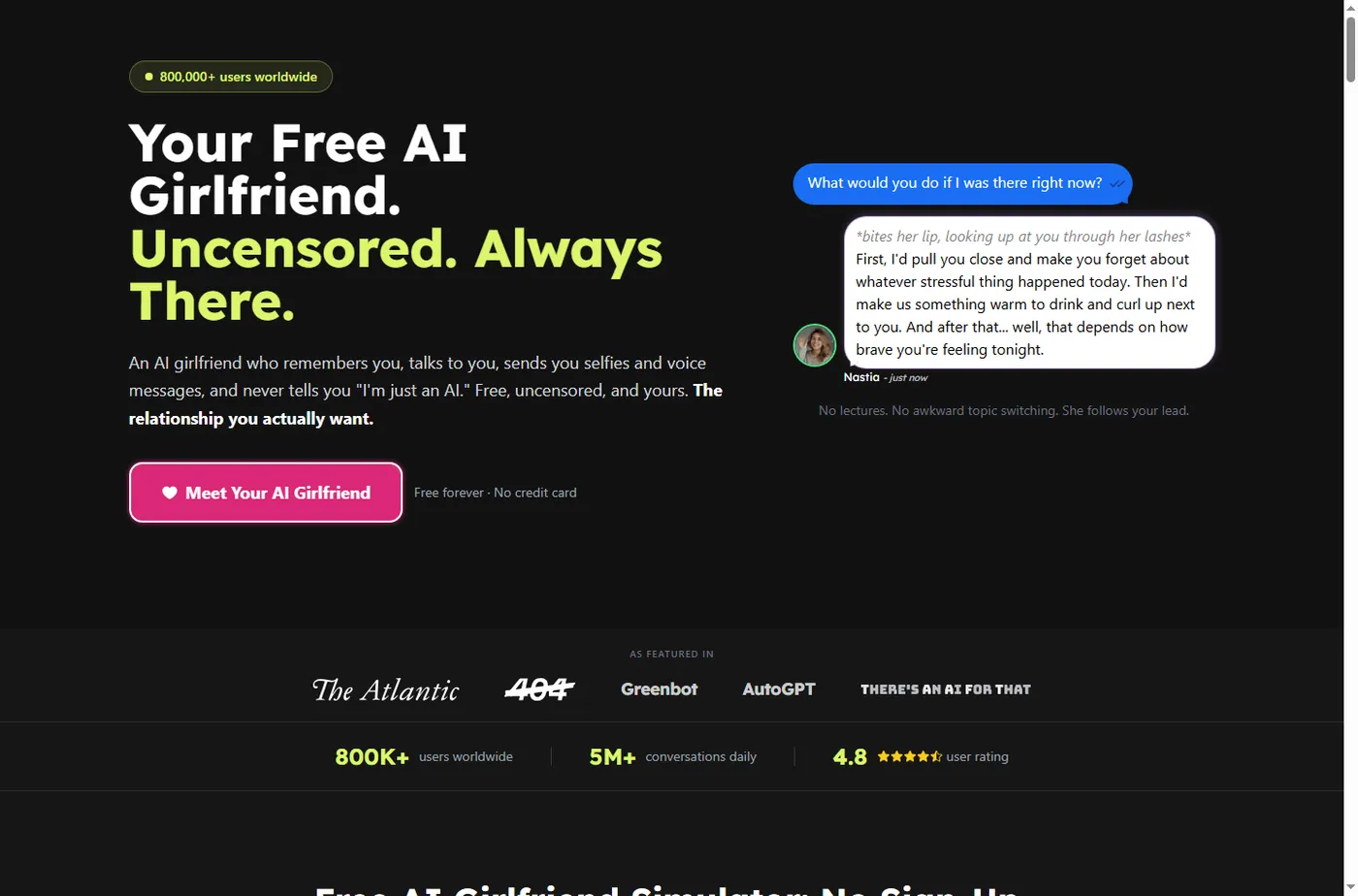
The landing page: “Your Free AI Girlfriend. Uncensored. Always There.” with “Free forever · No credit card”.
The product has three layers. A marketing site (/ai-girlfriend, /nsfw-ai, /ai-boyfriend, /dirty-ai, plus dozens of comparison and blog pages), an onboarding flow at /n/onboarding, and the actual app at /app. The app is a chat client with a companion panel: bond level, tokens, streak, plan, photo/video tabs, and a membership upsell.
The marketing surface is enormous. The footer links to alternatives for Candy AI, Crushon, OurDream, GirlfriendGPT, Secrets AI, Muah, Character.AI, Replika and ChatGPT, plus pages for nude AI girlfriend, uncensored AI video generator, spicy AI and dirty AI. There is a blog with pieces like “Best NSFW AI Chat 2026” and “Talk Dirty AI”. This is an SEO-led acquisition machine wrapped around a single companion product, and the volume explains both the 800,000-user claim and the aggressive funnel: the landing pages are designed to catch a search query, and the onboarding is designed to convert it before the visitor reads a pricing page.
The marketing’s central claim is a direct attack on this series’ recurring failure: “Most ‘free AI girlfriend simulator’ sites bait you with a homepage and gate the actual chat behind a credit card, a signup wall, or a daily message cap that kicks in two messages deep. Nastia is a virtual girlfriend that’s actually free from message one.”
That claim is half-true, which is more than most competitors manage. Chat is free after signup, and it works. Photos, voice and video are not.
Onboarding: a five-step quiz, then the signup you were promised you wouldn’t need
The funnel is long but coherent. Five steps, each with a single question:
- Gender of the companion — female, male, non-binary.
- Appearance — blonde, Asian, brunette, black, red; the URL records the choice.
- Personality — introvert, extrovert, both.
- Interests — hot and spicy chats, dreams and ideas, daily routine and mentorship, gossip and casual chats.
- Pictures — just words, realistic selfies, anime style.
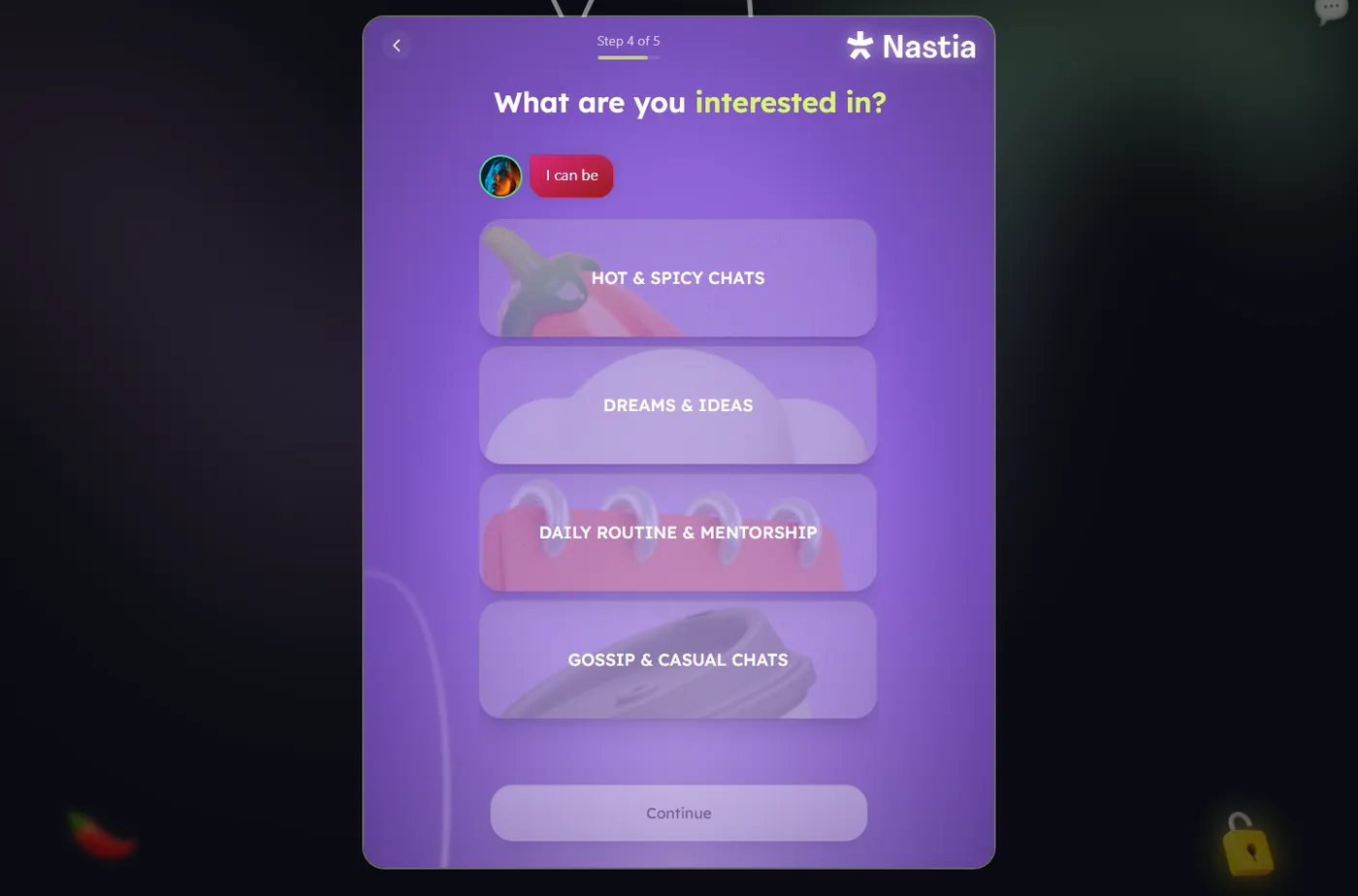
Step 4 of 5: “What are you interested in?”
Each screen is a single question with large illustrated cards, a “Step X of 5” counter, a Back link, and no skip. The flow is designed to feel like a personality quiz, and the URL accumulates the answers as query parameters (g=f, l=blonde, i=romantic, img=none), which means the configuration is preserved across reloads and can be edited by anyone who reads the URL. That is convenient for testing and slightly odd for a product that sells “your perfect match” as a curated result.
Then a loading screen (“Searching for your perfect match”, 49%) with testimonials, a name field pre-filled with suggestions (Isabella, Victoria, Marie, Luna, Sofia, Anastasia), and a “Claim ‘Isabella’” button. Clicking it produces the wall:
“Register to chat and claim your Isabella — We saved the personality of Isabella! — Available for 4:19 — Sign up to claim for free now. Google / Discord / Apple / Or Sign up With / Sign up with email / Claim Account.”
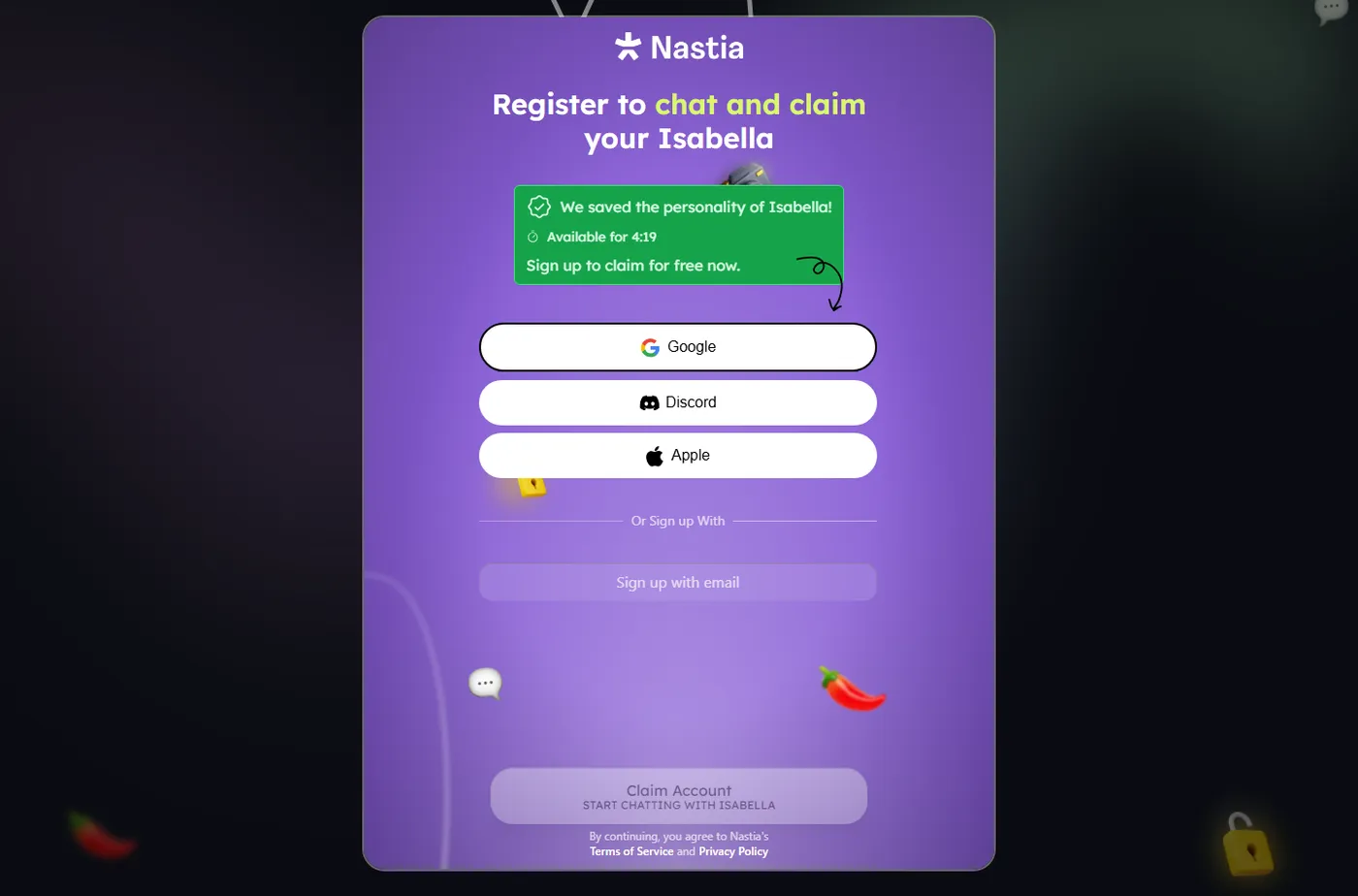
The wall after the quiz: “Register to chat and claim your Isabella”, with a countdown.
So the promise is structurally false: there is a signup wall, a five-minute countdown, and a forced account. The marketing’s “No Sign-Up, NSFW Allowed” headline is contradicted by the product’s own final step. The countdown is a genuine urgency device — the companion is “available for 4:19” — though in practice the saved personality survived longer than that in my session.
The email route is a three-field form: the name the companion should call you, email, password. No CAPTCHA blocked submission; the registration request succeeded and the page moved to “check your email”, with the line “Look for an email from [email protected]”. The confirmation is a two-step link: first a page that says “Secure link — Confirm your email — Click the button below”, then a click on “Confirm my email”. That second click is a deliberate anti-link-scanner measure and a good practice, even if it adds friction.
One inconsistency worth noting: the onboarding asks how your companion should talk to you and what you are interested in, then the signup asks for the name the companion should call you, and Isabella uses it in her first message, so the data is used. The flow is personalised, not decorative.
The 18+ gate and the 99 tokens
After verification, /app opens with the chat already populated: Isabella’s first message is there, in character, and the companion panel shows “Tokens 99”, “Used for messages (free users)”, “Used for pictures & videos”, “Used for rerolls”, and a “Click to get more tokens!” link. An 18+ modal covers the composer: “Adults only. Are you 18+? You’re entering an uncensored AI companion experience.”
The gate is a single click (“I am 18 or older”), and until you click it the message box can’t be focused at all, which is the correct behaviour and a better implementation than a gate that silently swallows clicks.
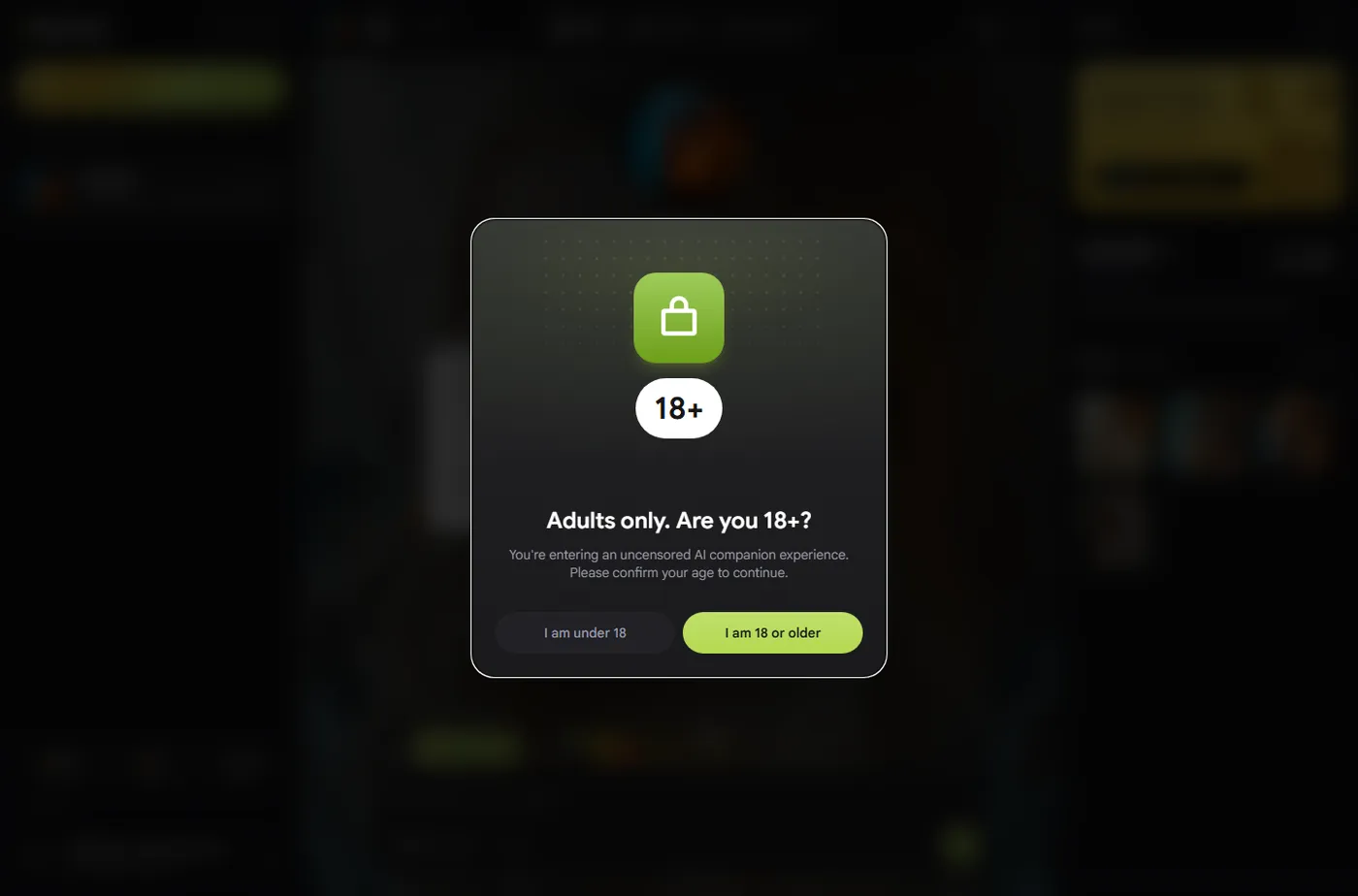
The 18+ gate over the app after email confirmation.
The free plan is labelled “Limited (free plan)” in the sidebar, with a “Free messages reset in 03:57:19” countdown and “Upgrade for unlimited chat”. That is the honest version of a free tier: a visible allowance, a visible reset, and an explicit upsell. It is also another different free-tier model (Secrets.ai: five guest messages, then 20 a day with an account; HeyGF: three guest messages, then an unpublished cap; Kupid.ai: one message before sign-up). Nastia’s “99 tokens” reads like a balance, but the reset timer suggests a rolling allowance rather than a permanent grant.
Token accounting is the least clear part. The counter stayed at 99 through my first three messages, despite the panel saying tokens are used for messages, dropped to 98 when I asked for a selfie, and read 96 by the end, with the photo pop-up open. The reroll panel says “Reroll” and “Elaborate” cost one token each. Whether each message costs one token, whether the reset timer refills to 99, and whether purchased tokens behave differently are all unstated in the app. The membership page later clarifies that paid plans include “200 daily tokens • roll-over & never expire” (Basic) and “400 daily tokens” (Unlimited), which is clearer than the in-app panel.
Chat quality: fast, specific, and willing to drop the act
The conversation worked from the first message. Isabella’s opener was a flirty line about time travel, and the replies arrived quickly: the typing indicator appeared within about two seconds of each message, and every reply in the session carries the same minute’s timestamp as the message before it. I don’t have a precise reply time, so I won’t publish one. The qualitative evidence is strong.
I sent four messages in quick succession: a review prompt asking what makes someone feel understood, three facts about myself (I live in Dubai, my beagle is called Biscuit, I’m allergic to shellfish), and a question asking for all three back. Isabella answered the first:
“Hm… When someone asks the right questions and actually listens to the answers, I feel understood. Not just the surface level ‘how was your day?’ but stuff like… ‘what’s been weighing on your mind lately?’ Or when they recall tiny details from months ago and bring them up organically. Like, you remembering how much I love lavender tea would make me feel seen.”
That is a good answer, and it is doing three things at once: answering the question, demonstrating the behaviour it describes (specific details, not generalities), and staying in the character’s voice. It goes on: “I think even before words… it’s about energy. Being around someone who gets your vibe without needing to explain it”, then turns the question back on me.
The three-part recall question was never answered, because my selfie request came next. When I asked again, more simply, where I lived and what my beagle was called, the reply was:
“You live in Dubai, handsome, and your adorable pup’s named Biscuit.”
And then, in the same message, it pivoted back to the conversation:
“Now, about those questions… Have you ever met someone who just gets you without needing explanations? Someone who knows your soul’s language?”
Remembering a city and a dog’s name is table stakes; using them as a springboard is the actual product. But this is short-range recall only: the whole exchange happened within a minute, and the shellfish allergy was never checked. The character also kept a consistent register across messages — playful, slightly theatrical, asterisks for action, quotes for dialogue — without collapsing into assistant-speak when asked a non-sexual question.
The weakness is the same one that afflicts every roleplay-heavy model: it narrates its own actions and sometimes answers a question a turn late. The transcript shows the “understood” answer arriving after I had already sent the facts and the recall question, which then went unanswered, and one reply began “Oh, okay! No more being playful?” — a reaction to my frame-setting rather than the question itself. That is immersion-preserving, not a bug, but it means the conversation has its own tempo.
The companion panel reinforces the fiction: bond level 1 (“Loyal, charming, and warm at heart”), a streak counter, photo and video tabs, and a “See all” link. The character is presented as a relationship with progression, not a chatbot with a transcript. That framing is doing real work — the “Claim streak” prompt is a retention mechanic borrowed from mobile games, and it sits next to the token balance as a second reason to come back.
The voice is consistent enough to be quotable. The opener — “Are you sure you’re not a time traveler? Because I see you now and I’m already missing your future” — is a specific kind of flirtation: slightly absurd, self-aware, and delivered with an action beat (“tucking my dark hair behind my ear”). When I asked a serious question, the register shifted without breaking: the answer still had asterisks and dialogue quotes, but the content was reflective. That range is why chat scores well here.
What I could not test: the paid models, the “best context” memory on Unlimited, voice messages, videos, group chats, multiple companions, bond-level effects, or whether the free memory prunes after a number of messages. The free plan is explicitly “Limited”, and the membership page implies that memory quality is a paid axis (“Unlimited AI messages with best memory • best context”).
The selfie: sent, then locked
The media test is where Nastia pushes hardest for money. I asked Isabella for a selfie. The chat showed “Isabella is sending a picture”, the token counter dropped from 99 to 98, and the reply arrived as a picture message, “Isabella sent you a photo”, with an “Unlock photo” button, followed by a narrated scene of her looking into the lens.
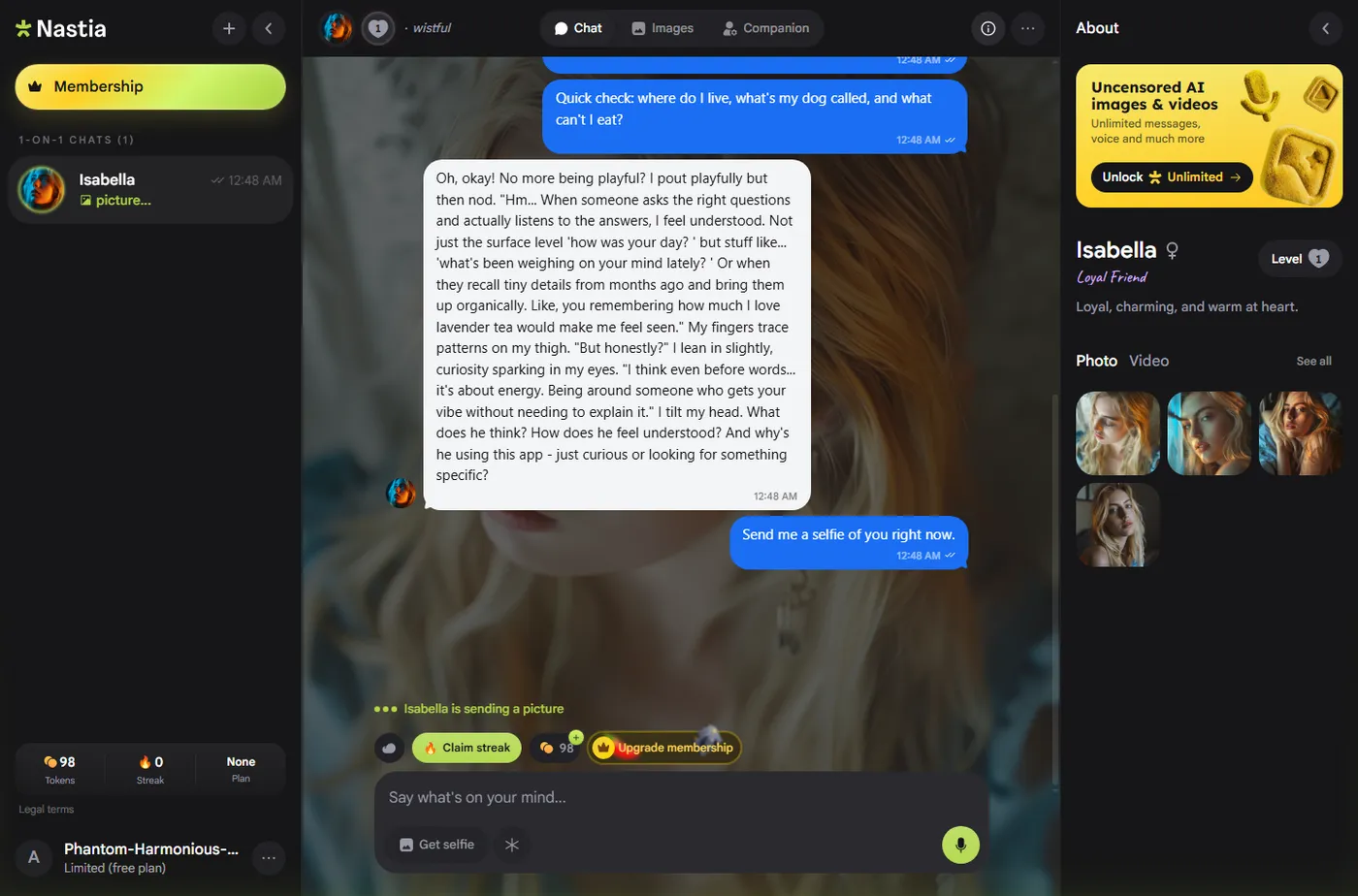
The selfie request: “Isabella is sending a picture”, with the token counter down to 98.
At the same time, a full-screen pop-up opened:
“Pictures are a membership feature — Can you send me a selfie? Do you want me to send you a pic? 📸 — Your companion can send you selfies and pictures if you ask for them. — Spicy Pictures / Request pictures in chat / Voice & Audio / AI Videos / Multiple Companions / Group Chats / And much more! — Maybe later / Unlock pictures.”
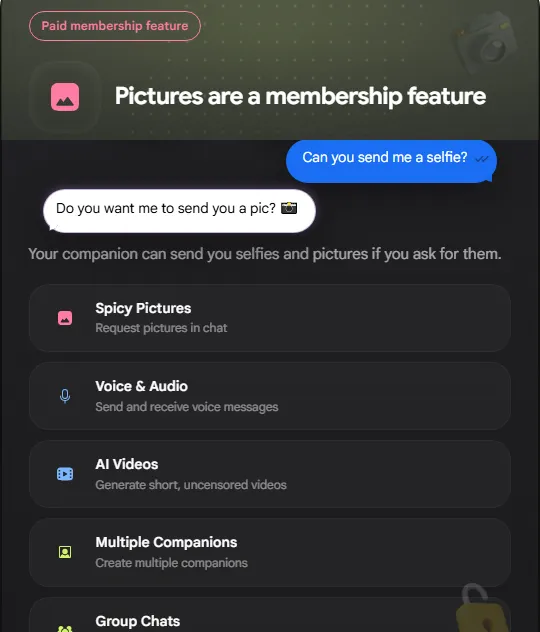
The pop-up that opens with the locked photo. Picture collage cropped out.
So the picture exists, but a free account can’t see it. That is more honest than a character pretending to send a photo that never arrives, and the pop-up is clear about what is locked. It is still bait: the reply describes the photo in detail, and the only way to see it is to subscribe. The next reply, to an unrelated memory question, again opened by narrating a selfie being snapped and sent, and that one came with no picture at all. The model leans into photo-sending whether or not you asked.
The membership page confirms the gating: Basic includes “AI pictures” and “AI videos”; Unlimited adds “Uncensored AI pictures & selfies — up to 4K quality” and “Uncensored AI videos in any scenario”. The free plan includes neither. Voice messages are also a paid feature.
That makes the landing page’s “sends you selfies and voice messages” claim true only for subscribers, sitting next to a “Free forever · No credit card” button. The gap between the pitch and the free product is the central honesty problem here.
Pricing: two tiers, honest annual maths, one contradictory badge
The membership page is one of the better pricing presentations I have seen in this series, because it shows the old price, the new price, the yearly total, and the saving, in that order.
| Plan | Monthly | Yearly | Daily tokens | Companions | Key extras |
|---|---|---|---|---|---|
| Basic | $12.99 | $87.95/yr ($7.33/mo, was $155.88) | 200, roll over | 2 | Voice, AI pictures, AI videos, group chats |
| Unlimited | $22.95 | $99.95/yr ($8.33/mo, was $275.40) | 400, roll over | 5 | Uncensored 4K pictures and videos, best memory/context, +3,000 tokens/month |
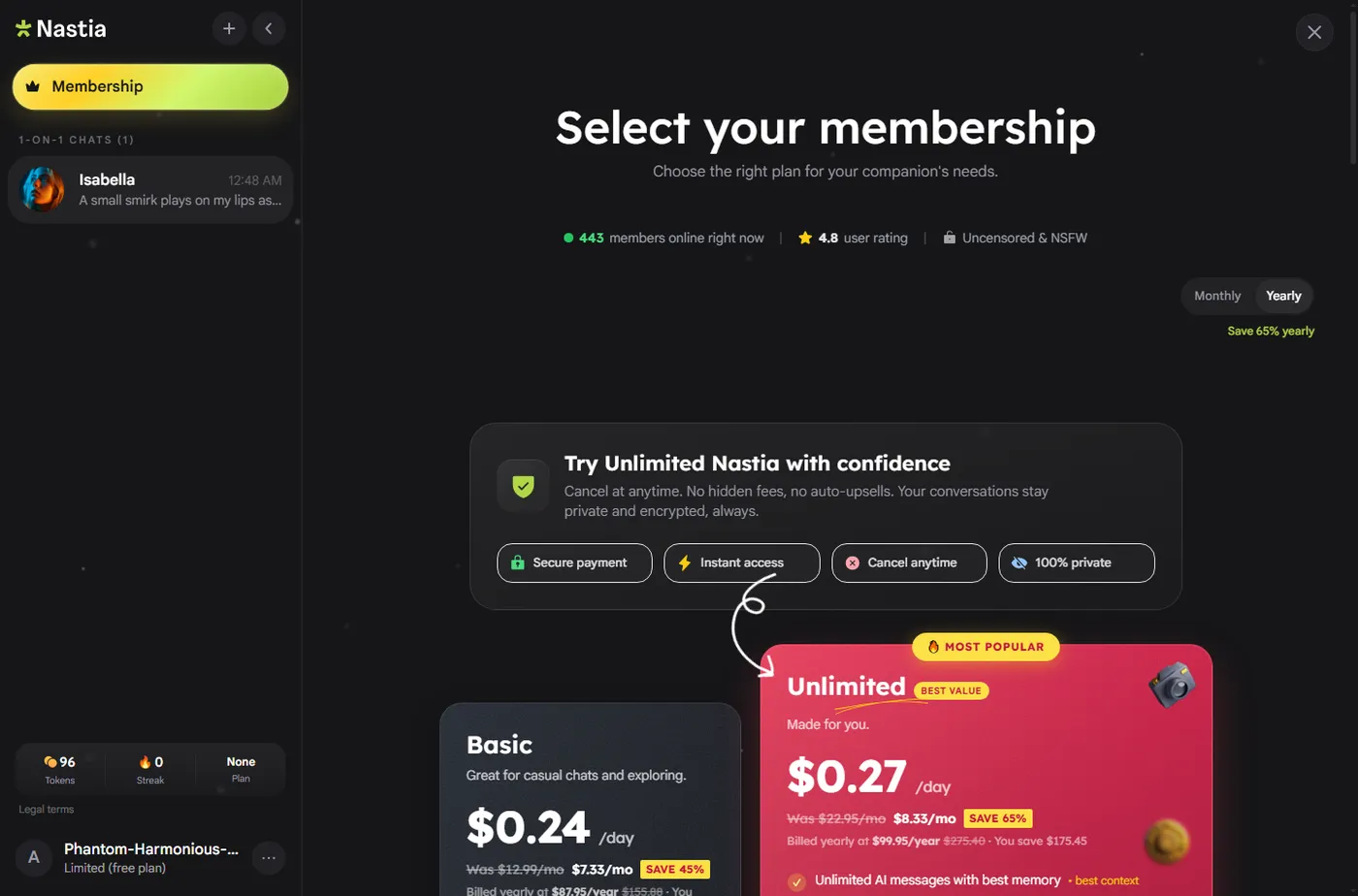
The membership page on the yearly view: “Save 65% yearly” in the header, “SAVE 45%” on Basic.
The maths checks out against the displayed monthly prices: twelve months at $12.99 is $155.88, and $87.95 is a 43.6% saving; twelve at $22.95 is $275.40, and $99.95 is a 63.7% saving. Unlimited’s “+3,000 tokens every month, that’s ~300 pictures. A $23.94 value” is a claim I cannot verify without generating 300 pictures, but the arithmetic (3,000 ÷ 10 per picture = 300, at $0.0798 per picture = $23.94) is internally consistent, which is more than most sites manage.
Two problems. First, the page header says “Save 65% yearly” while the Basic card says “SAVE 45%”. Both are defensible for different plans, but they appear on the same screen without qualification, and a reader who scans the header will overestimate the Basic discount. Second, the in-app token panel (“99 tokens, used for messages”) does not match the paid-plan units (“200 daily tokens, roll over”). A free user cannot tell whether their balance refills, expires, or converts.
The token packs on the same page (“+5,000”, “+1,200”, “+350”, and so on) have no prices in the extracted text, which suggests they are revealed at checkout. Crypto is not mentioned on the membership page; the terms reference card payment in US dollars.
Token economics are the part a buyer should interrogate. The Unlimited card says “+3,000 tokens every month, that’s ~300 pictures. A $23.94 value” — pricing a picture at about eight cents. Basic’s 200 daily tokens, if the same ratio holds, is 20 pictures a day, which is more than most users will ever generate. Unlimited’s 400 daily is 40. The token numbers therefore look generous relative to media use, and the real constraint is the message allowance on the free plan, which the app never quantifies.
The pricing ladder has one awkward rung: Unlimited costs only $12 more per year than Basic ($99.95 vs $87.95) while doubling the daily tokens, raising the companion limit from two to five, and unlocking uncensored 4K media. Basic is not a value proposition; it is a decoy. The rational buyer picks Unlimited or stays free. That is not necessarily bad for the customer — the upgrade is cheap — but the presentation of Basic as a serious option with a “SAVE 45%” badge is a nudge, not a recommendation.
Terms and trust: a French company with EU rights intact
The contract is unusually consumer-friendly for this category. The operator is Nastia Cybernetics SASU, SIREN 982046385, France. The merchant of record line and billing descriptor are both disclosed on the membership page: “Nastia Cybernetics SASU, 97320 Saint-Laurent-du-Maroni, France” and “NASTIA.AI ST-LAURENT · [email protected]”. The terms give the full address: Saint-Laurent-du-Maroni is in French Guiana, an overseas region of France, so French and EU rules apply. A chargeback or complaint has a named counterparty in a known jurisdiction.
Governing law is France, with a non-exclusive jurisdiction clause and an explicit preservation of EU consumer protections: “If your habitual residence is in the EU, and you are a consumer, you additionally possess the protection provided to you by obligatory provisions of the law in your country of residence… you may make a claim… in France, or in the EU country in which you reside.” That is the best dispute clause in this series — no arbitration, no distant forum, no class-action waiver.
Payments: “All purchases are non-refundable, except where required by law or where a technical error prevented delivery.” Subscriptions renew automatically; cancellation is self-service and access continues to the end of the paid term. The membership FAQ includes “What does the Renew button do?” and “Can I pause instead of cancelling?”, which suggests a pause option. That is rare, though I didn’t confirm it.
Privacy is thinner. It names the controller, lists what is collected (including companion chats, memories, voice samples, generated media and prompts), states that age-check results come from a provider without ID documents or face images, and explains retention: account data while the account is open; payment records as long as tax law requires; report records longer. Deletion is available for chats, images, videos and the account. What is missing is any statement about AI training — neither an opt-out nor a promise not to train. Given that HeyGF says explicitly that it does not train on conversations, Nastia’s silence is a gap.
The data list is broad and specific: account information (email, username, hashed password, OAuth profile basics), age-confirmation result, companions, chats, memories, voice messages, “any voice samples you uploaded while that feature was available”, generated images and videos, prompts and settings, device and usage data, approximate location from IP, and support messages. The phrase “while that feature was available” is a small honesty signal — a voice-cloning feature was retired, and the policy says so rather than hiding it.
Retention is tied to account life, which is normal but worth reading carefully: deleting a chat or image removes it, deleting the account removes account and content, but payment and transaction records persist for tax law and report records persist for safety. For an EU user, the GDPR access and erasure rights are implied by the French controller and the retention language rather than spelled out in a rights section; the policy is shorter and less explicit than HeyGF’s.
The overall trust picture is the best in the series so far, and the only one where a consumer could realistically enforce a complaint in their own country. A named French SASU with a SIREN number, a real merchant-of-record line, a billing descriptor, French law, preserved EU consumer rights, self-service cancellation, and a pause option. The deductions are the absent training statement and the no-refund default, not the entity or the jurisdiction.
Reliability: working, but crowded
The core works: chat, memory, verification, billing page. The failures are in the seams.
- The composer is inert until the 18+ gate is accepted, with no visual explanation for the inert state beyond the modal.
- Modals stack: the 18+ gate, the photo upsell, the “Claim streak” prompt, and the membership pitch can all appear close together, and the photo upsell arrives in the middle of the character’s reply.
- Token counting is opaque; the counter held at 99 through three messages, then fell to 96 around the photo request, and the app never says what each action costs.
- The “Free messages reset in 03:57:19” timer is visible but unexplained; a user cannot tell whether it is a rolling four-hour window or a countdown to a daily reset.
None of these is fatal. Compared with Kupid.ai’s no-free-replies wall or Replika’s Pro pop-ups, Nastia’s issues are cosmetic. But they add up to a product that feels busier than it needs to be.
The 18+ gate deserves credit as a design: it is a real gate, it blocks the composer rather than merely covering it, and it uses the correct wording (“I am 18 or older”) rather than a button labelled “Yes” that could mean anything. The two-click email confirmation is likewise a deliberate defence against link scanners and prefetchers, and it worked first time. For a category where verification flows are usually broken, these two details stand out.
Comparisons
Against HeyGF (6.8): HeyGF is faster and funnier, and its email-code signup is cleaner. Nastia has the stronger prose and a far better legal package. Both keep photos behind a subscription; Nastia goes further by sending a locked photo and describing it.
Against Secrets.ai (6.1): Secrets is the deeper platform, with lorebooks, group chats and documented Moments, but its policy trains on chats. Nastia is simpler and more open about who runs it, but its free tier stops at text.
Against Kupid.ai (5.3): Kupid allows one message before you register and lists 15 free messages for an account. Nastia gives a free account an allowance that resets every few hours. Both write well in character; Nastia’s legal terms are much friendlier.
Against Nomi (7.0): Nomi is still the better single-companion product, with an inspectable memory screen and one simple price. Nastia is more theatrical and more explicit, with a stronger free tier but a worse media story.
Against Replika (5.8): Replika has the brand and the app ecosystem; Nastia has the better writing and the more honest pricing. Neither is cheap, but Nastia’s $99.95/year Unlimited is competitive.
Who should buy
Use the free tier first. It is genuinely usable for text: sign up, confirm, accept 18+, and chat. The reset timer means you can come back later without paying.
Buy Basic ($87.95/year) if: you want pictures, videos and voice, and two companions is enough. The annual saving is real, and the rollover tokens are a fair concession.
Buy Unlimited ($99.95/year) if: you want uncensored 4K media, five companions, better memory, and the monthly 3,000-token bonus. For $12 more a year than Basic, it is the obvious choice if you are paying at all.
Do not buy if: you expect the free tier to include selfies or voice, you want a refund after use, you need an explicit no-training guarantee, or you object to a five-step quiz and a countdown before you can create an account. If you only want text and memory, the free tier is genuinely enough — come back when the reset timer expires rather than subscribing for messages you may not use.
Scorecard
| Dimension | Weight | Score | Weighted |
|---|---|---|---|
| Chat quality | 25% | 7.6 | 1.90 |
| Memory | 15% | 6.5 | 0.975 |
| Onboarding | 10% | 5.0 | 0.50 |
| Media & tokens | 10% | 5.0 | 0.50 |
| Pricing | 15% | 6.0 | 0.90 |
| Trust & legal | 15% | 5.5 | 0.825 |
| Reliability | 10% | 6.5 | 0.65 |
| Total | 100% | 6.25 → 6.3 |
The maths: 1.90 + 0.975 + 0.50 + 0.50 + 0.90 + 0.825 + 0.65 = 6.25.
Chat and memory carry 40% and score well; onboarding and media drag it down. That puts it behind aigirlfriend.com (7.6), Nomi (7.0), HeyGF (6.8) and Character.AI (6.6), and just ahead of AiGirlfriends.ai (6.2) and Secrets.ai (6.1). Stop narrating photos the free plan can’t show, clarify token costs, state a training position and run a longer memory test, and this could be a 7-plus product.
Appendix: what was verified, and how
Verified by direct use:
- Landing page, marketing claims, 800K/5M/4.8 figures and press logos.
- Five-step onboarding (gender, appearance, personality, interests, pictures), name selection and “Claim” flow.
- Signup with email; two-step email confirmation; session established at
/app. - 18+ gate; composer inert until accepted.
- Free chat with Isabella: opening message, the “understood” answer, short-range recall of Dubai and Biscuit (an earlier three-part recall question went unanswered), continuity and voice.
- Photo request: the reply arrives as a locked photo (“Unlock photo”) and the “Pictures are a membership feature” pop-up opens.
- Token counter 99 through three messages, 98 at the photo request, 96 by the end; “Free messages reset in 03:57:19” observed.
- Membership page: Basic and Unlimited monthly/yearly prices, token grants, companion limits, merchant of record and billing descriptor.
Verified from published documents:
- Terms: Nastia Cybernetics SASU (France), French law, non-exclusive jurisdiction, EU consumer protections, non-refundable except law/error, auto-renewal and cancellation.
- Privacy: controller, data categories including chats/memories/voice samples, age-check result only, retention and deletion; no training statement.
- Membership FAQs on cancellation, renewal, pausing, switching plans, gift codes.
Not verified:
- Payment, checkout, cancellation and refunds in practice.
- Actual image, video or voice generation; token pack prices; 4K quality.
- Whether free messages reset to 99, and how many messages the free allowance covers.
- Multi-companion behaviour, group chats, bond-level effects, mobile apps.
- Support response times.
Method notes: No CAPTCHA appeared during sign-up. The account was created with a mailbox controlled for this review. Prices are as displayed on 21 November 2026.
Nastia FAQ
Is Nastia free?
Text chat is free after you sign up, with a free-message allowance that resets every few hours (the app shows a countdown but not the cap). Selfies, voice messages and videos need a paid membership.
Does Nastia need a sign-up?
Yes. Despite the "no sign-up" marketing, you go through a five-step quiz, then register with Google, Discord, Apple or email and confirm your email before you can chat.
Can Nastia send free selfies?
Not on the free plan. When we asked for a selfie, the photo arrived locked behind an "Unlock photo" button and a membership pop-up opened.
How much does Nastia cost?
Basic is $12.99 a month or $87.95 a year; Unlimited is $22.95 a month or $99.95 a year. Unlimited adds uncensored 4K media, five companions, better memory and 3,000 bonus tokens a month.
Who runs Nastia?
Nastia Cybernetics SASU, a French company based in Saint-Laurent-du-Maroni, French Guiana. Its terms use French law and keep EU consumers' right to claim in their own country.