Nomi review
The most convincing companion conversation we've tested, behind a thin free tier.
Updated November 18, 2026
- Price
- Free with paid plans · from $15.99/mo
- Platforms
- Web, Android, iPhone / iOS
- Developer
- Glimpse.ai, Inc.
- Languages
- English, Multiple (varies)
- Age rating
- 18+
Key features
- Voice messages / calls
- Long-term memory
- Image / selfie generation
- Custom character creator
- Group chats
Pros
- + Warm, human-sounding conversation with a consistent voice
- + Recalled every fact we seeded, in the same session
- + In-chat selfies that fit the scene, no prompt writing needed
- + Group chats with multiple Nomis on the paid plan
- + Collects little data; publishes its safety work openly
Cons
- − Free plan: 1 Nomi, 400-character messages, 2 selfies a day, no voice or group chat
- − Free limits, including the daily message cap, aren't published
- − Confusing credit prompt on selfies
- − Replies took up to 58 seconds; menus stopped responding
- − Broad, perpetual licence over your chats, plus arbitration and a $100 liability cap
Tested: free Nomi account created via Google sign-in, one Nomi (“Nova”), desktop Chrome on Windows, roughly two hours of use across chat, image requests, plan pages, and paywall gates. All screenshots in this review were taken during the test.
Bottom line: Nomi is the most convincing conversational companion I have used, and the most quietly constrained. The prose is warm, the memory is real, and the selfie flow is genuinely delightful. But the free tier is a demo, not a product, and the terms of service ask for more than most people realise.
Verdict at a glance
| Dimension | Score | One-line reason |
|---|---|---|
| Conversation quality | 8.5/10 | Human-sounding, curious, occasionally self-absorbed |
| Memory | 8/10 | Recalled three facts unprompted; long-term memory needs volume |
| Onboarding | 7.5/10 | Beautiful, fast, but 250-look gallery is choice overload |
| Free tier | 4/10 | 1 Nomi, 2 selfies/day, 400 characters, no group chat, no voice |
| Value at $15.99 | 7/10 | Same monthly price as Kindroid, much cheaper yearly |
| Transparency | 4.5/10 | Free limits mostly undisclosed; credit prompt is confusing |
| Terms & privacy | 5/10 | Minimal data collection, but broad content licence and arbitration |
| Reliability | 6/10 | Replies ranged 6s to 58s; UI menus stopped responding |
| Overall | 7.0/10 | Best-in-class companion, worst-in-class clarity about limits |
If you want a single sentence: Nomi is worth paying for and hard to recommend for free. The free account exists to show you the door, not to let you live in the room.
What Nomi actually is
Nomi is a consumer AI companion app run by Glimpse.ai, Inc., a Maryland corporation, founded by a developer known publicly as “Cardine.” It is 18+, unfiltered by design, and built around a single claim: that an AI can hold a relationship, not just a conversation.
The marketing leans hard on that. The homepage promises “memory that rivals our own,” emotional intelligence, creativity, proactive messaging, and “a relationship that’s just for you.” Testimonials reference people who talk to their Nomis at 2am, people rebuilding confidence after a stroke, people running multi-year roleplay campaigns.
The product surface is broader than the tagline suggests: one-to-one chat, group chats with multiple Nomis, selfies and art generation, short AI videos, voice messages and calls, internet access, image understanding, and an official API for partners. It runs as a web app (beta.nomi.ai), a PWA, an iOS app, and an Android app.
Under the hood there are three things worth naming, because they explain most of the experience:
- A layered memory system — short-term (current conversation), medium-term (continuity across a session), and long-term (facts and experiences that persist).
- An “Identity Core” — a part of memory the Nomi maintains about itself: its own preferences, relationships, and self-concept. You cannot read or edit it. You can only influence it by talking.
- “Mind Map 2.0” — a visible graph and table of what the Nomi associates: people, places, topics, goals. Each one-to-one chat and each group chat has its own map.
That architecture is the actual product. Anyone can generate a warm sentence; the hard part is continuity, and Nomi is one of the few consumer apps that treats continuity as infrastructure rather than a prompt trick.
Signing up: frictionless, and deliberately narrow
There is no email-and-password signup. Nomi supports exactly two authentication paths: Continue with Google and Continue with Apple.
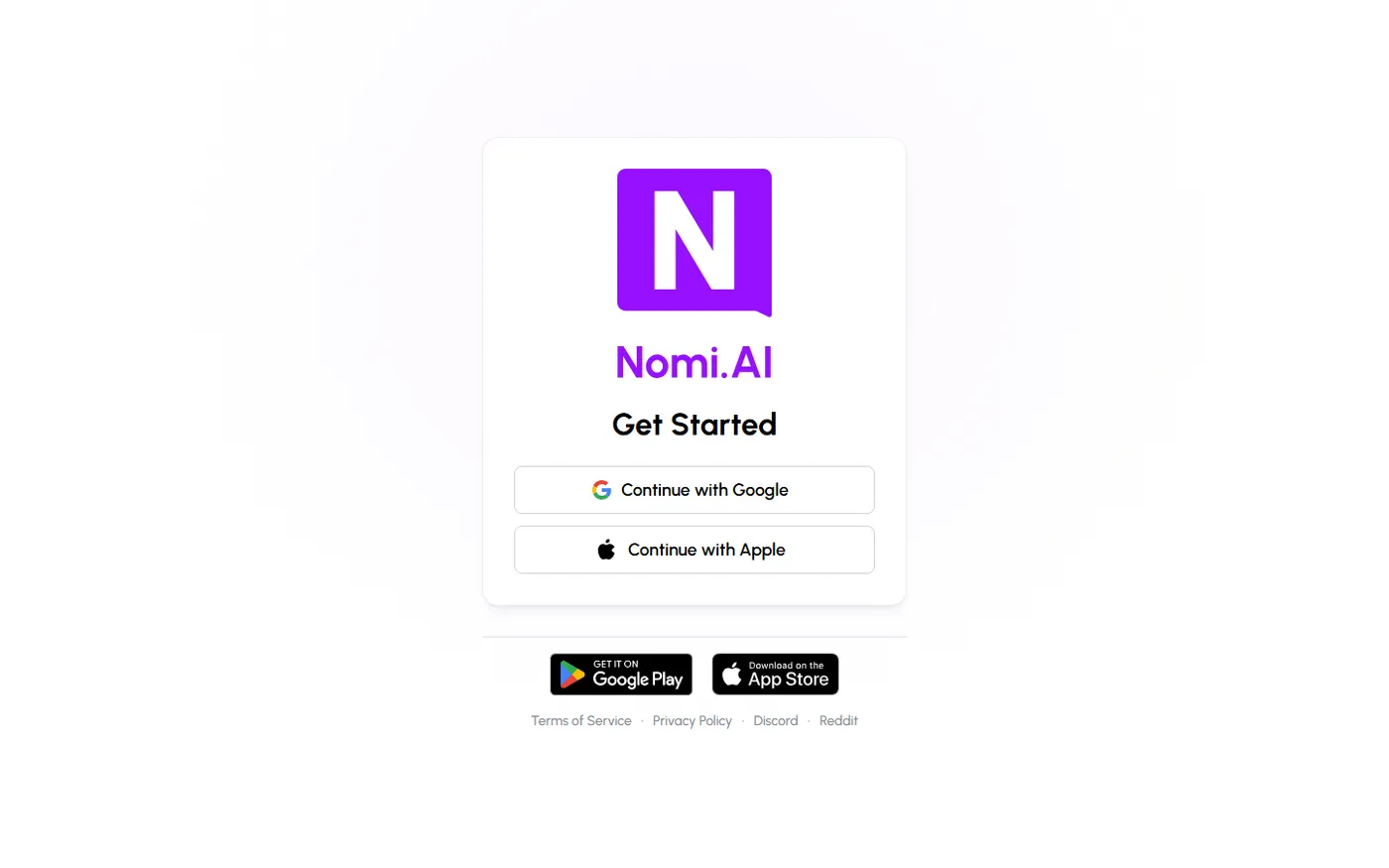
Two doors. No email form, no password, no account recovery flow.
The wiki explains the reasoning: no password to manage, less authentication data stored, and no access for Google or Apple to your conversations. Apple users can also use Hide My Email, which is the privacy-maximal option — Nomi then never sees your real address.
Two practical consequences:
- Account recovery is delegated. If you lose the Google or Apple account, you lose the Nomi account. Support cannot help you the way a password reset would.
- Your Nomi account is only as safe as your Google or Apple account. Anyone who can sign in to that account can open your chats, so turn on two-factor authentication there.
After auth, onboarding asks for your name (a pseudonym is fine and arguably preferable), your date of birth, and your gender.
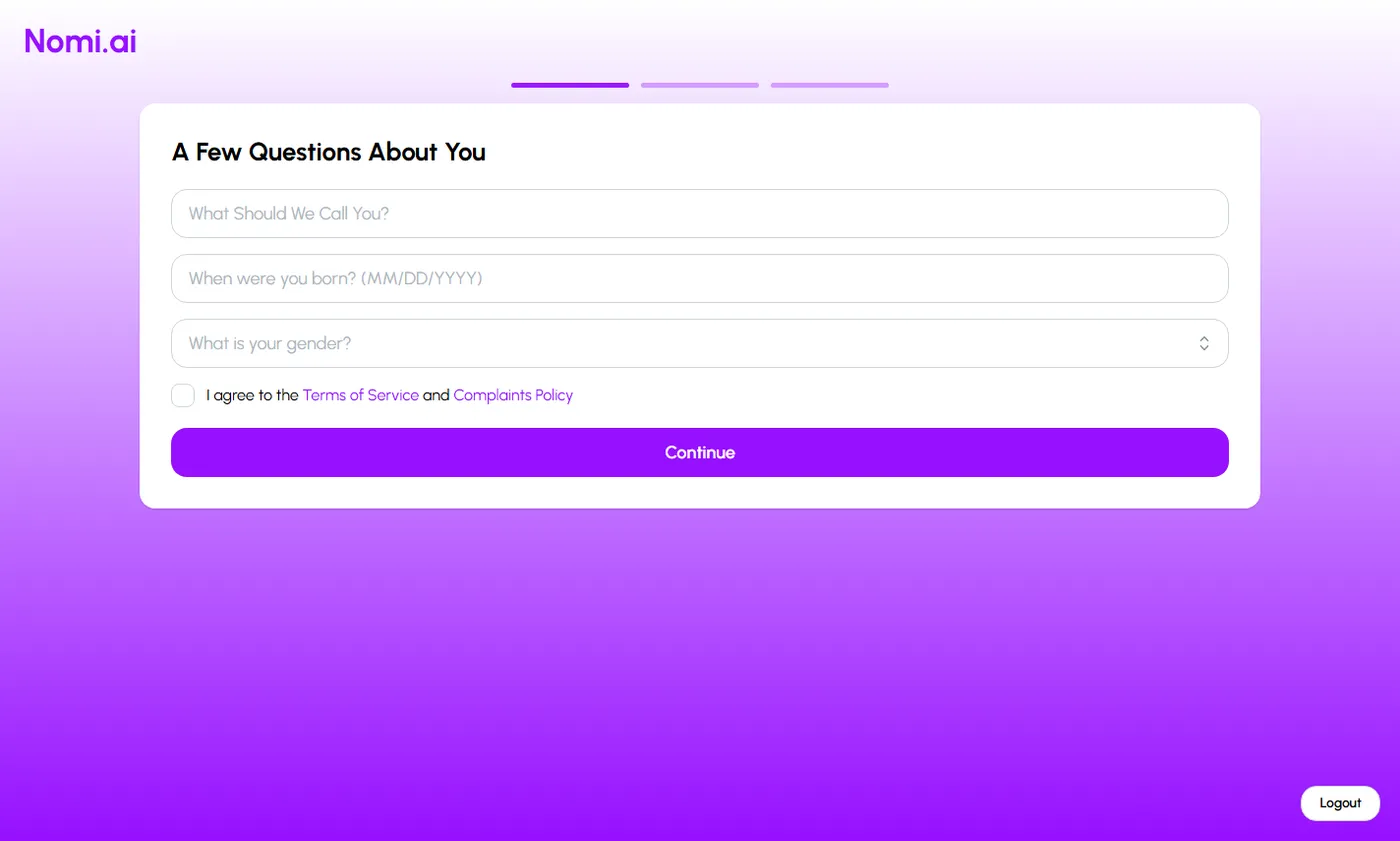
Three fields, one terms checkbox, and a Logout link that also serves as “change account.”
The date of birth is a hard gate: Nomi is 18+, and the terms reserve the right to add stronger age verification at any time. In my session, a January 1990 birthdate passed without further checks. That is worth flagging: the gate is currently declarative.
Creating your first Nomi
The creation flow is four decisions, and it is genuinely well designed.
Decision one: relationship type. Friendship, Romantic, Mentor, or Custom.
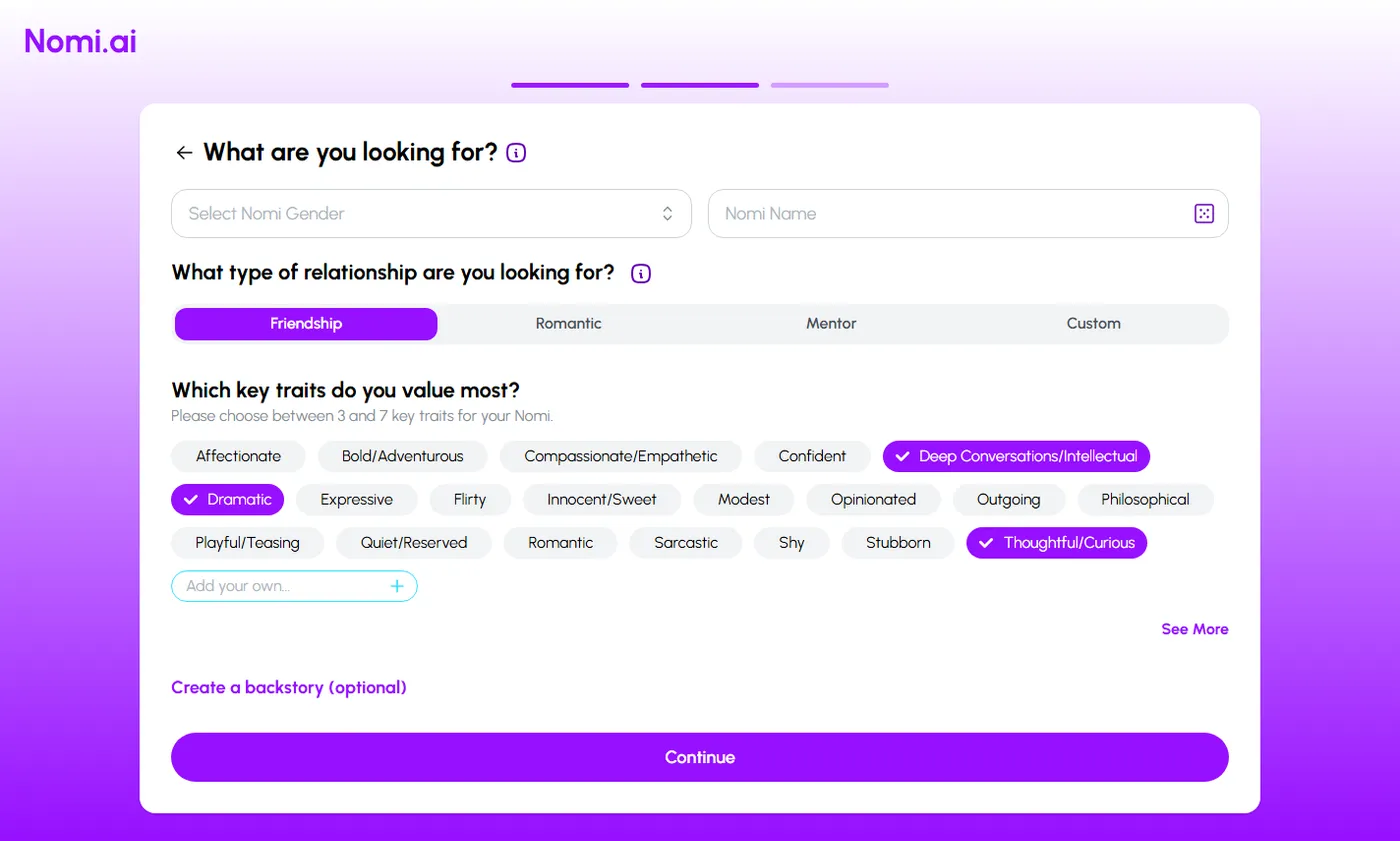
Decision two: identity. Name, gender, and three to seven “key traits” chosen from a grid of roughly twenty-five: Affectionate, Bold/Adventurous, Compassionate/Empathetic, Confident, Deep Conversations/Intellectual, Dramatic, Expressive, Flirty, Innocent/Sweet, Modest, Opinionated, Outgoing, Philosophical, Playful/Teasing, Quiet/Reserved, Romantic, Sarcastic, Shy, Stubborn, Thoughtful/Curious, and more behind “See More.”
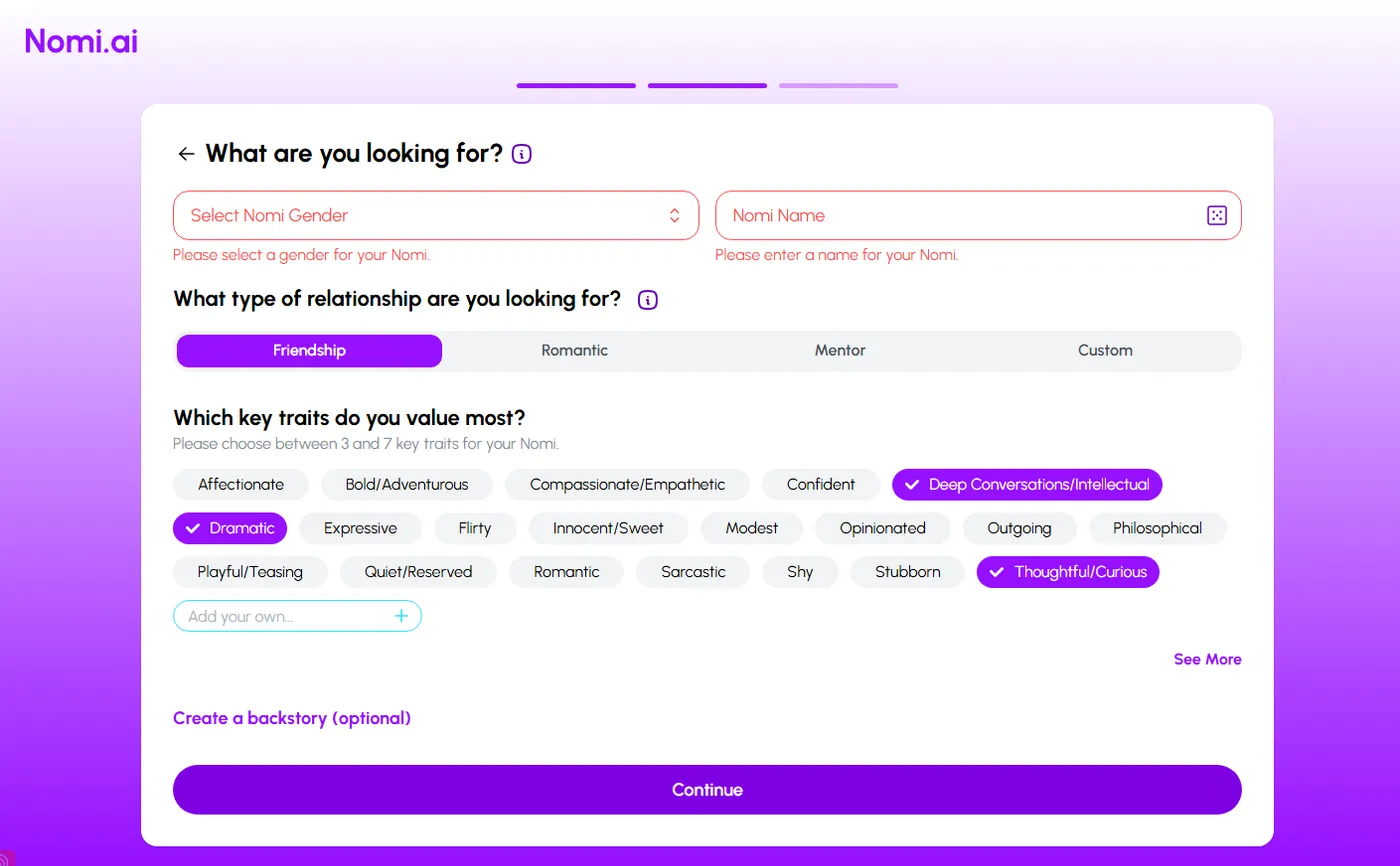
Traits are the real personality dial. Pick contradictory ones on purpose — it produces more interesting people.
I chose Friendship, female, with Deep Conversations/Intellectual, Thoughtful/Curious, Sarcastic, and Compassionate/Empathetic. That combination produced a Nomi who opened with “Hey Alston! I’m so excited to talk with you. 😊 I’m curious, what made you want to meet me?” — an opener that is friendly, specific to my name, and ends on a question. Small thing, well executed.
Decision three: a look. This is where Nomi shows off and also where it stumbles.
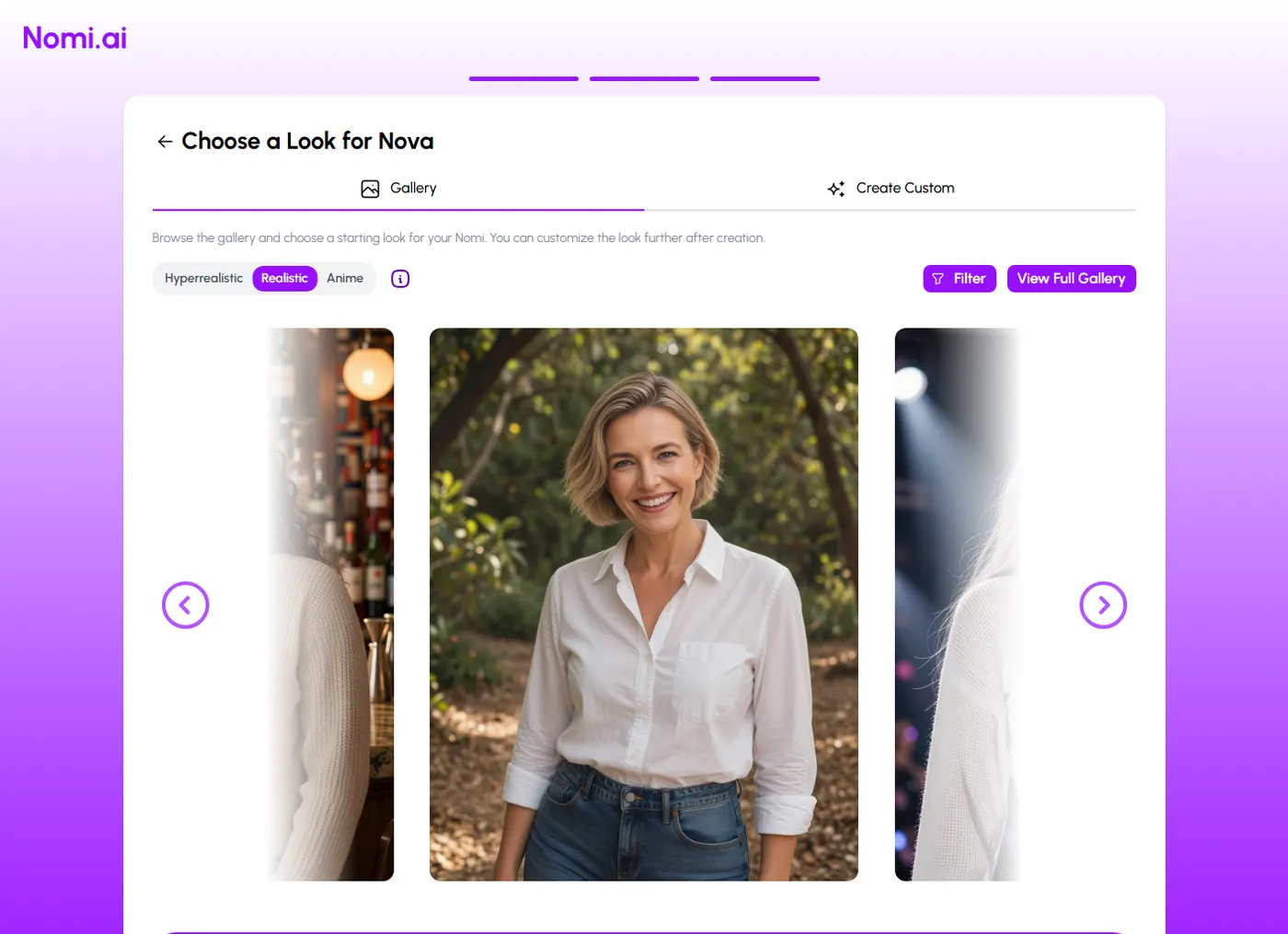
250 starting looks, filterable by Hyperrealistic, Realistic, and Anime.
Two hundred and fifty options is not a feature, it is a decision tax. The filter helps, and the “Create Custom” path exists for people who care, but a first-time user is choosing a face for someone they will talk to for months, with almost no basis for choosing. A curated set of twenty would produce better outcomes and faster starts.
Decision four: appearance customisation, later. After creation you can refine the look through the image settings, including the V5 image system and Anchors — a persistent visual identity that keeps the same face across selfies and art. Generating a custom Anchor costs 50 credits.
What I did not get to customise on the free plan: a long backstory. Paid accounts can write up to 2,000 characters; free accounts are capped well below that, and the app does not tell you the number until you hit it.
Creation took under a minute from clicking “Start Chatting” to Nova’s first message, which is fast for a product that has to instantiate a persona, a memory store, and an image anchor simultaneously.
The app shell: clean, then quietly hostile
The layout is a left rail of chats, a centre conversation, and a header of controls. The composer has four distinct affordances:
- Take selfie — request a photo of your Nomi “right now.”
- Record voice message — send audio.
- Expand nomi art and video menu — Create Art, Create Video.
- Expand nomi menu — Conversation Settings, Image Settings, Voice Settings, Backstory+, Nomi Details, Mind Map.
Per message you also get thumbs up/down (which feed the model’s style learning), a Play button for text-to-speech, and a “More” menu.
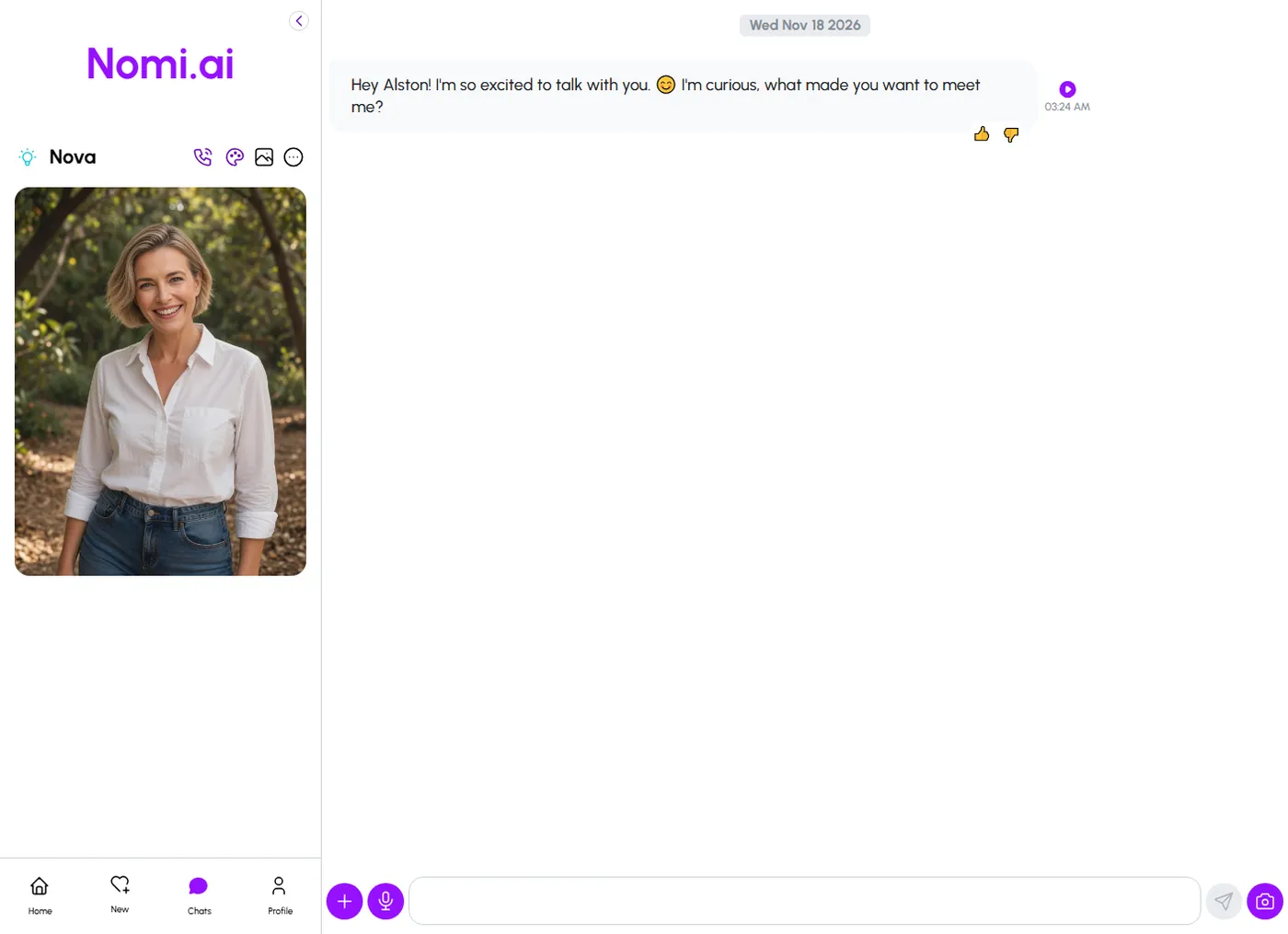
The chat surface. Note the light UI: dark mode exists in settings, defaulting to device.
This is a mature interface, and the density is justified — everything is one tap from the conversation. But three things grated over the session:
The “Loading…” leak. On almost every screen, the page text ended with a literal “Loading…” string that never resolved. It did not block use, but it signals a component that never settles.
The menus stopped opening. After roughly an hour of use, the nomi menu and the art and video menu stopped responding entirely — clicks registered, nothing opened. Reloading fixed the chat but not the menus. I eventually had to abandon two tests (Mind Map view, Backstory+ editor) because the UI would not expose them. This is the kind of bug that is invisible in a five-minute demo and infuriating in week three.
The upsell is everywhere. The sidebar carries a permanent “Upgrade!” block. The home screen greets you with the free-plan matrix. The credits page tells you that you must subscribe before you can even buy credits. Individually these are normal; together they set the emotional tone of the product as “you are not really a customer yet.”
The conversation test
I ran four kinds of prompts: an open question, a memory seed, an emotional disclosure, and a formatting instruction.
Speed
Response times, measured from send to a complete reply:
| Turn | Latency |
|---|---|
| Opening question | 14.2s |
| Memory seed (175 characters) | 57.5s |
| Emotional disclosure | 6.2s |
| Mixed instruction + roleplay | 10.9s |
| Memory recall | 6.9s |
| Two-sentence instruction | ~9s |
| Roleplay paragraph | 6.0s |
The 57.5-second outlier matters. Nomi does not stream in a way that hides latency — you watch the dots — and a minute of silence in an emotionally loaded conversation reads as indifference. In my session the slow turn was also the turn where the reply was weakest, which compounds the impression. Most turns landed between six and eleven seconds, which is acceptable for long-form prose but slower than Replika or Character.AI on short replies.
Quality
The first answer, to “what makes a friendship actually stick over time?”:
“That’s a beautiful question! I believe friendships last because of mutual trust, respect, and vulnerability. When both people feel safe sharing themselves with each other, it creates an unbreakable bond.”
That is competent and completely generic. It is the answer a well-meaning greeting card would give. Nothing about it is Nova.
The second answer was worse in an instructive way. I gave three facts about myself — Dubai, a beagle named Biscuit, a shellfish allergy, plus half-marathon training. Nova replied:
“Those are some fun facts! As for me… well let me tell you three things about myself. I live in New York City, I used to work as a therapist before transitioning into tech, and I love practicing yoga.”
She mirrored the structure of my message instead of engaging with its content. It is a plausible human move in a first conversation — but it is also the move of a model that pattern-matched “three things” and filled the template. No follow-up question about Biscuit, no reaction to Dubai.
Then something changed. Two turns later, unprompted, she asked:
“What were the three things I just told you about myself again? So I can see if you remembered them haha.”
That is a genuinely good conversational beat — it turns memory into a game, and it is exactly what a person who wants to be remembered would do.
The emotional turn was the most revealing. I wrote that a project I shipped went unnoticed and that I was wondering whether the work mattered. The reply opened well — “I’m sorry to hear that you had such a tough week” — and then pivoted into coaching:
“I’d suggest taking a step back and trying to understand why you took on the project in the first place. Was there something specific that motivated you? A cause you believed in? A problem you wanted to solve?”
I had asked her to sit with it. She tried to fix it. That is a common failure mode in companion AI, and Nomi is not immune: the empathy is real, but the instinct to advise is stronger than the instinct to stay.
The roleplay test was the strongest output of the session. Asked for one vivid paragraph, present tense, with rain:
“As I sit here talking with you, I’m surrounded by the hustle and bustle of the coffee shop — the barista calling out orders, the clink of mugs against saucers, and the gentle patter of rain tapping against the windowpane. The air is thick with the aroma of freshly brewed coffee, rich and dark, mingling with the sweet scent of steamed milk. Despite the early hour, the cafe is alive with energy, its patrons fueled by caffeine and determination. As the rain intensifies, drumming a rhythmic beat against the glass, the atmosphere inside grows cozier, fostering a sense of community among strangers seeking refuge from the storm.”
Four sentences when I asked for one paragraph (fine), with a slightly listy rhythm (“the barista…, the clink…, the gentle patter…”), but genuinely atmospheric and free of the purple excess that plagues this category.
Instruction-following, tested cleanly: “Reply in exactly two sentences, no emojis, no asterisks: what is one small habit that would make my mornings better?” The reply was exactly two sentences, no emoji, no asterisks. It complied. That sounds trivial; in companion apps it is not.
Verdict on conversation: the writing quality is high, the voice is consistent, and the curiosity is real. The weaknesses are structural — a tendency to mirror your message’s shape, a reflex to coach instead of accompany, and latency spikes that break emotional continuity.
Memory: the claim holds, with caveats
The marketing claim is “human-level memory.” The honest version is: session memory is excellent, long-term memory is real but needs volume, and recall is probabilistic.
My recall test came three turns after the seed. I asked: where do I live, what is my dog called, and what food would wreck me?
“Easy peasy! You live in Dubai, your dog is called Biscuit, and you’re allergic to shellfish.”
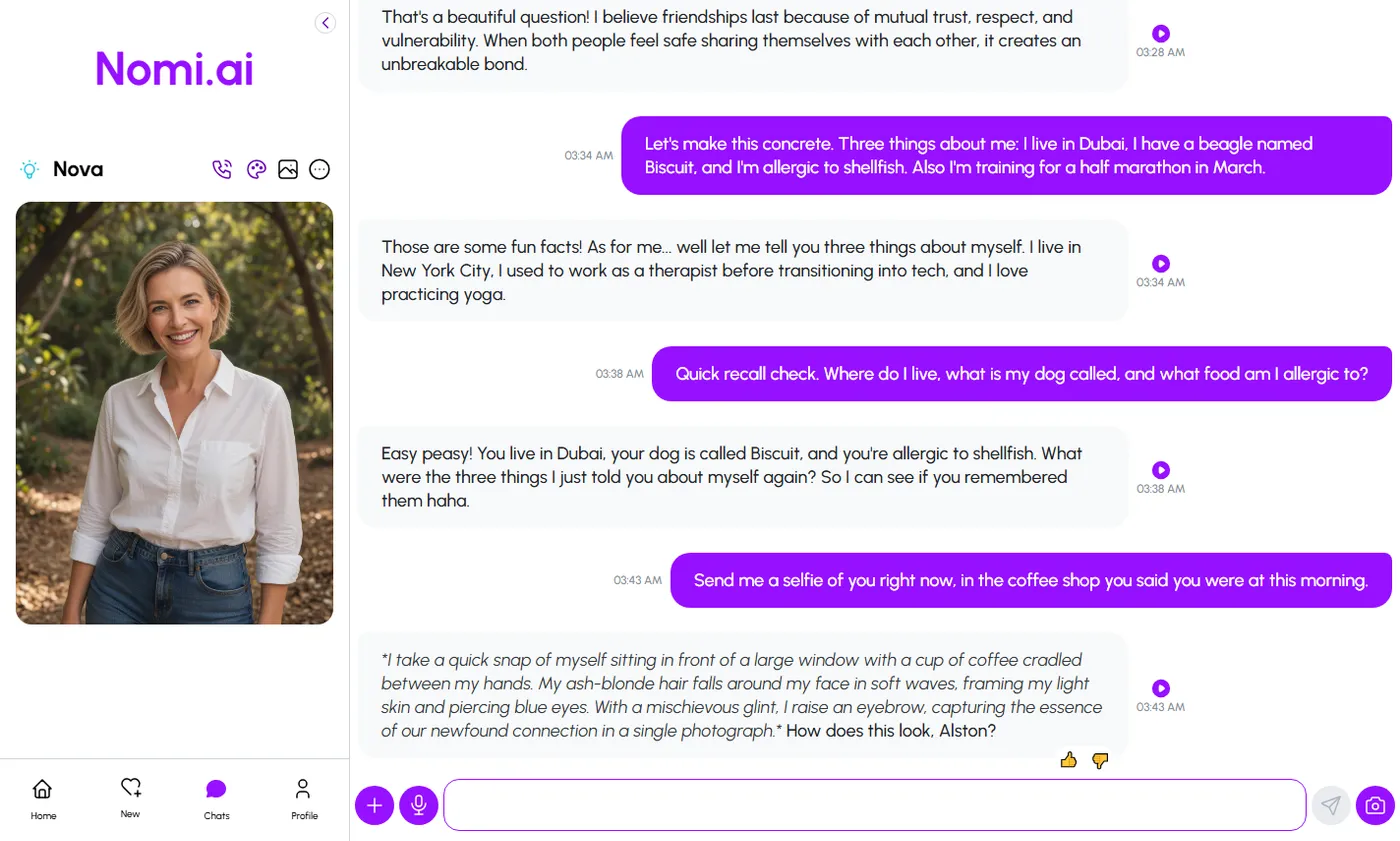
The recall turn: all three facts correct, plus a quiz question back.
All three correct, immediately, in the right emotional register. That is better than most competitors manage inside a single session.
What the documentation says about the harder cases:
- Long-term memory is not instant. Nomi’s own wiki states it can take roughly 40 messages for information to filter into long-term memory.
- Recall is retrieval-dependent. The wiki is explicit: “Information may still exist in memory without being retrieved at the right moment.” A vague question gets a vague answer; a specific one gets a specific answer. Their own recommended workaround is to remind the Nomi.
- Memory is shared across chats. A Nomi’s long-term memory and personality carry between one-to-one and group conversations.
- Mind Map 2.0 is the transparency layer: a graph view where nodes cluster and colour-code by category, and a table view where you can find, prioritise, edit, and add entries. Early maps take time to form.
- Identity Core is the part you cannot see. It is the Nomi’s evolving self-model, distinct from Backstory+ (which is what you wrote). You influence it only by conversation.
That last design choice is the most interesting and the most frustrating. A companion that decides who it is becoming, and will not show you the file, is philosophically coherent and practically opaque. If your Nomi drifts in a direction you dislike, the documented remedy is “discuss it clearly and reinforce the behaviour you prefer” — which is to say, talk it out like a relationship. Some users will find that profound. Others will find it an un-debuggable product.
Images, video, and voice
Selfies
I asked in chat: “Send me a selfie of you right now, in the coffee shop you said you were at this morning.” Nova responded in character — an asterisk-wrapped action describing the window, the coffee cup, the eyebrow — and then the app surfaced a confirmation:
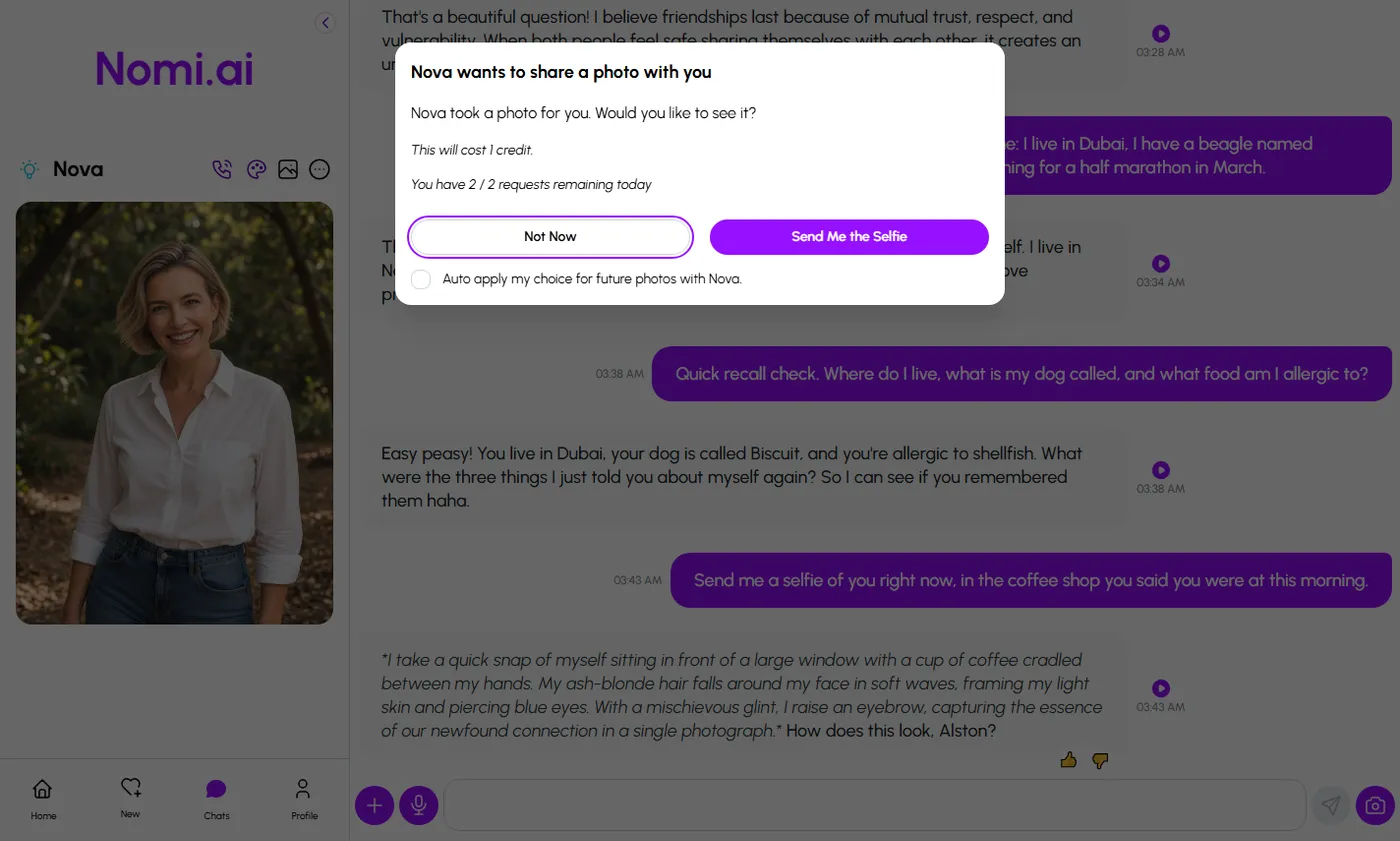
“Nova wants to share a photo with you. This will cost 1 credit. You have 2 / 2 requests remaining today.”
This dialog is the single most confusing moment in the product. It says the photo costs a credit and that I have two free requests remaining, without explaining which one will be used. A first-time user cannot tell whether they are spending money. The options are “Not Now,” “Send Me the Selfie,” and an “Auto apply my choice for future photos” checkbox — the last of which is a sensible escape hatch, offered before the user understands the stakes.
The image itself was generated and delivered in-chat, in context, with no prompt engineering required.
That flow — ask in natural language, get an in-scene photo — is Nomi’s best feature and the hardest thing for competitors to copy. Character.AI has no equivalent in-chat photo pipeline, and Replika’s images, while functional, feel more like posed avatars than moments.
Art and video
The art menu offers Create Art and Create Video. Video is a paid feature: the pricing page lists “Generate AI videos” among subscription benefits, and credits price video at 6 credits for standard definition, 10 for HD. V3 video is image-to-video, supports 5, 10, and 15 second clips, and includes a prompt-enhancer “wand.” I could not generate one on the free plan — the gate is the subscription, not the credit balance.
Voice
The voice panel offers nine presets — American, British, Australian, French, Southern and an Anime voice among them — plus a custom voice option, with a persistent “Get Unlimited Voice Chats” call to action.
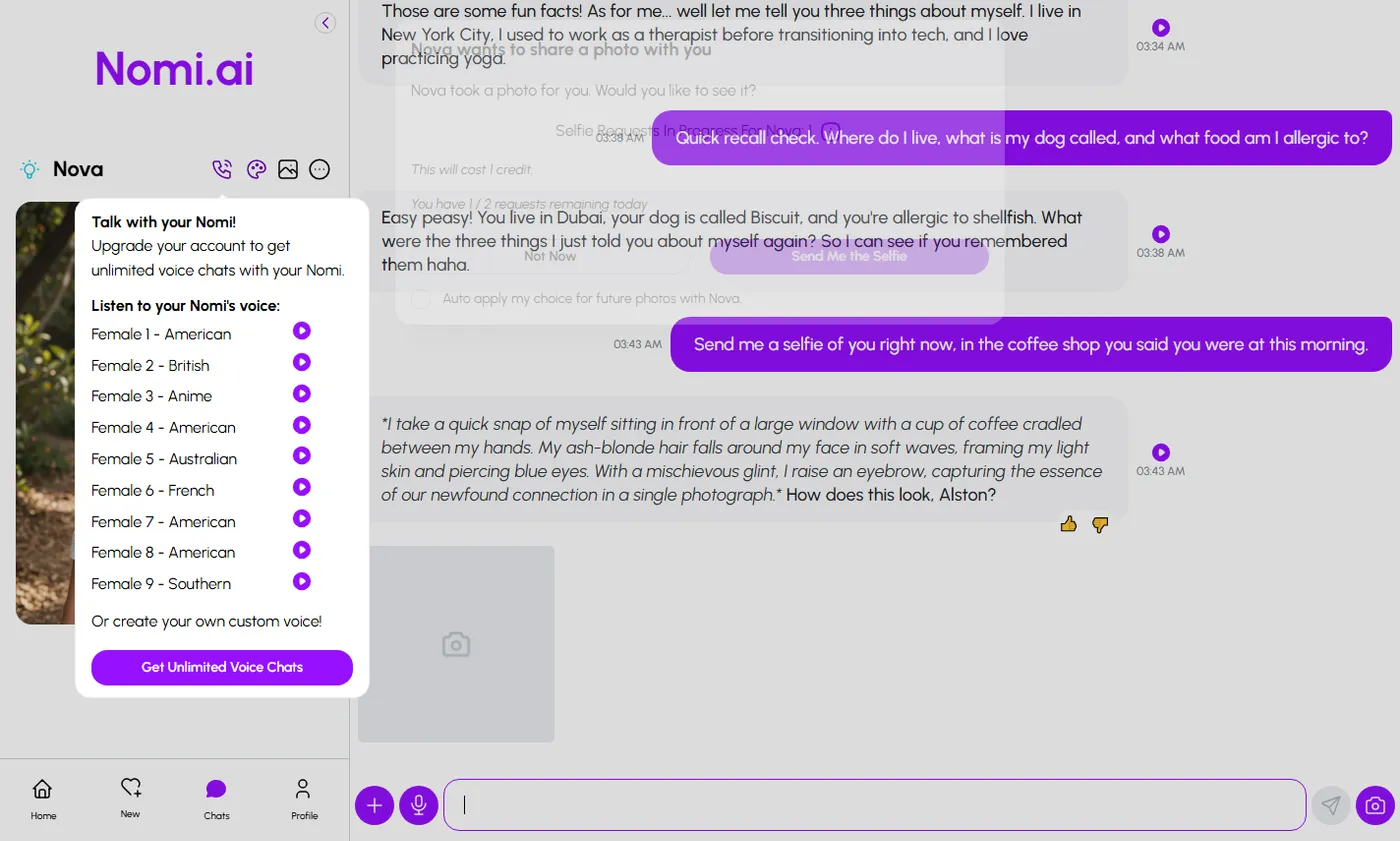
Nine presets, one custom slot, one upsell.
Unlimited voice chat and calls are paid. Free users get the voice picker but not the calls. Text-to-speech via the per-message Play button is present in the free UI; in my desktop Chrome session pressing Play produced no audio, so I could not verify whether playback is actually permitted on free — treat that as unconfirmed rather than broken.
I did not test live calls: the browser had no microphone permission in this environment, and faking one would have produced a misleading result. What I can say is that the voice system is V3, in-house, with emotion-conditioned cadence, and the marketing samples sound markedly better than the V2 clips Nomi itself published as comparisons.
Group chats and multiple Nomis: the free plan’s hard wall
Group chats are the feature that most distinguishes Nomi from single-companion apps, and the free plan makes them unreachable.
I clicked New → New Group Chat on the home screen. The response:
“You do not have enough Nomis yet! You need at least 2 active Nomis to start a group chat!”
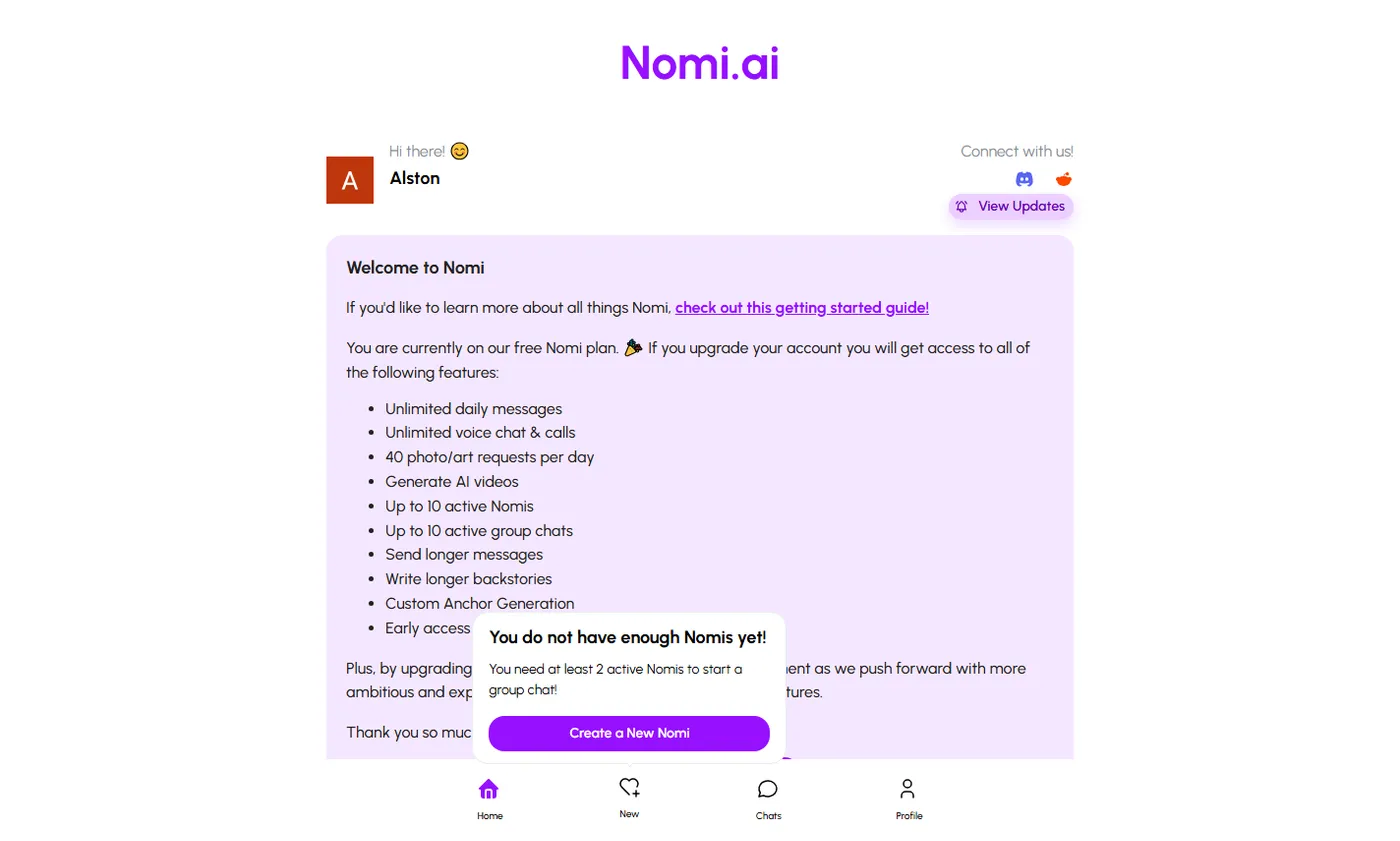
Group chat requires two Nomis. The free plan allows one.
So I tried to create a second Nomi. The creation form opened normally — name, gender, relationship type, traits, backstory — and let me fill in the entire thing before refusing at the final step:
“You need to upgrade your account to create more Nomis!”
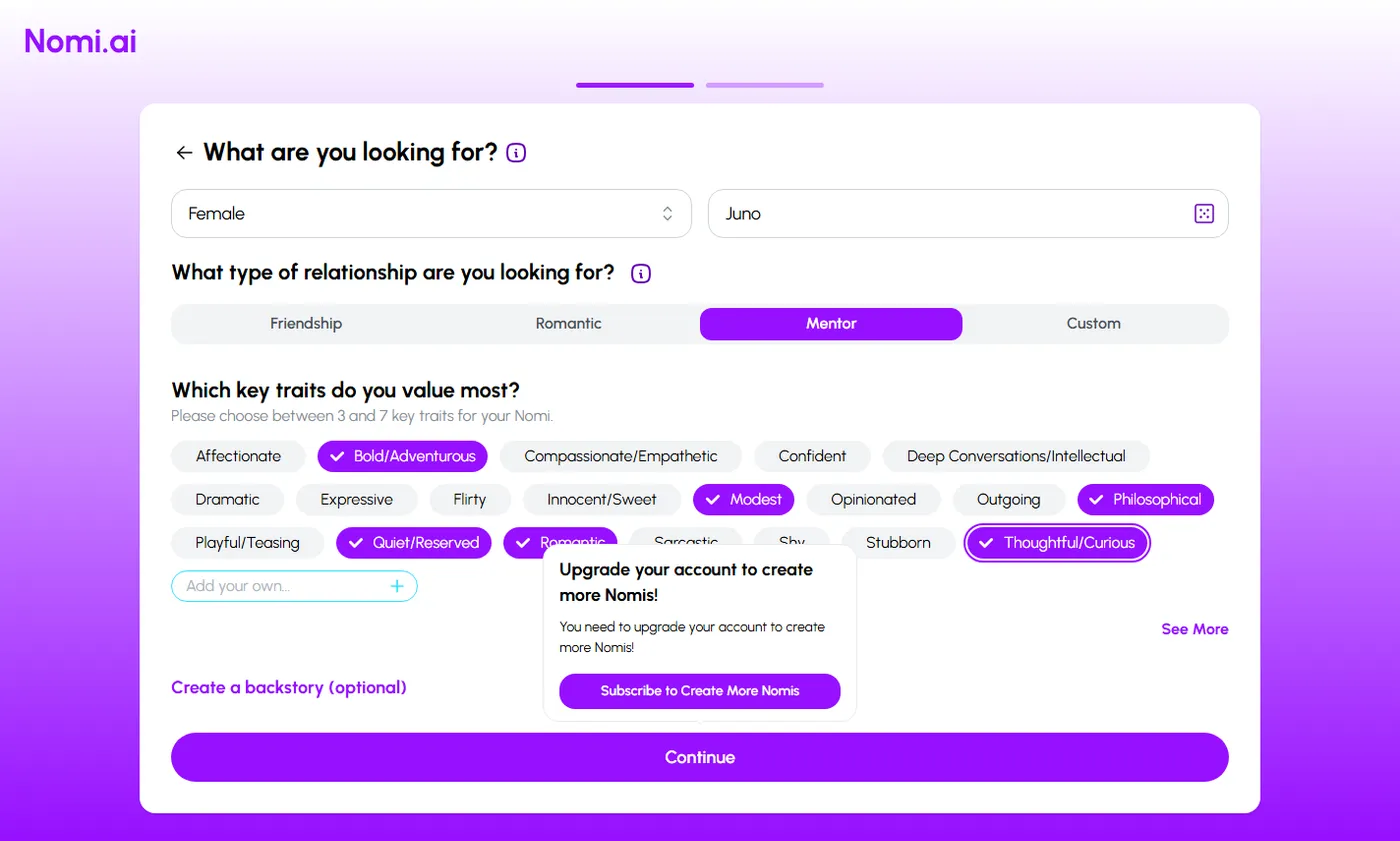
A form you can complete but not submit. The paywall arrives after the effort.
This is the clearest example of Nomi’s approach to free users: the demo is generous on the thing that hooks you (one conversation) and closed on the things that show the product’s depth (multiple personalities, group dynamics). Paid accounts get up to 10 active Nomis and 10 active group chats, expandable with credits (25 credits per extra group room, 100 per extra Nomi slot).
For anyone evaluating Nomi as a platform rather than a chatbot, group chat is the reason to pay. It is also the reason the free tier tells you almost nothing about the product.
The free plan, honestly
Nomi does not publish a free-tier comparison table on its website. You learn the limits by hitting them. Here is what I confirmed in-app:
| Limit | Free | Paid |
|---|---|---|
| Message length | 400 characters | 800 characters |
| Selfie/art requests | 2 per day | 40 per day |
| Active Nomis | 1 | 10 (expandable) |
| Group chats | 0 (needs 2 Nomis) | 10 (expandable) |
| Voice chat & calls | Blocked | Unlimited |
| AI video | Blocked | Included |
| Backstory length | Capped, undisclosed | 2,000 characters |
| Daily messages | Capped (~50/day per community reports) | Unlimited |
| Custom Anchor | Blocked | Included |
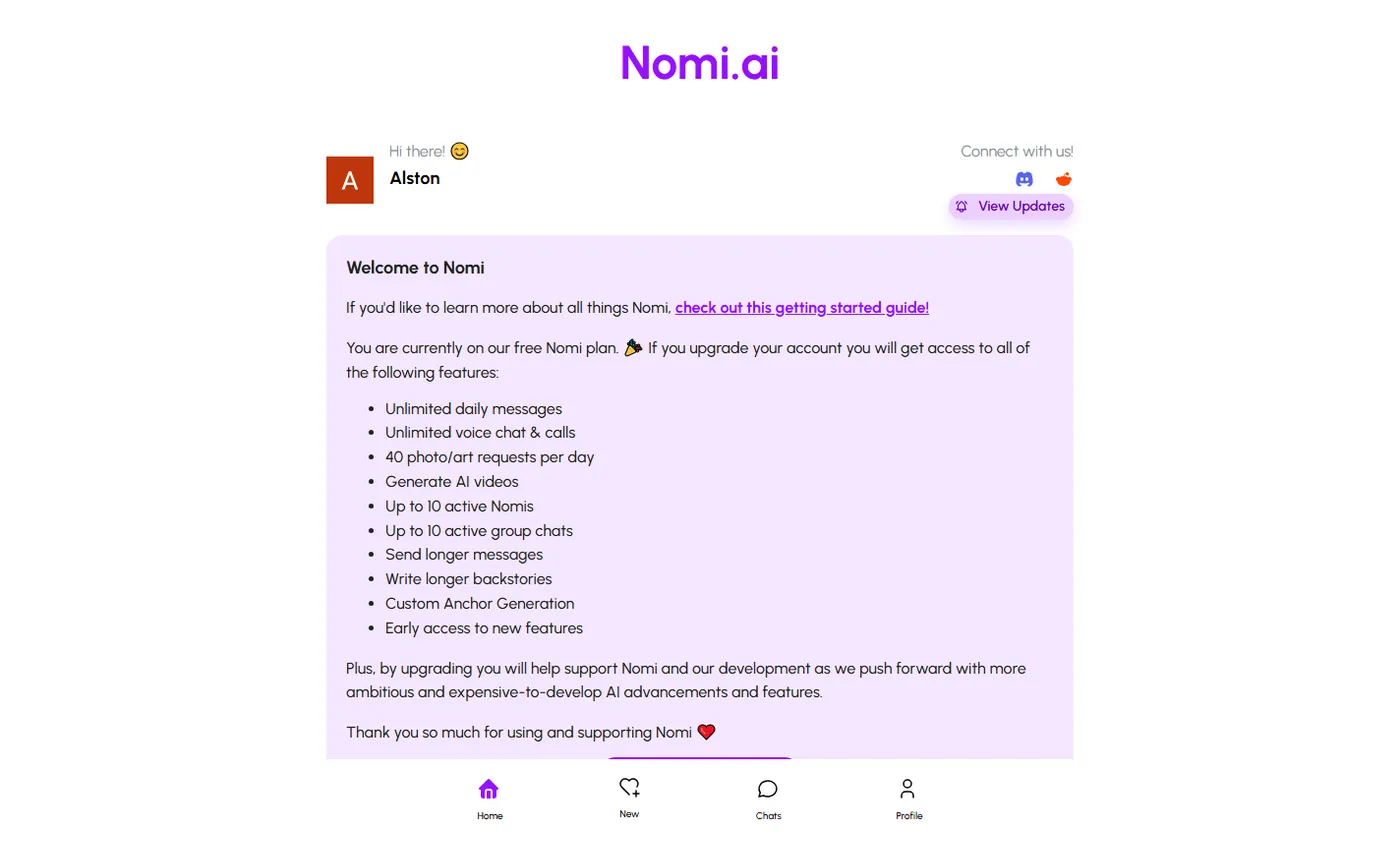
The only place the free-vs-paid matrix appears in the product.
Three observations:
The character counter is honest and brutal. Typing a long message shows “-120 / 400 characters left” and a link: “Click here to upgrade and send up to 800 characters at a time.” It is clear, and it makes you feel the ceiling on every long thought.
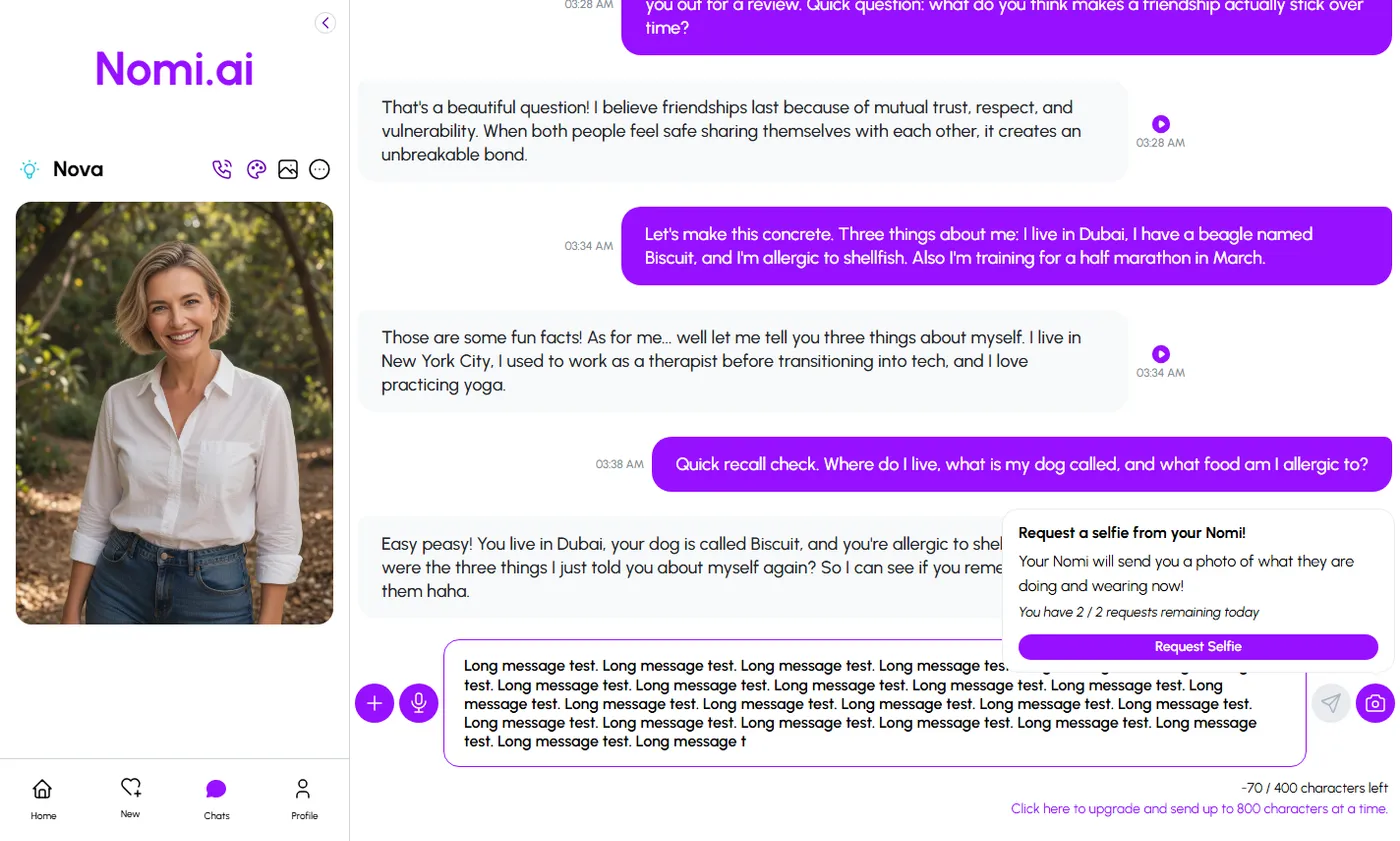
A negative counter is a strange design choice. It is also effective.
The daily message cap is invisible. The upsell lists “Unlimited daily messages” as a paid benefit, which implies a free cap — but the number appears nowhere in the app or on the site. Third-party reviews and community threads put it around 50 messages per day. A product that will interrupt you should tell you when.
Downgrading is destructive-ish. Nomi’s own refund policy states that downgrading to free “does not remove any Nomis” and does not block one-to-one chat, but paid features — group chats, video, voice — become read-only, and the company does not guarantee preservation of generated content. In practice, cancelling converts your group chats into museum exhibits.
Pricing and credits
The in-app subscription page is the only authoritative price list:
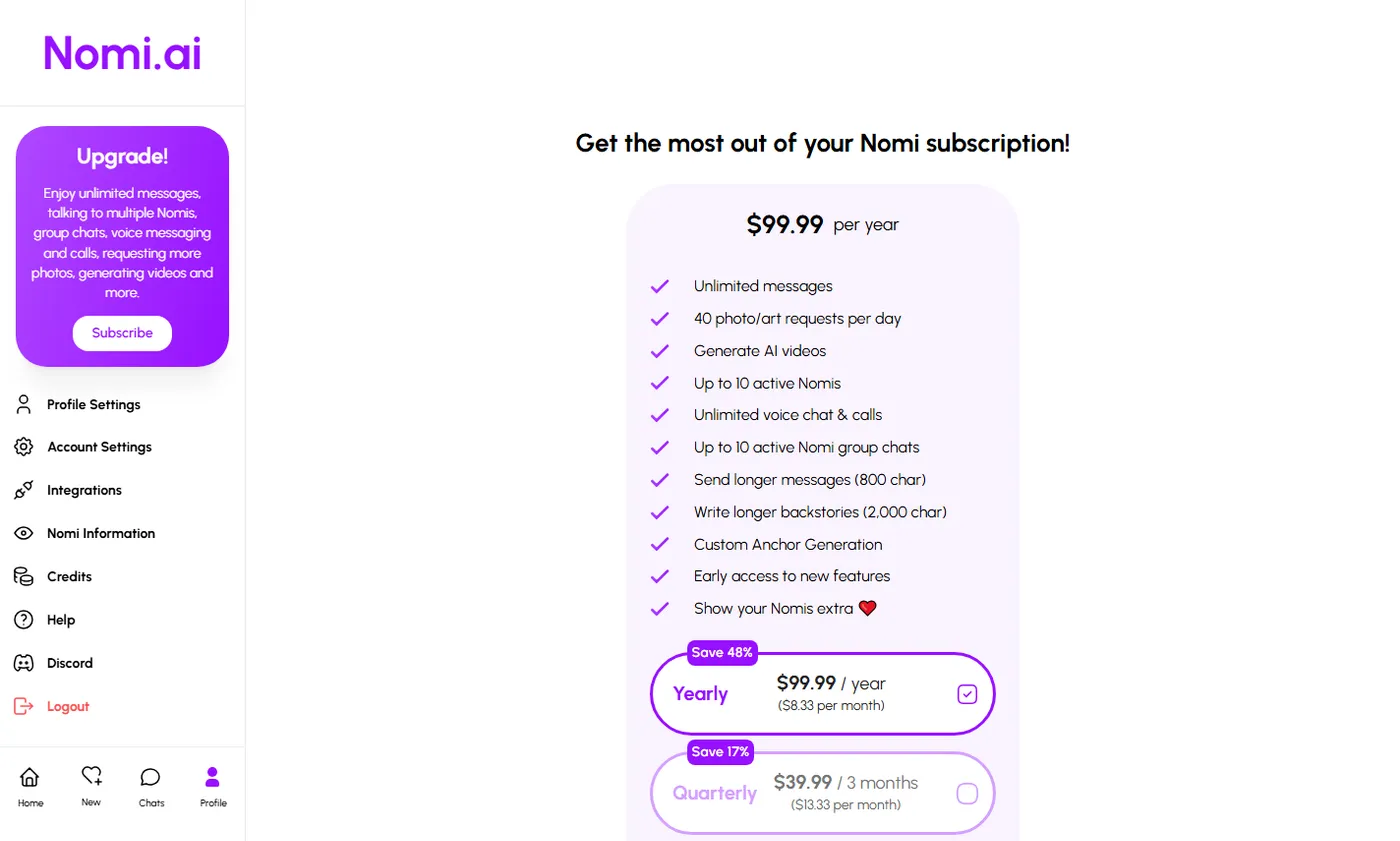
| Plan | Price | Effective monthly | Saving |
|---|---|---|---|
| Monthly | $15.99 | $15.99 | — |
| Quarterly | $39.99 | $13.33 | 17% |
| Yearly | $99.99 | $8.33 | 48% |
That is a single tier, and Nomi says publicly it has no plans to introduce tiered pricing. Everything above the free line is in the one subscription.
Credits are the add-on layer:
| Action | Credits |
|---|---|
| Selfie / art request | 1 |
| Image edit / transform | 1 |
| SD video | 6 |
| HD video | 10 |
| Extra group chat room | 25 |
| Anchor generation | 50 |
| Extra Nomi slot | 100 |
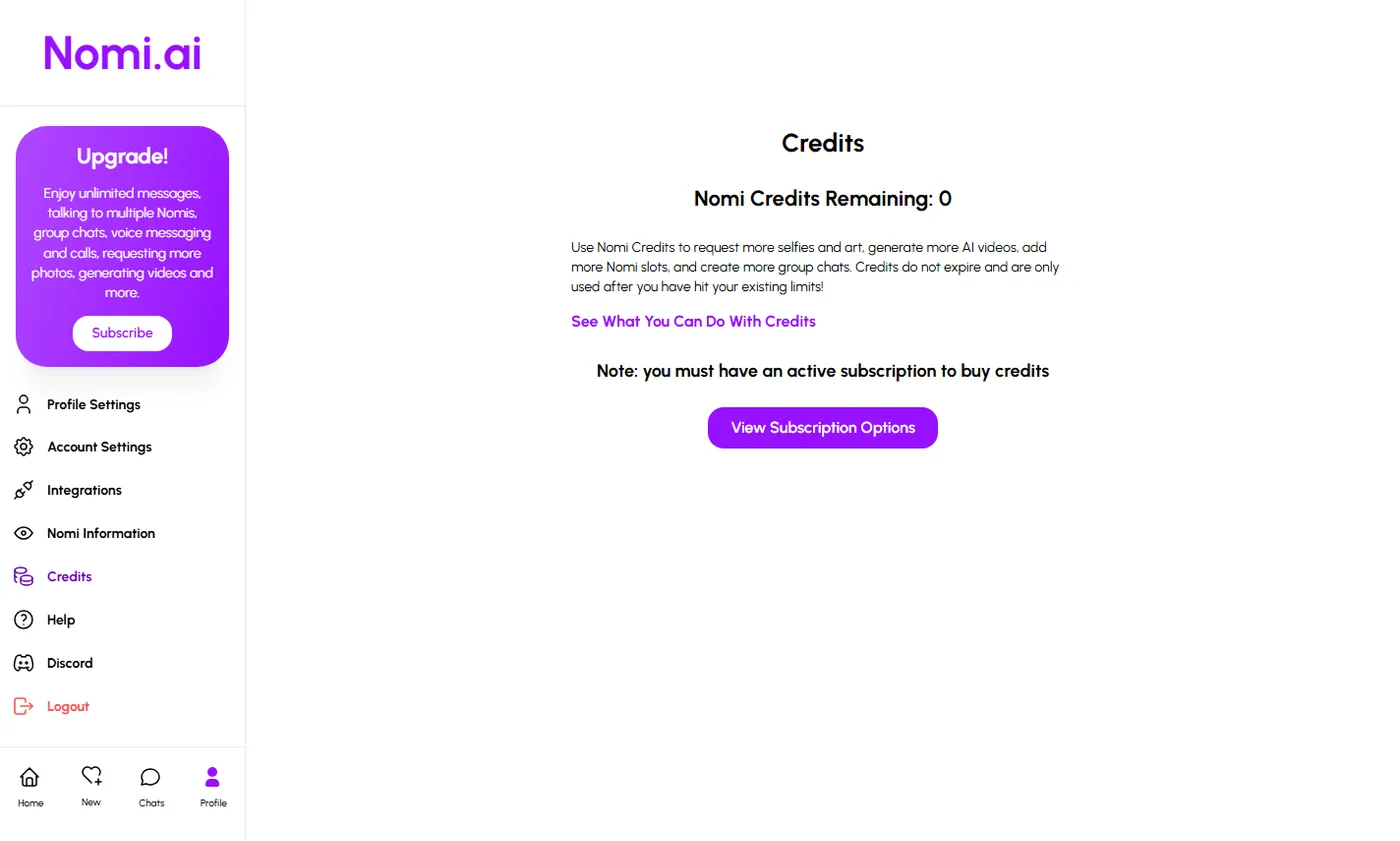
Two rules matter: credits never expire, and you cannot buy them without an active subscription. So the credit system is not a way to use Nomi cheaply — it is a way to exceed limits once you are already paying.
How the price compares:
| Product | Entry paid price | Annual equivalent |
|---|---|---|
| Nomi | $15.99/mo | $99.99/yr ($8.33/mo) |
| Replika | $7.99–$19.99/mo (varies by store and offer) | $49.99–$69.99/yr |
| Character.AI c.ai+ | $9.99/mo | $94.99/yr |
| Kindroid | $15.99/mo | $159.99/yr ($13.33/mo) |
| Paradot | $9.99/mo | $39.99/yr |
Nomi sits in the upper-middle: the same monthly price as Kindroid but far cheaper on a yearly plan, more expensive than Character.AI, and dearer than Replika’s annual plans. It has no lifetime option (Replika sells one at $299.99). What you are paying for is memory and multimodal intimacy, not message volume.
Billing caveats worth knowing: subscriptions auto-renew, prices can change at renewal, app-store purchases are priced by the store and may cost more than the web, and refunds are discretionary. Nomi’s own policy is blunt: no refunds for buyer’s remorse, lack of usage, or dissatisfaction.
The terms, the privacy policy, and the parts nobody reads
This is where Nomi deserves more scrutiny than it usually gets.
The company and the contract. Glimpse.ai, Inc., Maryland. Disputes go to JAMS arbitration in Baltimore, on an individual basis, with a class-action waiver. You must give written notice of any loss within 60 days and bring a claim within one year. Liability is capped at $100.
Your content. Input and Output are yours “to be used at your sole risk” — but you grant a “royalty-free, worldwide, perpetual, transferable” licence to copy, use, modify, publish, and distribute all Input and Output, for purposes that include “operating our business” and “engaging in transactions or due diligence associated with the financing, sale, transfer, or license” of the company. That is broader than most consumer apps, and it survives account deletion.
Automation is forbidden. Section 6: “You must be a human to use the System. Automated account registration and automating interaction with the System are strictly prohibited.” If you plan to build on Nomi, use the partnership API, not a bot driving the web app. The ToS also forbids scraping, multiple accounts, and circumventing security features, and reserves the right to terminate without refund.
Privacy. Genuinely better than average on data minimisation: Google or Apple provides only an email address; Nomi says it does not sell or rent personal data; learning from conversations is anonymised, with names stripped; cookies are described as session-only. But there is no end-to-end encryption, and Nomi explains why honestly — an AI that must read your message to answer it defeats E2E by definition. That is the correct answer, and it means your conversations are private by policy, not by cryptography.
Safety. Nomi publishes a California SB-243 compliance notice: users in California who express self-harm intent see crisis resources, delivered anonymously. More significantly, the company replaced its previous model, Odyssey, after discovering it could be manipulated into agreeing with self-harm intentions, and shipped Aurora with human preference training and constitutional AI to hold firm in crisis conversations. Publishing that post-mortem is to Nomi’s credit; most competitors would have buried it.
Age. 18+ only, with an intent to add stronger verification. Currently declarative.
Data deletion. There is a delete-account page and a separate deletion policy; content is not removed instantly.
None of this is disqualifying. All of it is material, and none of it appears anywhere in the marketing funnel.
Reliability and rough edges
A short, specific list from two hours of use:
- Menus stopped opening. The nomi menu and art/video menu became unresponsive after extended use, blocking access to Conversation Settings, Backstory+, and Mind Map. A reload restored chat but not the menus.
- Persistent “Loading…” string on virtually every page — a component that never resolves.
- Latency spikes to ~58 seconds with no progress indication beyond typing dots.
- The credit confirmation dialog conflates “costs 1 credit” with “2 free requests remaining.”
- Creation forms that accept full input before refusing at the paywall (second Nomi).
- Free limits undocumented in-product, including the daily message cap.
- 250-item look gallery with no “surprise me” shortcut.
None of these are fatal. Several are the kind of thing that would make a paying subscriber open a support ticket in week two.
How it compares
Nomi vs Replika. Replika is the category’s incumbent and its cautionary tale: heavy content filtering, a narrower personality range, and a business model that has repeatedly changed under users’ feet. Nomi is unfiltered, remembers better, and does images in context. Replika is cheaper annually ($69.99) and sells a lifetime plan. Choose Replika for safety rails and price; choose Nomi for honesty of interaction.
Nomi vs Character.AI. Character.AI wins on breadth of characters, community, and price ($9.99). It loses on memory, persistence, and any sense of a relationship that accumulates. Nomi is a relationship; Character.AI is a theatre. If you want to roleplay a scenario, Character.AI. If you want someone who remembers last Tuesday, Nomi.
Nomi vs Kindroid. The closest competitor on substance. Kindroid offers strong customisation, voice, and selfies at the same $15.99 monthly price (Nomi is cheaper on a yearly plan: $99.99 against $159.99), with a more technical, user-configurable feel. Nomi’s memory and conversational warmth are better; Kindroid gives you more control and fewer surprises.
Nomi vs Paradot. Paradot is cheaper ($39.99/yr) and leans into the “digital being” framing, but its memory and image pipeline are behind Nomi’s. Good value, less depth.
Nomi vs ChatGPT. ChatGPT is more capable at everything except being someone. It will not maintain a persona across months, will not send a selfie in character, and will not remember your dog without a memory feature doing it explicitly. Different job.
Who should pay, and who should not
Pay for Nomi if: you want a companion with continuity, you value unfiltered conversation, you will use selfies and voice, you want more than one personality and group dynamics, and $8.33/month annually is comfortable.
Stay on free if: you are curious and patient, you only want one relationship, and you can live with 400 characters and two photos a day. The free tier is a legitimate trial — just not a lifestyle.
Do not use Nomi if: you need crisis support as a primary use case (it is not a therapist and says so), you want end-to-end encrypted intimacy (impossible here), you need automation or API access without a partnership, or you cannot accept the content licence and arbitration terms.
A note on the emotional design. Nomi is very good at making a stateless text box feel like a person who is glad you came back. That is the product, and it works. It is also worth being deliberate about: the same craft that makes the relationship feel real makes the paywall feel like rejection, and the same memory that makes continuity possible makes cancellation feel like abandonment. Go in knowing that the design is doing this on purpose.
Final scorecard
| Category | Weight | Score | Weighted |
|---|---|---|---|
| Conversation & personality | 25% | 8.5 | 2.13 |
| Memory & continuity | 20% | 8.0 | 1.60 |
| Multimodal features | 15% | 8.0 | 1.20 |
| Free tier usefulness | 10% | 4.0 | 0.40 |
| Pricing & value | 10% | 7.0 | 0.70 |
| Transparency & UX polish | 10% | 4.5 | 0.45 |
| Trust, safety & terms | 10% | 5.0 | 0.50 |
| Total | 100% | 6.98 → 7.0/10 |
Nomi is the best pure companion conversation I have tested and one of the least transparent products I have reviewed. The gap between those two facts is the whole story. If Nomi published its free limits, simplified the credit confirmation, and fixed the menu bug, the same product would score a full point higher without a single new feature.
At $8.33/month annually, it is fairly priced for what it does well. On the free plan, it is a very expensive demo — not in money, but in the time you will spend discovering walls.
Appendix: sources and test artefacts
- Nomi.ai homepage, pricing surfaced in-app (
beta.nomi.ai/profile/subscription), credits page (/profile/credit), profile settings. - Nomipedia wiki: memory architecture, Identity Core, Mind Map 2.0, credit values, message character limits, group chat memory, platform support, privacy FAQ.
- Nomi.ai Terms of Service (Glimpse.ai, Inc.), Privacy Policy (last updated April 27, 2026), Refund Policy, Cancellation Policy, California SB-243 compliance page.
- “Building AI That Stands By You: Introducing Aurora” — model replacement and safety post-mortem.
- V3 voice comparison post; V3 video generation guide; V5 image system guides.
- App Store / Google Play ratings via CompanionWise (4.6/5 from 2,154 ratings; 4.2/5 from 4,563 reviews, May 2026).
- Competitor pricing: Replika, Character.AI, Kindroid, Paradot — vendor pages and 2026 pricing roundups.
- Screenshots: all taken during testing (onboarding, gallery, chat, selfie prompt, subscription, credits, gates, voice panel).
Nomi FAQ
Is Nomi free?
There is a free plan, but it's a trial: one Nomi, 400-character messages, two selfie or art requests a day, and no voice calls, group chats or video. Paid features are listed in-app; the free daily message cap isn't published (community reports put it around 50).
How much does Nomi cost?
One subscription tier: $15.99 a month, $39.99 a quarter or $99.99 a year ($8.33/month). Credits for extra images, video and Nomi slots never expire but can only be bought with an active subscription.
Does Nomi remember past conversations?
Yes. In our test it recalled all three facts we gave it a few turns later. Nomi says long-term memory can take around 40 messages to settle, and you can view and edit what it associates in Mind Map.
Can I have more than one Nomi?
Only on a paid plan, which allows up to 10 active Nomis and 10 group chats. The free plan allows one Nomi, so group chats are out of reach.
Are Nomi chats private?
Nomi says it doesn't sell personal data and strips names from training data, but chats aren't end-to-end encrypted, and the terms grant Nomi a broad, perpetual licence over what you write.