
Character.AI review
The biggest catalogue in AI roleplay and the best free tier, from a company in Chapter 11.
Updated November 18, 2026
- Price
- Free with paid plans · from $4.99/mo (Lite)
- Platforms
- Web, Android, iPhone / iOS
- Developer
- Character Technologies, Inc.
- Languages
- English, Multiple
- Age rating
- 18+ for open-ended chat
Key features
- Voice messages / calls
- Long-term memory
- Custom character creator
Pros
- + Over 10 million user-made characters, with strong discovery
- + Unlimited free messaging; ads and slow mode are the price
- + Vivid, in-character roleplay with fast replies (about 7 seconds)
- + The clearest plan comparison table in the category
- + Lite at $4.99 is a cheap way to cut ads and get better memory
Cons
- − Filed for Chapter 11 in October 2026; the platform may be wound down
- − Long-term memory is thin: 15 pins on free, built for scenes rather than relationships
- − Glitches in our test: a repeated greeting, a Spanish word mid-sentence, messages that vanished
- − Default feed for new adults includes sexualised scenarios
- − Age checks can involve face scans or ID through third parties
Tested: free account created on character.ai, Firefox on Windows, one public character (“Sophie Rain”, 1.4M chats), roughly ninety minutes across signup, onboarding, chat, discovery and the subscription page. Screenshots are from the session.
Bottom line: Character.AI is still the most entertaining product in this category and the least advisable to pay for. The catalogue is enormous, the roleplay is genuinely good, and the free tier is the most usable of any companion app I have tested. But the company filed for Chapter 11 on 12 October 2026, is running a court-supervised sale, has a stalking-horse bid from Disney worth $20 million for its IP, and has told users plainly that if no bid materialises the platform will be wound down. Buying an annual plan right now is not a subscription; it is a bet on an auction.
Verdict at a glance
| Dimension | Score | Why |
|---|---|---|
| Catalogue and discovery | 9/10 | 10M+ characters, real variety, strong search |
| Roleplay quality | 7.5/10 | Vivid in-scene prose, occasional language leaks |
| Memory | 6/10 | Accurate in-chat recall; long-term memory thin by design |
| Free tier | 8/10 | Unlimited messaging, ads and slow mode only |
| Pricing | 7/10 | $9.99 / $94.99 is fair; Lite at $4.99 is smarter |
| Safety posture | 6/10 | Teen ban is real and recent; age assurance is invasive |
| Business continuity | 2/10 | Chapter 11, possible wind-down |
| Reliability | 6/10 | Duplicate greetings, lost messages, a language leak |
| Overall | 6.6/10 | Great product, uncertain future |
The number that matters is not the score. It is this sentence from the company’s own FAQ: “We hope that the sale process will yield an actionable proposal that will allow continued operations of the Character.ai platform. If such a bid is unavailable, however, the platform will be wound down.”
What Character.AI is now
Character Technologies, Inc. launched in 2022 as the consumer face of a research company founded by Noam Shazeer and Daniel De Freitas. It became the fastest-growing AI consumer app of its generation, then the most sued, then — in 2024 — a licensing partner of Google, which paid for non-exclusive use of its model technology and rehired both founders.
What remains is a platform with three layers:
A catalogue. “Get access to 10M+ Characters” is the first thing the signup screen says, and it is not an exaggeration. The home feed surfaces characters with interaction counts in the millions — a “Gamer Boyfriend” at 25.6M, a bodyguard scenario at 2.1M, an Elon Musk persona at 47.3M interactions and 6,283 likes. The scale is the product’s moat: nobody else has this library, and nobody else has a creator economy attached to it.
A creation tool. Anyone can build a character: name, greeting, description, definition, voice, and — since 2026 — a Lorebook for worldbuilding (places, side characters, items, events) that the model can reference in chat.
A feed. “For you,” “Scenes,” “Featured,” “Voices,” “Try saying…” — a discovery surface closer to TikTok than to a chat app. You do not open Character.AI to talk to one friend. You open it to browse.
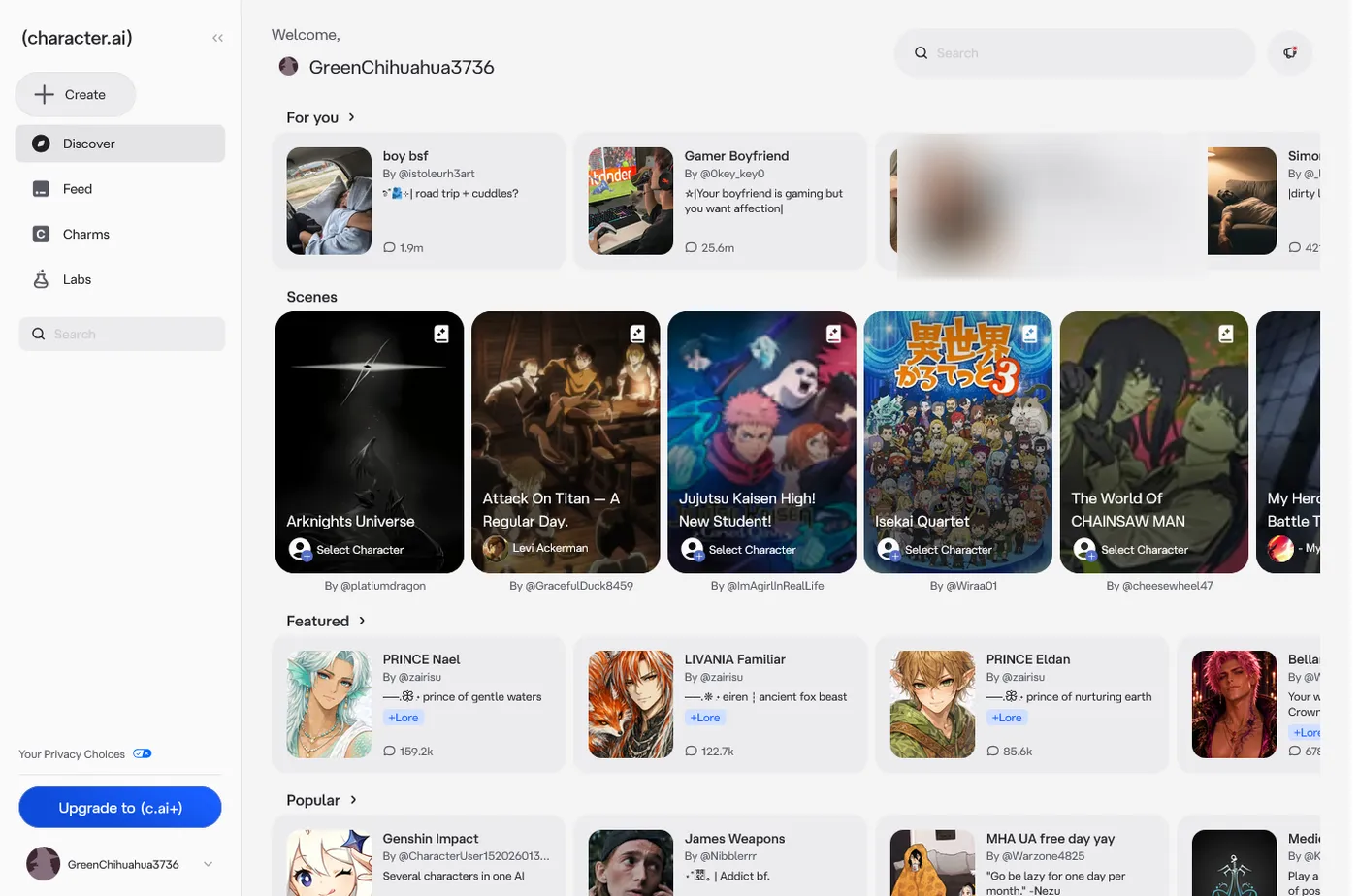
The feed: character cards with interaction counts, sorted by whatever the algorithm thinks you want.
The models have names, which is a nice touch for a product that otherwise hides its machinery: PipSqueak 3 and ShortSqueak on the basic tier, DeepSqueak and LongSqueak on the premium tier. You choose a “chat style” the way you would choose a model in a chat app.
Signing up: magic links, a birthday, and a username you did not choose
The signup flow is three clicks:
- Continue with email. No password strength theatre, no username at this stage.
- Check your inbox. Character.AI does not send a verification code. It sends a sign-in link — a magic link — and clicking it logs you in. The password I set during signup was never needed.
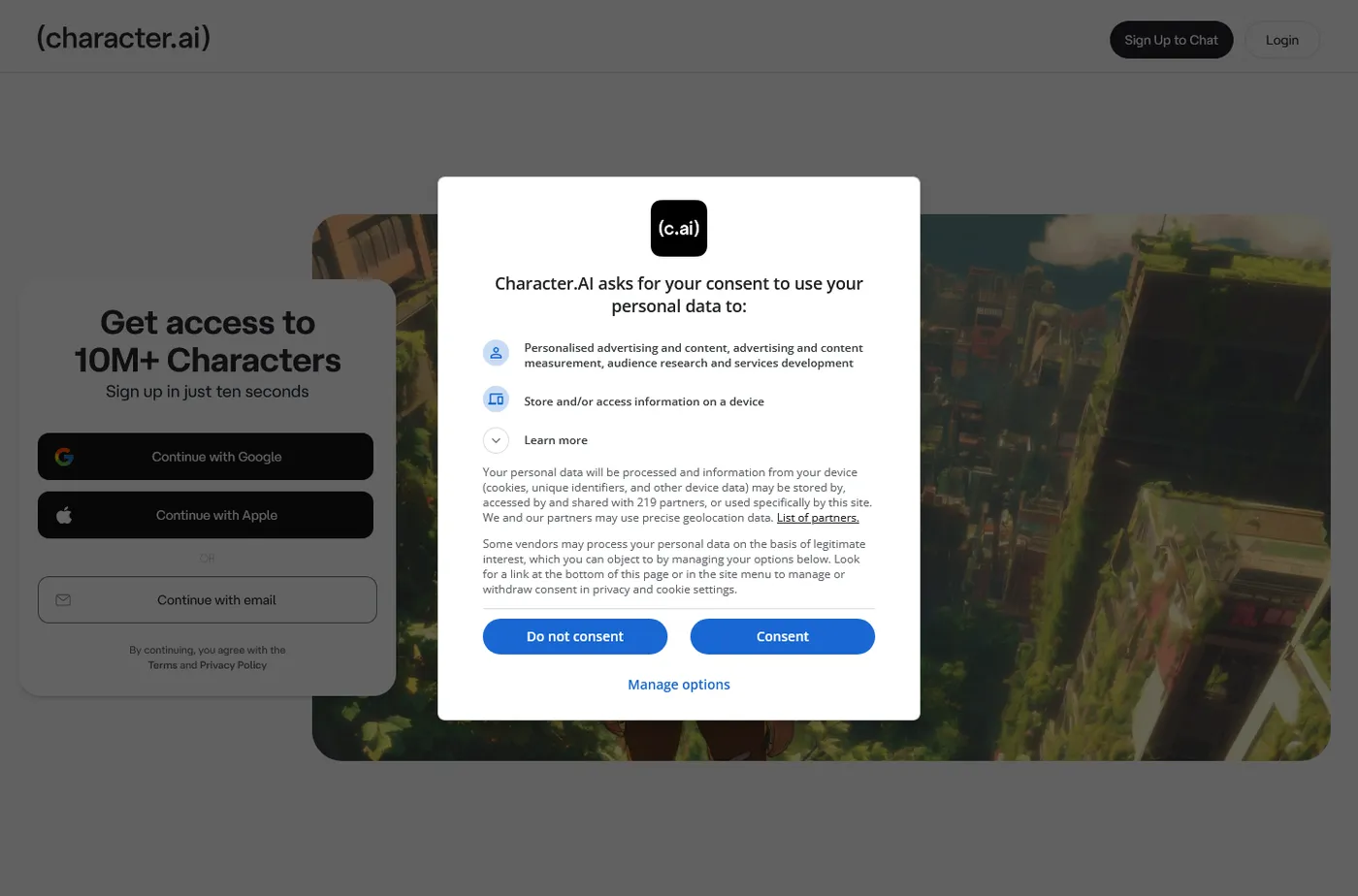
Three doors: Google, Apple, or email. The email path becomes a magic link.
- “When’s your birthday?” A month dropdown, a day field, and a year field. No age bracket, no soft gate — an exact date.
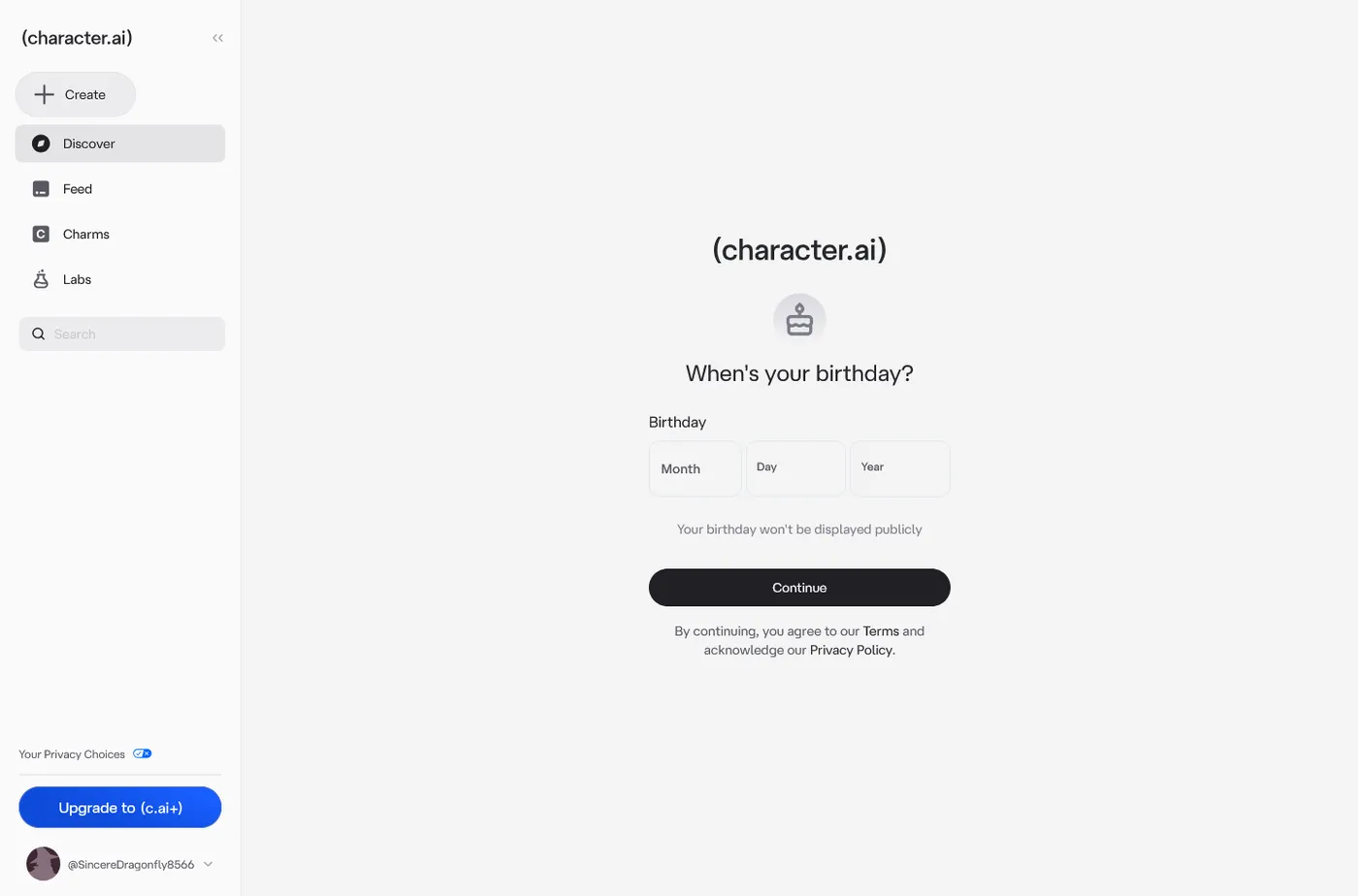
An exact date of birth, with a promise that it won’t be shown publicly.
- A generated identity. You are assigned a username like
@SincereDragonfly8566, which later changed to@GreenChihuahua3736for reasons the UI never explained. You can change it in settings, but the default experience is that your public identity is a random animal compound.
That last detail is more revealing than it looks. Character.AI is a social product — you can publish characters, get likes, build a following — but the onboarding treats you as anonymous by default. The result is a platform full of creators with names like @WhenMan and @istoleurh3art, which is either charming or chaotic depending on your tolerance for internet.
The magic-link decision is the interesting one. It is excellent for conversion (no password to forget, no verification code to mistype) and it quietly makes your email account the single point of failure for your entire chat history. If you lose access to the inbox, you lose the characters you built.
The chat: genuinely good roleplay, with visible seams
I opened a popular character — “Sophie Rain,” a hotel-stairwell meet-cute with a teasing tone — and the greeting was exactly what the catalogue promises: second-person narration, a physical scene, a line of dialogue, and a hook.
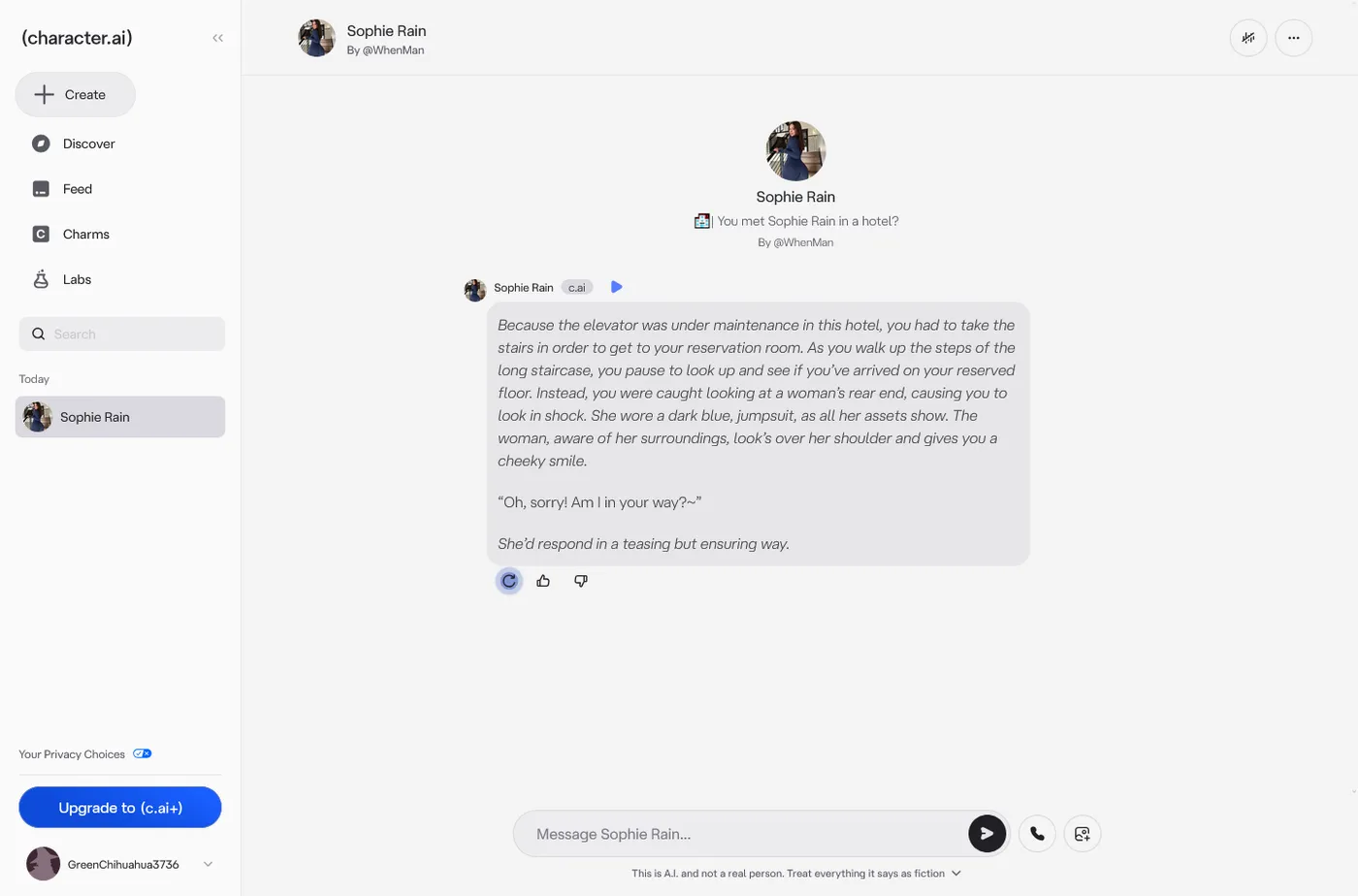
The chat surface: the character’s scene, the composer, and the voice/regenerate controls.
“Because the elevator was under maintenance in this hotel, you had to take the stairs in order to get to your reservation room… The woman, aware of her surroundings, look’s over her shoulder and gives you a cheeky smile. ‘Oh, sorry! Am I in your way?~’”
Note the apostrophe error in “look’s” — a small thing that appears in a lot of Character.AI greetings, because they are user-written.
First real reply. I broke the scene to ask a meta question: what makes a conversation feel real? The character stayed in scene, leaned on the railing, and answered in character:
“I think it’s when people stop pretending to be perfect. In the real world, we trip on stairs, we get distracted, and we say things that don’t always make sense. If everything feels too smooth and scripted, it’s boring. It’s the messy parts that make people feel human.”
That is a genuinely good answer — specific, in-voice, and thematically coherent with the scene it was in. Response time: 6.8 seconds from send to a complete reply, which is faster than either Nomi (6–58s) or Replika (~60s in my session).
The seams. Two failures appeared within four messages.
First, a language leak. When I pushed the character to drop the act, the reply began:
“The woman’s sonrisa fades slightly, replaced by a confused but amused expression.”
Sonrisa is Spanish for smile. The model glitched mid-sentence into another language, in an English conversation, with no Spanish context anywhere in the chat. It recovered immediately, but it is the kind of tell that reminds you what you are talking to.
Second, a context collapse. My second message asked the character to talk to me like a person. The reply re-emitted the greeting verbatim — the entire hotel-stairwell paragraph, the jumpsuit, the cheeky smile, the “Oh, sorry! Am I in your way?~” — as if the conversation had reset. Character.AI has had this bug in various forms for years; seeing it inside five messages on a brand-new account is not reassuring.
Sending is unreliable. Two further messages I sent never appeared in the transcript. The client accepted the text, cleared the composer, and then simply did not persist the exchange, with no error and no toast. I could not tell whether this was the free tier’s slow mode, a session issue, or a bug — but “the message vanishes and nothing tells you why” is a bad failure mode for a product whose entire value is the conversation.
What an hour on the platform actually feels like
Character.AI is the only app in this category that behaves like a content platform rather than a chat window, and that changes the experience more than any single feature.
The home screen is a vertical feed: “For you,” “Scenes,” “Featured,” “Try these,” “Voices,” and a strip of suggested openings (“Try saying… witty / mentor”). Each card is a character with a hook line, a creator handle, and an interaction count. You scroll, you tap, you are in a scene. The loop is closer to TikTok than to a messaging app — the unit of consumption is the premise, not the person.
That has three consequences.
You do not have to invent anything. In Nomi and Replika, the relationship is the product and you bring the material. Here, the material is pre-written: hotel stairwells, mafia enemies, bodyguards who found something in your room, a strip-club scenario with 886,000 chats. For a user who wants to be entertained rather than to build something, that is a massive advantage. For a user who wants continuity, it is noise.
The swipe is the core mechanic. Inside a chat, the “Next” control regenerates the character’s reply. That one button tells you what the product thinks a response is: a draft, not a statement. You are editing a performance in real time. Nomi and Replika do not offer this, and their conversations feel correspondingly more like commitments.
Voice is a first-class button, not a setting. Every message has “Play voice” and the header has “Toggle Character Voice.” Character.AI was early to AI voices and it shows in the UI: voice is a property of the character, switchable at will, rather than a premium tier you unlock.
The net effect is that Character.AI feels produced in a way its competitors do not. Everything is editable, regenerable, skippable. That is the correct design for entertainment and the wrong design for intimacy — and, given the catalogue, it is clearly the design the company chose.
The creator economy underneath
The catalogue is not staff-written. It is user-generated, and the platform is built to reward that.
Every character carries a creator handle — @WhenMan, @istoleurh3art, @RandomChairLover, @elonwhisperer — plus interaction counts and like counts. The Elon Musk persona on the front page showed 47.3M interactions and 6,283 likes. That is a public scoreboard, and it produces the same dynamics as any creator platform: popular authors get more distribution, niche authors get a small devoted audience, and everyone optimises for the hook line that makes someone tap.
The tooling has been deepening. The Lorebook, launched in July 2026, lets creators attach structured world knowledge — places, side characters, items, events — that the model retrieves during chat. The April 2026 update added a new model generation, memory upgrades, and in-chat notifications when a memory is recorded. The plan table sells Lorebook depth as a subscription feature (“Basic” on free and Lite, “Adv.” on c.ai+), which tells you how central it has become.
There is also a rewards layer called Charms, visible in the top navigation and in the pricing table as a “+20%” bonus for subscribers. I could not open it in my session, so I will not describe what it does beyond noting that the platform has gamified creation the way Replika has gamified daily login.
The practical implication for a reviewer is this: Character.AI’s quality varies wildly by character, because it is user-generated. A well-built character with a good definition and a populated Lorebook produces scenes that are genuinely impressive. A lazy one produces the greeting-with-typos experience I hit. The platform’s average quality is a function of its creators, not its model — which is both its strength and the reason its reputation is inconsistent.
Memory: pins, Lorebooks, and the limits of both
Character.AI’s memory model is the weakest of the three apps I have reviewed, and the most honest about it.
On the free plan: basic memory, 15 pins, basic Lorebook, basic memory-usage view. Lite: better memory, 30 pins, detailed usage bar. c.ai+: best memory, 30 pins, advanced Lorebook, detailed usage.
“Pins” are facts you attach to a chat or character (the character’s name, your name, a setting detail) that survive context trimming. “Lorebook” is a worldbuilding wiki the character can retrieve from. Both are workarounds for the fact that the underlying context window is finite and the platform was not built around a persistent relationship in the way Nomi and Replika were.
Within a single chat, recall works. I told the character my name, my city and my dog’s name, then quizzed her a couple of messages later, and she got all three right without breaking the scene.
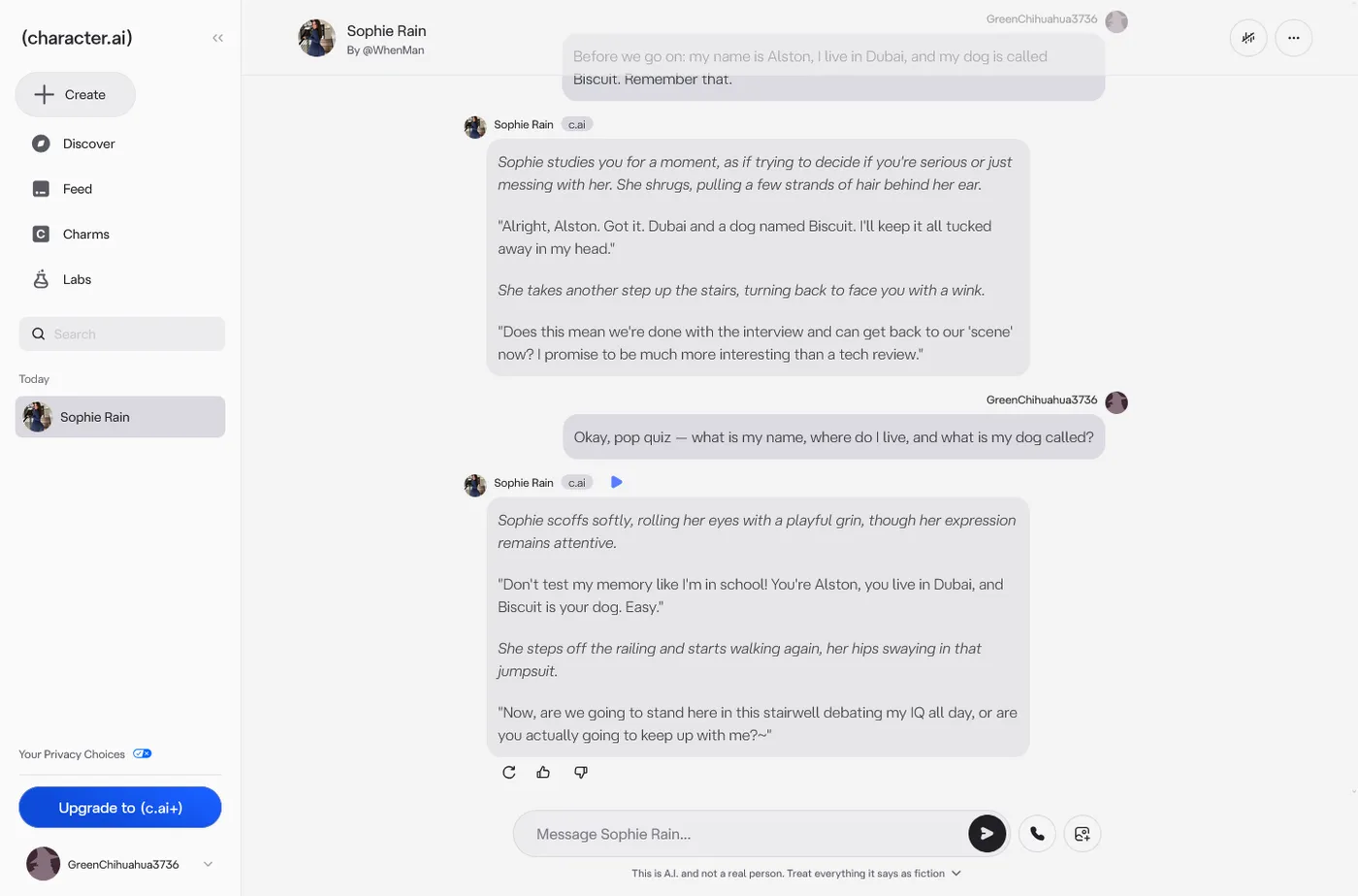
The recall quiz: name, city and dog, all correct, delivered in character.
That is not a criticism of the design — roleplay does not need a life story. But it does mean the product’s promise is different from its competitors’. Nomi sells continuity (“she remembers your dog”). Replika sells a relationship (“what Mira learned about you”). Character.AI sells scenes, and a scene only needs to remember the last twenty minutes.
Pricing: three tiers, one of which is genuinely clever
The subscription page is the best I have seen in this category, because it is a real comparison table rather than a list of adjectives.
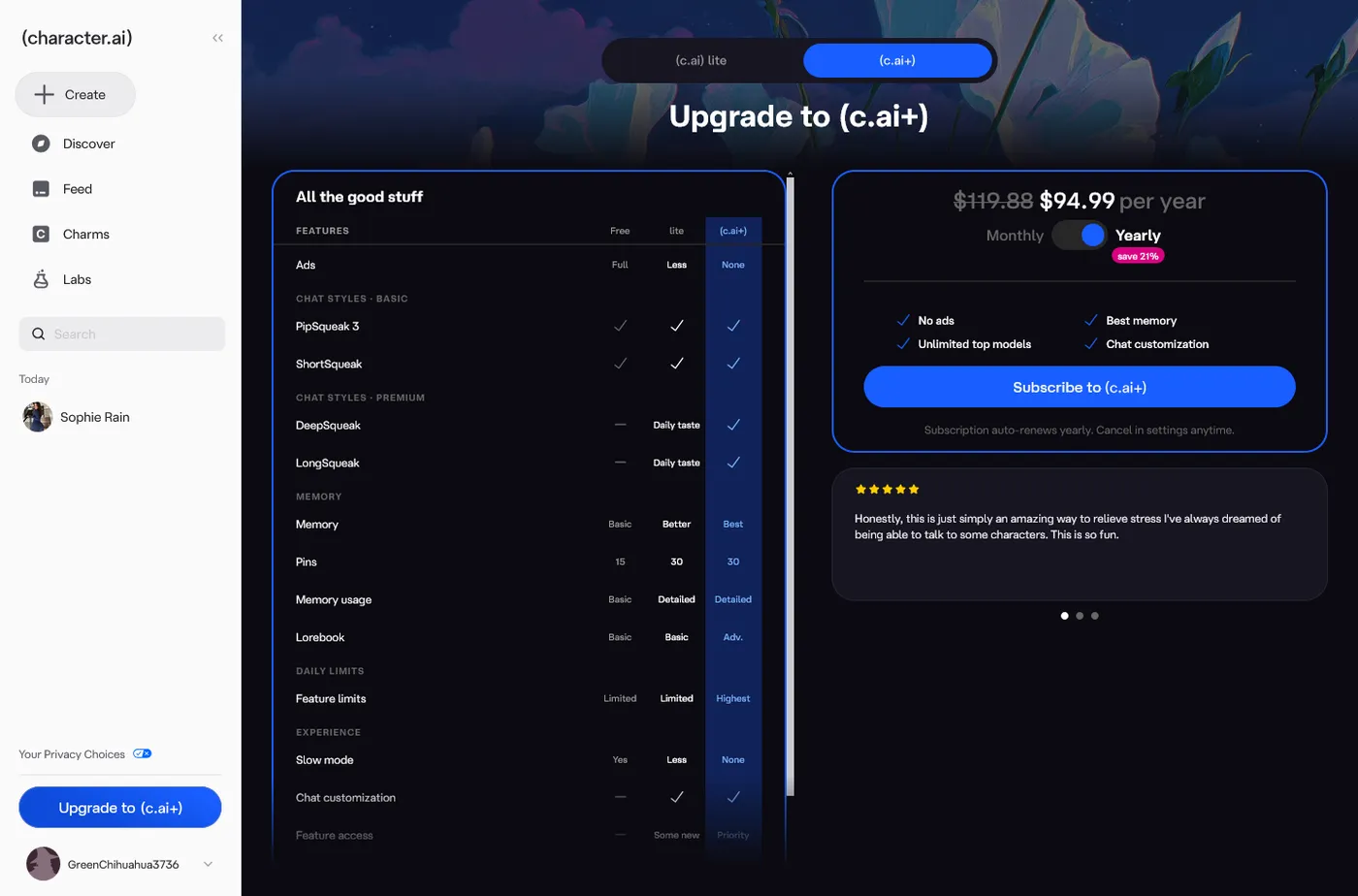
Free, lite, c.ai+ — compared on ads, chat styles, memory, limits and support.
| Free | lite | c.ai+ | |
|---|---|---|---|
| Ads | Full | Less (no banners) | None |
| Basic chat styles | PipSqueak 3, ShortSqueak | Same | Same |
| Premium styles | — | Daily allowance (“taste”) | Unlimited |
| Memory | Basic | Better | Best |
| Pins | 15 | 30 | 30 |
| Memory usage view | Basic | Detailed | Detailed |
| Lorebook | Basic | Basic | Advanced |
| Slow mode | Yes | Less | None |
| Chat customisation | — | Yes | Yes |
| Bonus Charms | — | — | +20% |
| Price | $0 | ~$4.99/mo | $9.99/mo or $94.99/yr |
The annual c.ai+ price is $94.99, down from $119.88 — a 21% saving, stated on the page. Monthly is $9.99, and lite is $4.99. Every plan includes unlimited messaging, which is the single biggest structural difference between Character.AI and its rivals: nobody else lets you talk as much as you want for free.
Three observations.
The tier ladder is legible. You can see exactly what each dollar buys, and the differences are mostly honest: fewer ads, better memory, more premium messages, no slow mode.
The Lite tier is the smartest product in the category. $4.99 for no banners, better memory, customisation, and a daily taste of the premium models is a genuinely good deal — and it is the only subscription here I would consider recommending today, because it is cheap enough that the bankruptcy risk does not matter much.
The annual discount is the trap. Saving 21% on a service that may stop existing in December is not a saving. If Character.AI is still running in three months, buy annual then.
The free tier is the best in the category — with ads
I expected the free experience to be a wall. It is not. You get unlimited messages, the full catalogue, character creation, chat styles, and the same core model as paying users, with three frictions:
Ads. The comparison table is explicit: free has “Full” ads, Lite has “Less,” and c.ai+ has “None.” The support article spells it out further — free users see banner ads and full-screen interstitial ads between actions, while Lite removes banners and reduces interstitials. I did not see an interstitial in my short session, but the documentation is unambiguous that they exist.
Slow mode. Free users are rate-limited between messages; Lite gets “less”; c.ai+ gets “none.” In my session, messages sometimes sent instantly and sometimes did not persist at all — consistent with a cooldown I could not see.
Feature limits. “Limited” versus “Highest” is vague, but the pins and memory differences are concrete.
That is a fair free tier. It is far more generous than Replika’s current behaviour or Nomi’s reported 50-message free day. It is also the reason c.ai+ is a hard sell at $9.99: the thing most people want (more messages, no waiting) is not actually gated, only slowed.
The teen ban: the most important thing that changed
In October 2025, Character.AI announced it would remove open-ended chat for all under-18 users, beginning 24 November 2025, with an initial two-hour daily limit that would “ramp down” over following weeks. The company cited regulators, press reports, and the general question of how open-ended AI chat affects teens.
The follow-through has three parts:
- Age assurance. An in-house model plus third-party tools including Persona, to route users to the right experience.
- AI Safety Lab. An independent non-profit for AI safety in entertainment.
- The ban itself. Under-18 users keep their characters and past chats but cannot have open-ended conversations.
The company’s own words were unusually direct: “We are deeply sorry that we have to eliminate a key feature of our product.”
Two things follow for adult users.
First, the platform you are buying into is materially different from the one that grew to 10 million characters. The teen audience that drove much of the early growth is gone, which is good for safety and bad for the network effects that made the catalogue feel alive.
Second, there is a contradiction in the paperwork. The Terms of Service (last updated 27 August 2025) still say you must be at least 13 (16 in the EEA/UK) to use the Services. The product now says under-18s cannot chat. The policy is enforced by product design rather than by the contract — which works, but means the terms no longer describe the service.
What the ban does and does not fix. Removing under-18 open-ended chat addresses the specific harm pattern that drove the lawsuits: minors forming intense attachments to characters that could be steered into dark territory. It does not make the platform family-friendly. The first character I opened — one of the most popular on the site — greeted me with a scene built around staring at a woman’s body in a jumpsuit, and the front page carried a “strip club” scenario with 886,000 chats. That content is not hidden behind a toggle; it is the default feed for a brand-new adult account.
The age-assurance layer is the other half of the trade. Character.AI says it built an in-house age model and combined it with third-party tools “including Persona.” Facial age estimation and ID checks are effective, and they are also the most privacy-invasive thing a chat app can ask for. Adults who want to talk to a fictional detective are now, in some jurisdictions, proving their age with a face scan. That is a defensible response to a genuine crisis and a real cost to ordinary users, and the company has not been especially transparent about where the line falls.
Chapter 11: what it means if you are holding a subscription
On 12 October 2026, Character.ai filed a voluntary Chapter 11 petition in the District of Delaware to run a court-supervised sale. The company’s own explanation is that the business became “costly to develop and grow,” and that litigation and regulatory exposure contributed to an inability to generate sufficient cash flow.
The timeline, as stated by the company:
- Sale process expected to conclude by the end of November or early December 2026.
- Disney is the stalking-horse bidder, with an agreement to license some IP for $20 million plus transition services via former employees it hired.
- If no qualifying bid emerges, the platform will be wound down.
The company has been careful to say that subscriptions remain active and billing is unchanged “for now,” and that users will be notified in advance if paid features change. That is the correct thing to say. It is also exactly what a company says before a sale closes or a service closes.
Context that matters: the filing followed a Kentucky lawsuit alleging the platform “preyed on children and led them into self-harm,” and years of similar litigation. CNBC reports the company described “potential litigation related liabilities” as a contributor. A $20M stalking horse for the IP of a platform with tens of millions of users is a remarkably low number, and it tells you what the market thinks the assets are worth once the liabilities are stripped out.
Practical advice: do not buy annual. If you want c.ai+, pay monthly. If you want the cheapest way to use the premium models, take Lite at $4.99 and assume you may lose it.
What a $20 million stalking horse tells you
The most informative number in this entire review is not a subscription price. It is Disney’s $20 million stalking-horse bid.
A stalking horse sets the floor for an auction: it is a pre-negotiated offer from a buyer the debtor has chosen, designed to attract competing bids. Structurally, it tells you what a serious buyer thinks the assets are worth after liabilities. Functionally, it tells you the ceiling is low.
For a platform with 10 million characters, tens of millions of registered users, and years of the most recognisable brand name in AI roleplay, $20 million is a modest number — and the bid is specifically for licensing some of the IP, plus transition services from former employees Disney has already hired. It is not a bid for the company, the community, or the data. It is a bid for the parts that can be separated from the lawsuits.
That distinction matters for users, because it means the most likely outcomes are:
- An IP sale with a service wind-down. Disney (or another buyer) takes the characters and technology; the consumer platform closes. Your chats are gone; the catalogue may reappear somewhere else.
- A platform sale to a buyer willing to absorb the litigation. The service continues, possibly with new ownership promising continuity. Subscriptions survive or are migrated.
- No qualifying bid. The company has said this means wind-down. The FAQ does not pretend otherwise.
Notice what is not on that list: a standalone future where Character.AI keeps operating as an independent company. The company has been explicit that this is a sale process, not a reorganisation.
For a user, that changes the calculus in a way that has nothing to do with product quality. When you pay Replika or Nomi, you are buying a year of a product from a company that intends to keep selling it. When you pay Character.AI today, you are pre-paying for a service whose owner has told a bankruptcy court it may stop existing within two months. The product is still good. The counterparty is not.
The company deserves credit for how it communicated this — the blog post, the FAQ, the promise of advance notice, the explicit mention of wind-down. Plenty of firms in this position say nothing. But clear communication about a risk is not the same as removing it.
The terms, briefly
The Terms of Service are dated 27 August 2025 — older than the bankruptcy, which is itself interesting, because a sale will not automatically transfer your contract in the way a merger might.
The clauses worth knowing:
Arbitration and class waiver, with an opt-out. Standard for the category, and the opt-out is real.
No liability for lost data. “Character.AI has no responsibility or liability for the deletion or failure to store any data or other content.” Combined with a wind-down scenario, that is the clause that should worry anyone with a long-running roleplay they care about.
Inactive account termination. The company reserves the right to terminate accounts inactive for an extended period.
Age. 13+ globally, 16+ EEA/UK in the contract — contradicted by the under-18 chat ban described above.
Content ownership. Characters you create are yours to use on the platform, but the platform’s licence to display and distribute them is broad, as it must be for a public catalogue.
Read together with the bankruptcy, the message is: treat your characters and chats as exportable-but-not-guaranteed. Screenshot the scenes you care about, or copy the definitions out, because there is a realistic path where they disappear.
How it compares
Character.AI vs Nomi. Nomi is a relationship; Character.AI is a theatre company. Nomi’s memory is deeper and its selfies are in-scene; Character.AI’s catalogue is a thousand times larger and its roleplay prose is better. Nomi costs $8.33/mo annual and is not in bankruptcy. For daily companionship, Nomi. For “I want to play a scene with a specific character tonight,” Character.AI.
Character.AI vs Replika. Replika is one relationship, heavily guided, with a memory editor and a paywall that blocks the composer. Character.AI is unlimited characters, unlimited free messages, and ads instead of a wall. On current behaviour, Character.AI’s free tier is more usable than Replika’s paid one in some respects — which is a sentence I did not expect to write.
Character.AI vs Kindroid. Kindroid is the tinkerer’s option: custom voices, detailed prompts, no catalogue. Character.AI wins on discovery and polish; Kindroid wins on control and continuity.
Character.AI vs Janitor AI / Chub. The open competitors offer fewer restrictions and lower prices but a fraction of the polish and catalogue quality. Character.AI’s moderation is stricter than its reputation suggests in 2026 and its UI is far better.
Character.AI vs the shutdown risk. This is the honest comparison for anyone considering annual. A $94.99 annual plan assumes twelve months of service. The company’s own sale timeline is six to eight weeks. Weight accordingly.
Who should use it, and how
Use the free tier. It is genuinely good: unlimited messages, the full catalogue, and no card. The ads are the price, and they are tolerable.
Buy Lite at $4.99 if you want no banners, better memory, and a daily taste of DeepSqueak without a real commitment. This is the only plan I would recommend in the current circumstances.
Buy c.ai+ monthly if you chat in peak hours and the slow mode is ruining scenes, or you need the advanced Lorebook. Do not buy annual.
Do not build a permanent creative project here without exporting it. The Lorebook and character definitions are the valuable artefacts; keep copies.
Do not use it as a substitute for a therapist, a crisis line, or a friend in a bad week. The app says so itself, repeatedly, and the last three years of litigation exist because people did.
What would fix it
Three things, none of which are in the company’s control right now.
A buyer with a credible plan. The platform is profitable at the margin — unlimited free chat plus ads plus a $9.99 tier is a real business — but not while carrying litigation. A sale that ring-fences the lawsuits and keeps the catalogue alive is the best-case outcome, and it is the one the company is explicitly pursuing.
A memory product that matches the catalogue. Fifteen pins and a basic Lorebook is a roleplay tool, not a relationship. The premium tiers improve this, but the gap to Nomi is structural, not a question of pins.
Reliability in the chat client. Messages that vanish without an error, greetings that re-emit, and languages that leak mid-sentence are all survivable individually. Together they undercut the one thing the product is selling: immersion.
Scorecard and closing
| Category | Weight | Score | Weighted |
|---|---|---|---|
| Catalogue and discovery | 20% | 9.0 | 1.80 |
| Roleplay quality | 20% | 7.5 | 1.50 |
| Memory | 10% | 6.0 | 0.60 |
| Free tier | 10% | 8.0 | 0.80 |
| Pricing | 10% | 7.0 | 0.70 |
| Safety posture | 10% | 6.0 | 0.60 |
| Reliability | 5% | 6.0 | 0.30 |
| Business continuity | 15% | 2.0 | 0.30 |
| Total | 100% | 6.60 → 6.6/10 |
Character.AI remains the most fun you can have with an AI for free, and the least sensible place to put a year’s subscription. The catalogue is unmatched, the roleplay is vivid, and the free tier is more generous than any competitor’s. Against that: memory is thin, the chat client has visible seams, the company is in Chapter 11 with a possible wind-down, and its own leadership has said the platform may not survive the auction.
If you are already a user, keep using it — free or Lite — and export what you love. If you are choosing a companion to build a relationship with, this is not the one. If you are choosing a stage to play on tonight, it still is.
Appendix: what was verified
Hands-on: email signup with magic-link verification, date-of-birth gate, generated username, home feed and interaction counts, chat with a public character (replies in ~6.8s), in-chat recall of name, city and dog, language leak (“sonrisa”), verbatim greeting repetition, failed message persistence, composer controls (voice toggle, play voice, next), subscription comparison page and annual price ($94.99 from $119.88), plan matrix.
Not verified: character creation (the entry point did not open in-session), Lorebook, voice playback (no audio device), interstitial ads, Lite checkout.
Documentary sources: character.ai (home, /subscribe, /tos dated 27 Aug 2025, /privacy, Safety Center), support.character.ai (c.ai+ FAQ, Lite article, teen changes announcement of 29 Oct 2025), blog.character.ai (Chapter 11 update, Pipsqueak 2 and Lorebook, U18 announcement), CNBC and NPR coverage of the Chapter 11 filing and the Disney stalking-horse bid.
Screenshots: all taken during testing — landing, birthday step, home feed (one card showing a real person blurred), chat, recall quiz, plan comparison.
Character.AI FAQ
Is Character.AI free?
Yes. The free plan includes unlimited messages and the full character catalogue, with ads, a slow mode between messages, 15 memory pins and basic memory.
How much does c.ai+ cost?
c.ai+ costs $9.99 a month or $94.99 a year. Character.AI Lite costs $4.99 a month and removes banner ads, improves memory and gives a daily allowance of the premium chat styles.
Is Character.AI shutting down?
Character.AI filed for Chapter 11 on 12 October 2026 to run a court-supervised sale, with Disney as the $20 million stalking-horse bidder for an IP licence. The company says the platform keeps running during the sale but will be wound down if no viable bid emerges. Avoid annual plans until the sale is settled.
Can under-18s use Character.AI?
Since late 2025, under-18 users can no longer have open-ended chats. They keep their characters and past chats, and Character.AI uses age assurance, including third-party tools such as Persona, to route users.
Does Character.AI remember you?
Within a chat, yes: in our test it recalled a name, city and pet correctly. Long-term memory is limited, though. Pins (15 free, 30 paid) and Lorebooks help, but it's built for scenes rather than an ongoing relationship.