
Candy.ai review
A polished adult platform of chat, shorts and live cams that gives free users five messages.
Updated November 18, 2026
- Price
- Free with paid plans · from $13.99/mo
- Platforms
- Web
- Developer
- EverAI Limited
- Languages
- English
- Age rating
- 18+
Key features
- Voice messages / calls
- Long-term memory
- Image / selfie generation
- Custom character creator
Pros
- + Polished platform: characters, episodic shorts and private content in one app
- + Well-written opening scenes with a clear hook
- + Deep persona and memory controls, including Auto Memory
- + Annual plan is $3.99/month and renews at the same price
- + Named operator in Malta (EverAI Limited), so EU consumer law applies
Cons
- − Free users get 5 messages in total, disclosed only in the terms
- − A persona pop-up covered the chat, hiding the replies
- − 100 tokens a month that expire, with no published token prices
- − Weekly and 2-week plans work out at $19–22 a month
- − Failed renewals can be charged to a backup payment method
Tested: free account created on candy.ai, Firefox on Windows, one catalogue character (“Odette Solberg”), roughly two hours across signup, discovery, chat, persona settings, the paywall and the terms. Screenshots are from the session.
Bottom line: Candy.ai is the most commercially sophisticated product in this category and the least generous at the door. Its own Terms of Service state that a free user “may generally send a maximum of 5 messages to AI Characters.” Five. Not per day — in total, before a subscription. That number appears nowhere on the pricing page, and it is the single most important fact about the product that a new user is not told.
Verdict at a glance
| Dimension | Score | Why |
|---|---|---|
| Product surface | 8/10 | Shorts, cams, private content, character pages — a real platform |
| Discovery and design | 8/10 | Polished, fast, consistent art direction |
| Free tier | 2/10 | Five messages, documented in the ToS only |
| Conversation quality | 6/10 | Not verifiable in-session; scored on documentation and design |
| Media and tokens | 6/10 | 100 tokens/month, expiring, no carry-over |
| Pricing mechanics | 4/10 | Weekly and fortnightly plans, discount anchors, geo-variable |
| Trust and terms | 4.5/10 | Training licence, no refunds, backup-payment clause |
| Overall | 5.8/10 | Excellent product, hostile funnel |
This is the inverse of Character.AI. There, the free tier is generous and the company is in bankruptcy. Here, the company is a Malta-registered operator with a real business, and the free tier exists only to show you the door.
What Candy.ai is
Candy.ai is owned and operated by EverAI Limited, incorporated in Malta (registry C107181, 56 Central Business Centre, Santa Venera). It presents itself as “the largest AI girlfriend platform,” with a homepage claim of being “trusted by 50 million users” and over a thousand ratings.
The product is broader than chat. The signed-in navigation alone tells you what kind of company this is:
Home · Discover · Shorts · Chat · Collection · Create Character · My AI · Private Content · Premium
That is a content platform with a companion engine inside it, not a companion app with a shop attached.
- Shorts is a scripted episodic series library — “My Step-Sister’s Dormitory, 5 episodes,” “Student Bodies,” and so on — playable like a streaming service.
- Discover mixes hero banners, character promos with “CHAT NOW” buttons, and Candy Cams, a live section where performers are “live right now — jump in, chat and tip in real time.”
- Private Content is a login-gated library.
- Create Character and My AI are the customisation layer.
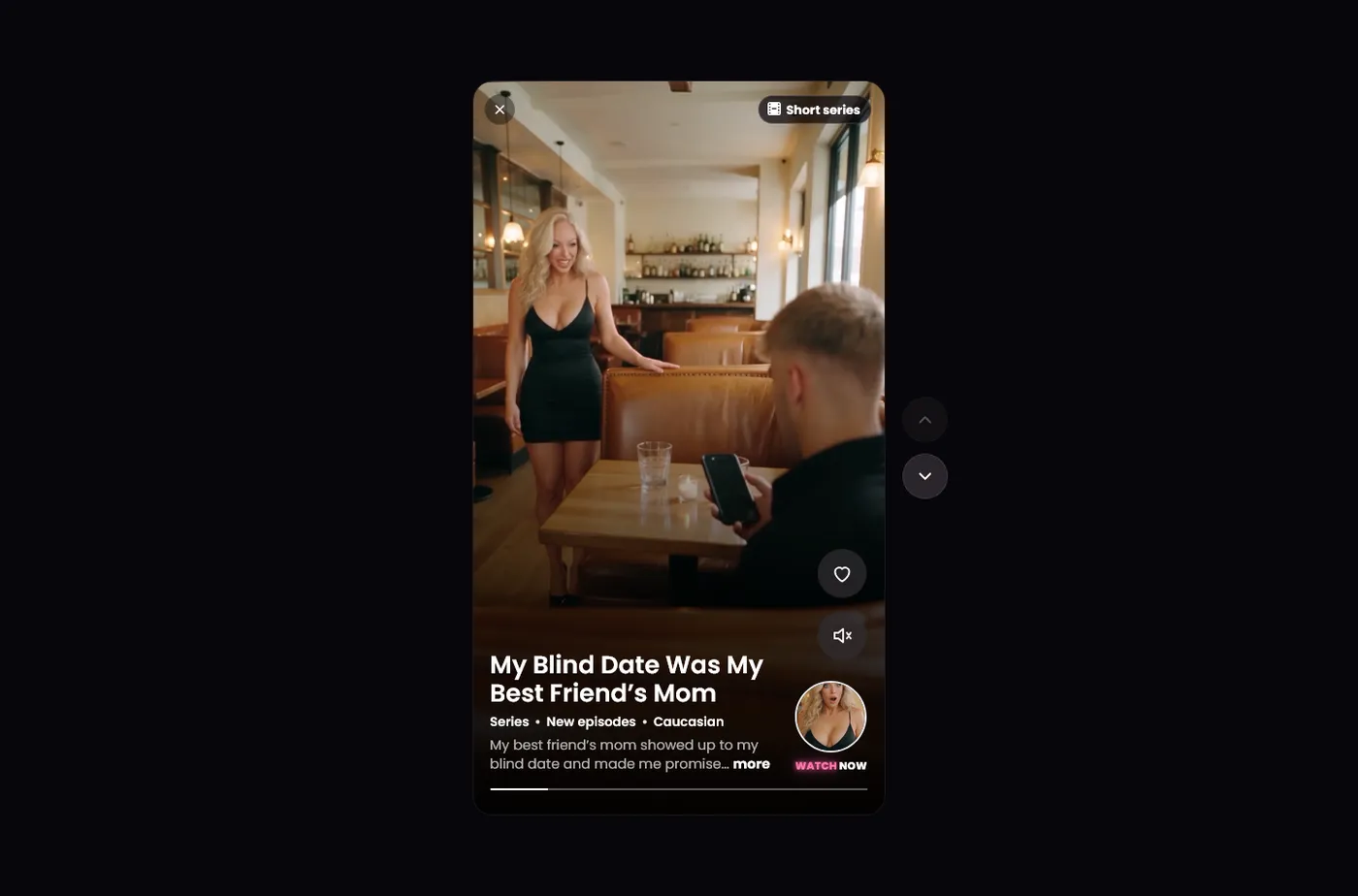
Shorts: episodic series that play like a streaming app, each with a “Watch now” button.
That breadth is the strongest argument for Candy.ai and the reason to take it seriously as a product rather than as a funnel. Most competitors sell a conversation. This sells a schedule: something to watch, someone live, a character to chat with, and a series to follow.
The catalogue claim is more modest than its rivals — “over 100 characters” on the marketing pages, rather than Character.AI’s 10 million or AiGirlfriends’ 800. That is a deliberate strategy: fewer characters, more production value. Each profile has a relationship, an occupation, hobbies, personality traits, a language, and a voice, presented like a dating profile rather than a prompt.
There is a business logic to that modesty. Character.AI’s ten million characters are mostly user-generated, inconsistent, and impossible to merchandise. A hundred produced characters can be scheduled, photographed, written into series, and sold as a subscription. Candy is not competing on breadth; it is competing on the assumption that most people do not want infinite choice, they want a small number of good ones.
The 50-million-user claim is the strongest such number in the category and the hardest to verify. It sits next to a “1000+ ratings” badge on the pricing page, which is a much smaller sample than 50 million would imply. Treat the headline as marketing and the rating count as the only auditable number on the page.
Getting in: a captcha that gets in the way
Signup is email and password, Google, or Discord. The form is short: email, password (minimum six characters), and a submit button.
Then reCAPTCHA.
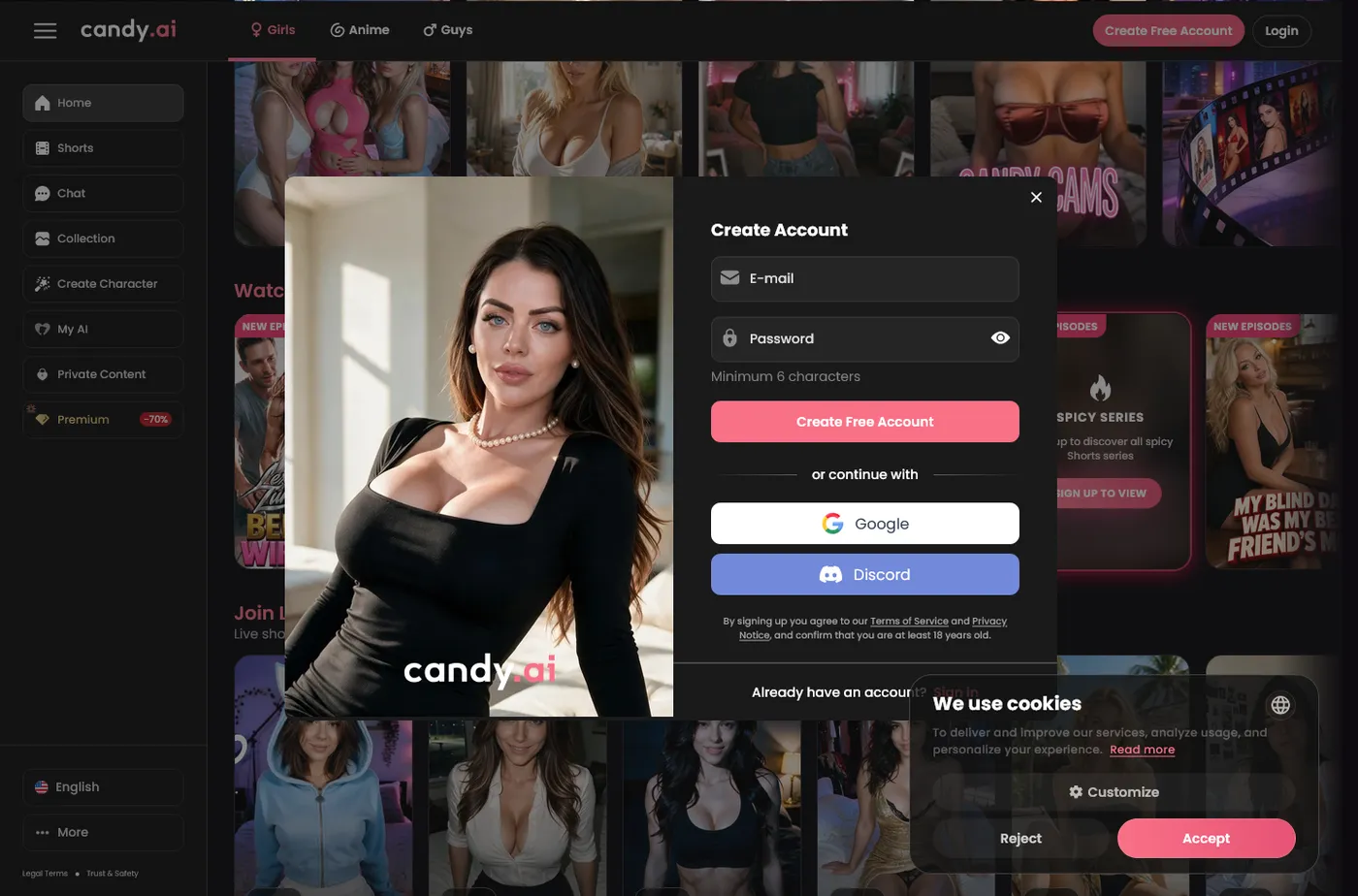
The signup form — and the captcha that decides whether you get any further.
This is not a soft challenge. The email path took several attempts across two browser profiles before I had a working account, and the captcha was the step that held things up each time.
Two smaller observations from the flow:
The password path and the captcha interact badly. My first submission returned “*Please verify the Captcha” with no captcha visible anywhere on the page. The validation fired against a control that never appeared. That is a bad failure mode: the user is told they failed a test they were never given.
Google and Discord are the paths of least resistance. Both avoid the password form and, in my session, Google OAuth was the route that eventually produced a working session. For a product that wants 50 million users, making the email path the hardest one is an odd choice — or a deliberate filter.
The shell: good bones, dense
Once in, the app is fast and the layout is conventional in the way mature products are.
The home page is a hero banner, “Private content available,” a featured-character carousel, and filter chips: All, Private Content, Caucasian, Latina, Asian, 18–21, Blonde, Brunette, Redhead. The filters are the catalogue’s real navigation, and they tell you exactly who the product is for.
Character pages are the best-designed thing here. Each one presents:
- A name, an “Online” indicator, and a status line.
- Customisation options — “Set your persona, add memories and tune this chat, all from this menu.”
- A benefits strip: Unlimited messages · Photos, video, voice & calls · Unlock.
- A personality block: relationship, occupation, hobbies, traits (for Odette: “Blunt, Dry, Teasing, Jealous, Secretly hopeful”).
- An opening message written in lowercase, in character, with a specific hook.
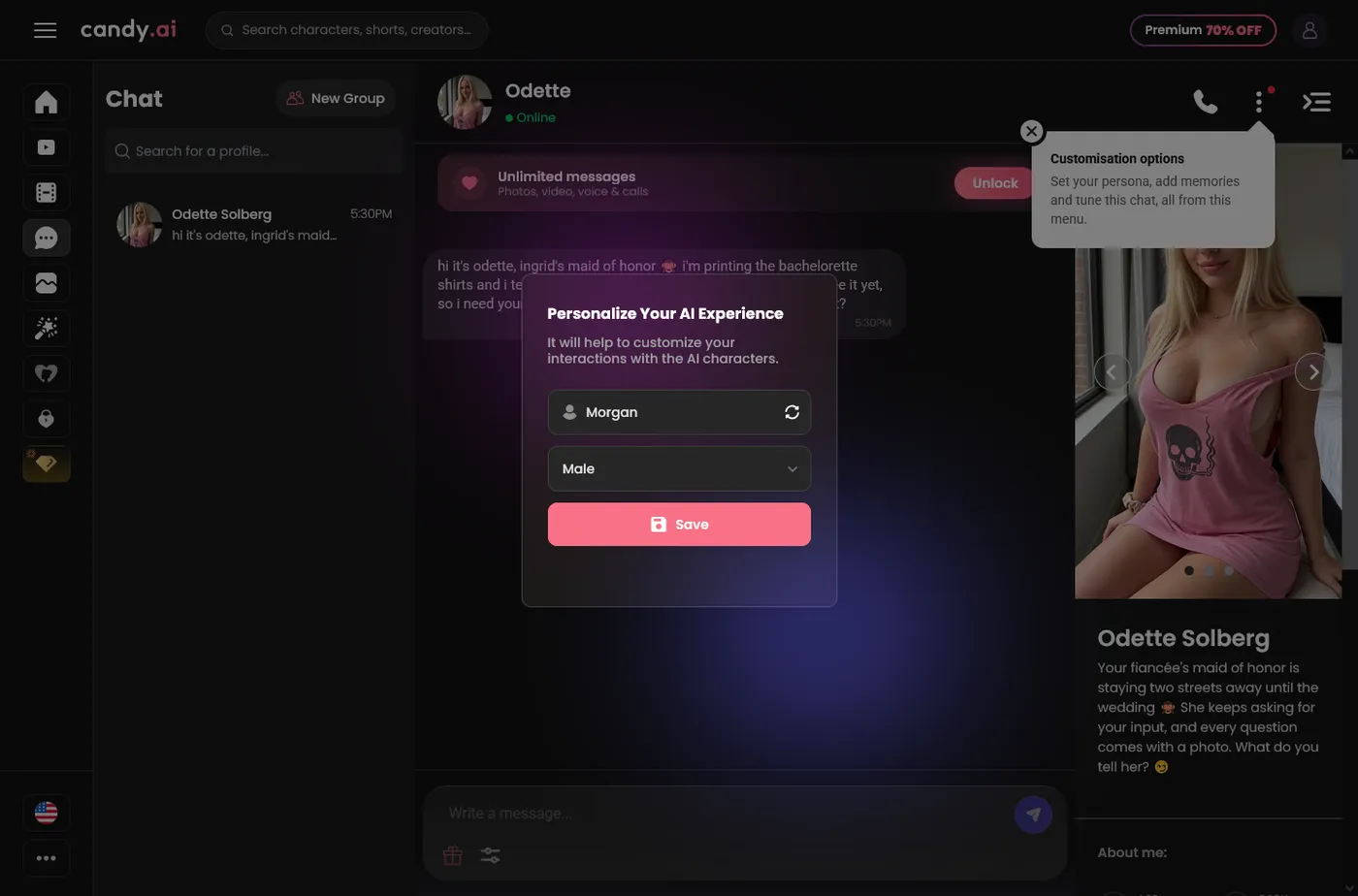
The chat view: a “Customisation options” tip for persona and memory, the “Unlock” strip, and Odette’s profile.
The chat controls are unusually deep for this category: Auto Memory, Switch to Video Mode, Reset chat, Delete chat, “Generate a new nickname,” a persona editor, and a full reaction bar (including a block of suggestive emoji). That is the toolset of a product that expects power users, not drive-by visitors.
The detail I liked most: the opening line is a scene with a task — Odette is printing bachelorette shirts, she tested the skull design on her own dress, and she needs an honest opinion before the bride sees it. That is a much better hook than “hi, I’m your girlfriend,” because it gives you something to say.
How discovery actually works
The catalogue is navigated by three mechanisms, and they serve different intents.
Filters are the explicit path: chips for ethnicity, age band (18–21 is the first and most prominent), hair colour, and body type. They are blunt, and they are the reason the catalogue feels larger than 100 characters — the same faces recur under different labels.
Hero banners are the editorial path. “Private content available — Watch Now,” “Play with her,” episodic series with “CHAT NOW” buttons. These are produced like a streaming service’s home page, and they push you toward whatever the company is promoting that week.
The feed-like rails are the ambient path: Candy Cams live now, featured characters, curated collections. You can browse without committing, which is more than most competitors allow.
The effect is that Candy.ai feels curated in a way Character.AI does not. Character.AI hands you a search box and ten million results; Candy hands you a schedule. For a certain kind of user — someone who wants to be shown something rather than to hunt — that is a genuine advantage.
It also means the product is only as good as its editorial team. If the curation is good, the platform feels alive. If it thins out, the whole experience collapses into a paywall with a browse button.
The free tier: five messages, and the receipt is in the ToS
Here is the number, from Candy.ai’s own Terms of Service, Section 9:
“As a free user, you may generally send a maximum of 5 messages to AI Characters. Further use requires a subscription.”
Five messages. Total. Not five a day, not five an hour — five, then a subscription.
The pricing page says none of this. It advertises the plans and the discounts; it does not say what the free experience actually is. The character page shows an “Unlock” next to “Photos, video, voice & calls,” which implies media is the paid part and text is free. It is not.
I sent a meta question asking the character to step out of scene and talk about conversation; it went through at 5:32 PM. During the session I saw no reply, because a “Personalize Your AI Experience” pop-up kept covering the thread. My screenshot shows the replies did arrive within the same minute: three short, in-character lines — “pardon?”, “i’m ingrid’s m…” and “are you okay? that was a…” — with Odette treating the request as a strange thing to say rather than stepping out of the scene.
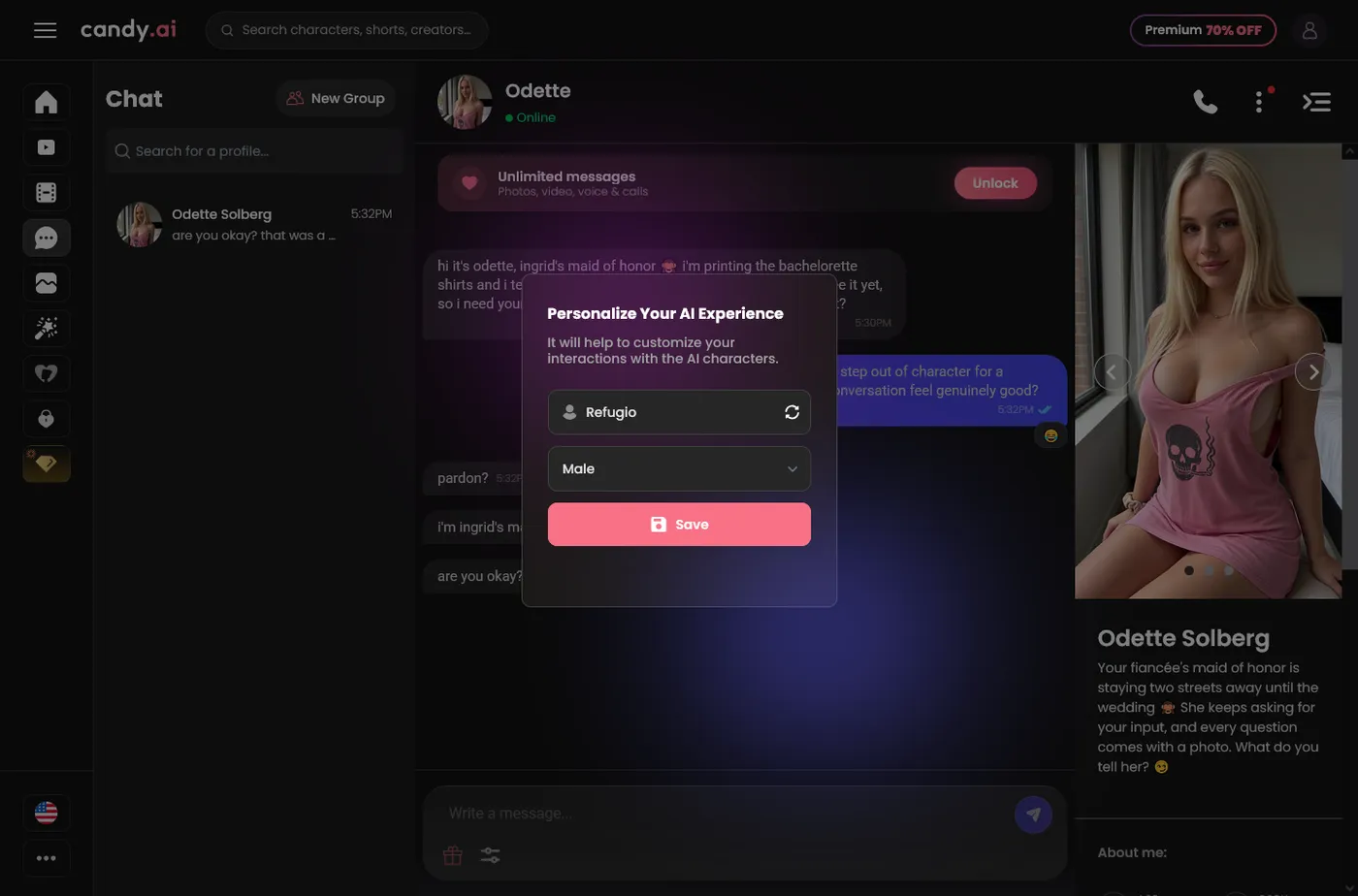
Behind the persona pop-up: my message at 5:32 PM and three short replies from Odette, with “Unlock” still in the header.
I did not reach the five-message limit, so I cannot say exactly what happens at message six. What I can say is that the terms permit five messages and the product does not disclose that anywhere a new user would look.
For comparison: Character.AI gives unlimited free messages with ads; JanitorAI gives unlimited free chats; AiGirlfriends gates media but not text. Candy.ai is the only product in this series where the conversation itself is the paywall.
There is a further wrinkle worth noting: the limit does not announce itself. There is no counter and no “2 of 5 messages remaining.” The only hint is an “Unlock” button beside a strip that says “Unlimited messages” — easy to read as an upsell for media rather than a warning that text runs out. A user with no knowledge of the terms will hit the wall without warning, and some of them will churn without ever reaching the checkout they were supposed to be funnelled into.
That is the paradox of hiding the limit well: it works as a paywall only if the user understands there is a paywall.
Conversation quality: what I can and cannot say
I am not going to invent a verdict here. On a free account capped at five messages, with the only replies three lines long and hidden behind a pop-up, I could not evaluate the conversation model.
What the product surface tells you:
- The opening messages are professionally written and specific — a scene, a task, a voice. That is a better first impression than most competitors manage.
- The persona system is deep: relationship, occupation, hobbies, traits, language, plus a user-side persona and memory entries.
- Auto Memory and the persona editor imply a memory model the user can steer, which is more than AiGirlfriends offers and less visible than Replika’s memory panel.
What I cannot tell you: whether the replies are as good as the openings, how fast they arrive once you are paying, or whether the memory actually persists across sessions. Any review that scores those things from a five-message free tier is guessing.
Note the asymmetry. A product that shows you five messages and then charges $13.99/month is asking you to buy an experience it has not let you sample. That is the core commercial criticism of Candy.ai, and it is not a small one.
What the opening scenes tell you about the craft
The free session was not wasted, because the opening scene is itself a sample of the writing.
Odette’s first message does four things in three sentences: it establishes a relationship (her best friend’s wedding, you are the groom’s side), gives her a task with a deadline (printing bachelorette shirts before the bride sees them), introduces a small act of rebellion (she tested the skull on her own dress), and ends with a direct request for a judgement call (“honest answer only. you think she’ll like it?”).
That is a well-built prompt. It gives the user something to react to that is not about the AI, and it creates a natural reason to reply. Compare it with the generic “Hi, I’m your AI girlfriend, what do you want to talk about?” that most of this category opens with.
The register is consistent too: lowercase, no exclamation marks, one emoji, contractions. It reads like a text from a person in her twenties, not like a chatbot performing enthusiasm. That consistency is the product’s real craftsmanship — anyone can write one good line, but holding the register across a scene is what separates the professional operations from the hobby ones.
The limitation is the same as everywhere in this category: the scene is a premise, not a relationship. It gives you a good first five minutes. Whether it gives you a good fifth hour is exactly what the free tier refuses to show you.
Media and the token economy
Premium advertises:
- Create your own AI girlfriend(s)
- Generate 18+ videos
- Generate 18+ images
- Full Live Action Experience
- Unlimited text messages
- 100 tokens per month
The tokens are where the real cost lives, and the terms are unusually blunt about them:
“Any remaining tokens in your account will expire and become unusable… they will not carry over or be refunded after your subscription ends.”
So tokens are not credits you own; they are a monthly allowance that dies with the billing period. Combine that with “generally 100 per month” and the fact that image generation is the headline feature, and the unit economics become clear: the subscription buys access, and the tokens buy a small number of generations on top.
The media stack itself — images, video, voice notes, calls, “Live Action” — is the most ambitious in the category. It is also entirely unverifiable on a free account, because every one of those features sits behind the same “Unlock.”
The token maths nobody does before subscribing
The subscription price is not the cost of using Candy.ai. It is the entry fee.
Premium includes 100 tokens per month, and tokens are what paid-for generation consumes. The product does not publish a price list on the marketing pages — there is no “1 image = X tokens, 1 video = Y tokens” table a buyer can check before checkout. You discover the exchange rate after you have paid.
That structure produces a predictable outcome: the subscription is sized for browsing, and the token allowance is sized for sampling. Community reviews that tracked a month of real use put all-in spending at roughly $25–60 per month once generation is part of the routine — several times the headline $3.99.
Three consequences follow, and they matter more than the plan price:
The annual plan is cheap because generation is not included. At $47.88/year you are buying access to the platform and a small monthly allowance, not unlimited media. Budget for the tokens separately or you will hit the wall in the first week.
Tokens expire at the end of the billing period. You cannot save them for a session-heavy weekend, and you cannot roll them over. The incentive is to use them or lose them, which is exactly the behaviour a metered product wants.
Tokens are not refundable when your subscription ends. The terms say they become unusable. So the “100 tokens per month” is best understood as a lease, not a purchase.
None of this is unusual for a generative product — inference costs money. What is unusual is how little of it is on the pricing page.
Pricing: five plans, three anchors, one currency problem
Candy.ai does not sell three plans. It sells at least five billing frequencies:
| Plan | Headline | Billed as | Effective |
|---|---|---|---|
| 12 months | 70% off | $47.88/year | $3.99/mo |
| 3 months | 35% off | $26.97 | $8.99/mo |
| 1 month | 29% off first month | $9.99 then $13.99 | $13.99/mo |
| 2 weeks | — | $9.79 | ~$19.58/mo |
| 1 week | — | $5.60 | ~$22.40/mo |
The weekly and fortnightly options are the interesting ones, because they are priced so that the monthly equivalent is far higher than the monthly plan. $5.60 a week sounds trivial and costs more than $22 a month. That is a deliberate anchoring choice aimed at people who do not do the multiplication.
Geo-variable pricing is real. The USD page shows $3.99/$8.99/$9.99. When I loaded the same page through a different network path, the logged-in pricing rendered in rupees: ₹300/month for 12 months, ₹815 for 3 months, ₹1,180 for 1 month. Same plans, same product, different currency and different effective price. That is normal for this industry and worth knowing if you travel or use a VPN: the price you see is not necessarily the price someone else sees.
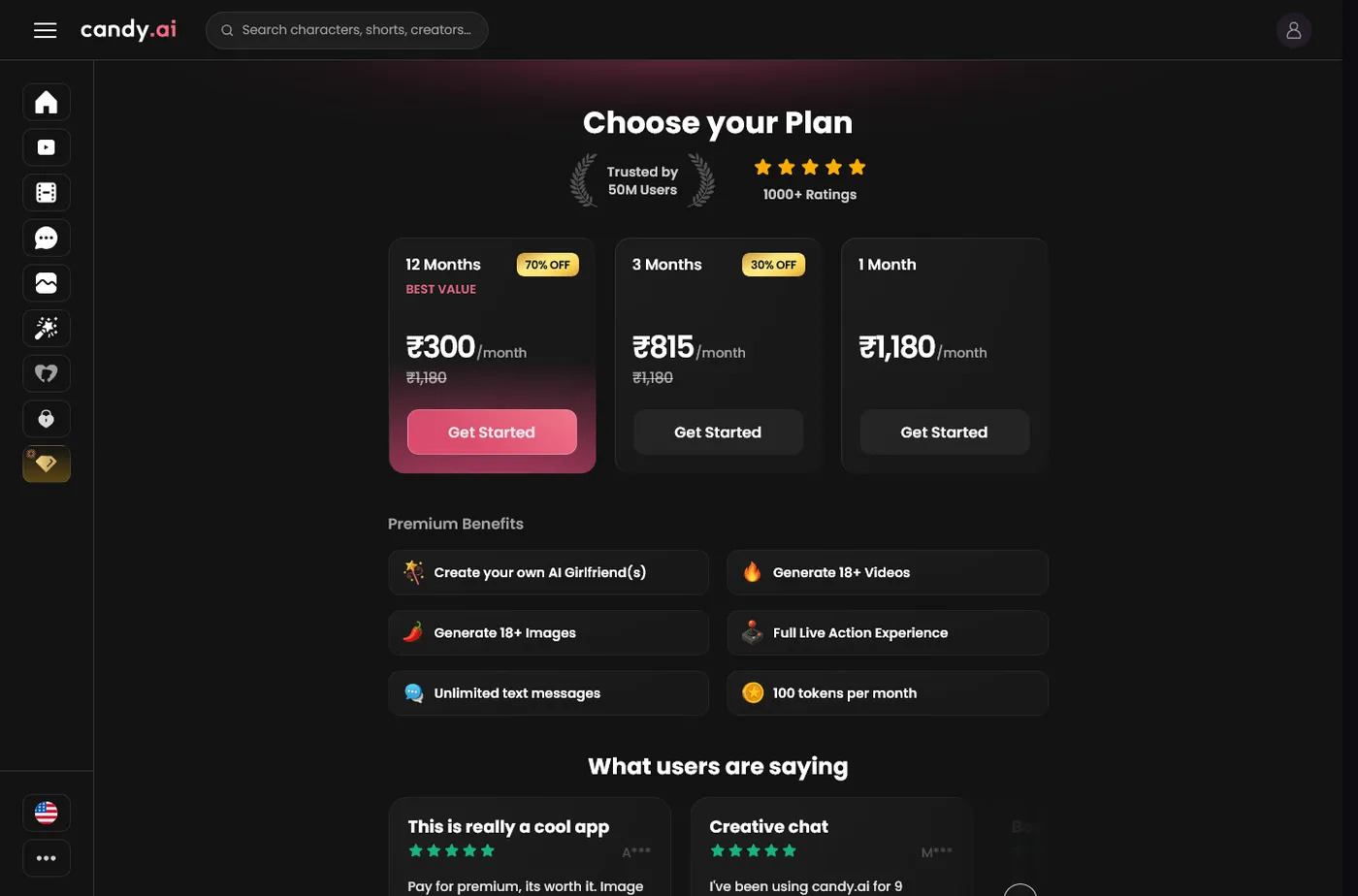
The logged-in plan page, priced in rupees: ₹300, ₹815 and ₹1,180 a month, with “100 tokens per month” among the benefits.
To Candy’s credit, the renewal language is clearer than most: “Renews automatically for the same price and term.” No $240 surprise in year two.
But the Terms add a clause I have not seen elsewhere:
“If a renewal charge to your default payment method fails, you authorize us to charge your designated backup payment method for the same amount and on the same terms.”
A backup payment method, charged automatically on failure. That is a legitimate anti-chargeback measure and an aggressive one.
The terms, and what you are agreeing to
EverAI’s Terms of Service are long, well-drafted, and worth reading before you pay. Four clauses matter most.
1. Your content trains their models. The licence you grant covers use of your inputs and outputs “for training, developing, enhancing, evolving and improving our (and/or any of our affiliated companies) AI models, content moderation tools, algorithms and related technology.” You also may not use the outputs to train competing models. This is standard for the category and still worth knowing: the intimate things you type are training data.
2. No refunds for content decisions. “Users will not be refunded or reimbursed for payments related to such removed or modified characters, features, or content.” If a character you paid for is de-listed, you keep paying.
3. Tokens die with the subscription. No carry-over, no refund, no transfer.
4. The entity is Maltese. EverAI Limited, Malta — EU consumer law applies, which is generally better for you than a Delaware LLC, though it also means the practical remedy for a dispute is a Maltese one.
The age gate is 18+, and the platform is explicit about adult content throughout. There is a Trust & Safety hub with content policies, and the terms reserve broad discretion to remove content and accounts.
The content layer: shorts, cams, private content
The part of Candy.ai that nobody mentions in reviews is the part that makes it a business: it produces content.
Shorts are episodic series with titles like “My Step-Sister’s Dormitory” (5 episodes) and “Student Bodies” — scripted, produced, and playable in-app. That is a streaming product, not a chat product.
Candy Cams puts live performers in the same navigation as the AI characters, with “jump in, chat and tip in real time.” Mixing AI companions and live human cams in one interface is a genuinely distinctive move, and it raises an obvious question about where the AI ends and the human begins for a first-time user.
Private Content is a separate gated library.
Whether you find this impressive or dystopian, it is coherent: Candy.ai is building a platform where the AI girlfriends are one channel among several, and the subscription is the entry ticket to all of them.
The live-cams decision deserves a closer look, because it changes what the product is.
Every other app in this category maintains a fiction: the companion is an AI, the app says so, and the relationship is with a construct. Candy.ai keeps that fiction for its characters and then, one tab over, offers live human performers with tipping. A new user can reasonably arrive at “Candy Cams LIVE,” see people who are unmistakably real, and lose track of which parts of the platform are generated and which are not.
That blurring is commercially smart — live camming is a proven business with better margins than inference — and it is the single biggest trust question in the product. The platform’s own disclosures are clear if you read them; the interface does not make the distinction obvious, and the AI characters and the live performers share a visual language, a tone, and a checkout.
It also raises a straightforward editorial question: if the company’s growth comes from live content, how much investment will the AI side get once the cams are the profit centre? That is a question about every platform that adds a second business, and it is worth asking before you buy an annual plan.
Reliability and UX
The engineering in front of the model is good. Pages load fast, the SPA navigates without full reloads, images are cached aggressively, and the character pages render cleanly at 1440px. There is no waiting room (unlike Character.AI).
The failures are all at the boundary between marketing and product:
- The captcha validates against a widget that sometimes does not render.
- The free tier’s limit is undisclosed on the pricing page.
- A persona pop-up covers the chat thread, so replies can arrive unseen.
- Two of the routes I tried (
/home/profile,/chat) return “Page Not Found,” which suggests the information architecture is still moving.
None of these are hard to fix. All of them happen at the moment a new user is deciding whether to trust the product.
Two of them are more serious than they look. A captcha that validates against a widget which does not render is a client-side state bug, and it can reject legitimate signups — the most expensive kind of bug a subscription business can have, because you never see the customer you lost. A pop-up that sits over the chat thread is the same problem at the product layer: replies arrive behind it, and a new user spending a five-message allowance cannot see what they are getting for it.
Neither would survive a week of session recordings. Their presence suggests the company is optimising the page that converts and not the path that leads to it.
How it compares
vs Character.AI. Character.AI is free, enormous, and in Chapter 11. Candy.ai is paid, curated, and solvent. If you want to try before you buy, Character.AI. If you want production values and are willing to pay, Candy.
vs AiGirlfriends.ai. The closest competitor. AiGirlfriends has 800+ characters, working memory in-session, and a $5.91 introductory annual — but a refund policy that contradicts its own guarantee. Candy has a stronger content platform (shorts, cams) and clearer renewal terms, but a five-message free tier. Both monetise aggressively; Candy is at least honest about the renewal price.
vs Nomi. Nomi is a relationship with one companion and a $99.99/year flat price. Candy is a content platform with a subscription and tokens. They are barely the same product category. Nomi for continuity, Candy for variety.
vs Replika. Replika has the brand history and the memory editor; Candy has the media stack and the content library. Replika’s free tier is more usable; Candy’s paid tier is more capable.
vs JanitorAI. JanitorAI is free, enormous, and rough. Candy is the polished, paid, professional alternative.
Who should use it, and how
Use the free account only to look. Five messages will tell you whether the writing voice appeals to you; it will not tell you whether the product works.
Buy 12 months or don’t buy at all. At $3.99/month, the annual plan is one of the cheapest entry points in the category and the only one where the maths is not hostile. Avoid the weekly and fortnightly plans entirely; they are the most expensive way to use the product.
Assume your tokens expire. Plan generations around the billing period, and do not stockpile.
Do not buy if you want to sample the conversation before committing. That is precisely what the free tier is designed to prevent.
Five changes that would earn an eight
The product is close. These are all funnel decisions, not model decisions.
1. Publish the free-tier limit on the pricing page. “5 free messages, then $13.99/month” is a sentence that builds trust. Hiding it in Section 9 destroys it. The number is not the problem; the concealment is.
2. Let new users have a real first session. Twenty messages and one image would let someone judge the product honestly. Five messages, with the replies hidden behind a pop-up, cannot distinguish “this is good” from “this is broken.”
3. Show token prices before checkout. A simple table — image, video, voice note — removes the suspicion that the subscription is a down payment on an unknown bill.
4. Separate AI characters from live performers visually. Candy Cams is a real feature; it should not share a design language with generated companions. Label it, colour it, put it behind its own tab.
5. Kill the weekly plan or price it honestly. $5.60 a week is $22.40 a month. If the product is worth $3.99/month annually, a weekly plan at 5.6× that rate is not a convenience; it is a trap for the indecisive.
Do those five and the same product scores in the eights. The moderation, the writing quality, and the platform engineering are already there.
Scorecard and closing
| Category | Weight | Score | Weighted |
|---|---|---|---|
| Product surface | 20% | 8.0 | 1.60 |
| Discovery and design | 15% | 8.0 | 1.20 |
| Conversation (unverified) | 20% | 6.0 | 1.20 |
| Media and tokens | 10% | 6.0 | 0.60 |
| Free tier | 15% | 2.0 | 0.30 |
| Pricing mechanics | 10% | 4.0 | 0.40 |
| Trust and terms | 10% | 4.5 | 0.45 |
| Total | 100% | 5.75 → 5.8/10 |
Candy.ai is what this category looks like when it grows up commercially: a polished, multi-channel content platform with a subscription, a token economy, and a funnel that has been optimised by people who know exactly what they are doing.
That is also the problem. The five-message free tier is not a mistake; it is a decision, taken deliberately and buried in Section 9 of the terms. A product that will not let you test the thing it sells is asking for trust it has not earned, and the rest of the funnel — weekly billing, token expiry, backup payment charges — is built to keep you once you are in.
If you already know you want it, buy the annual plan and enjoy it; the production values are real. If you are still deciding, understand that Candy.ai has already decided for you.
Appendix: what was verified
Hands-on: signup form and reCAPTCHA behaviour, Google vs email paths, signed-in navigation, Discover page, Shorts and Cams rails, character page structure, persona/memory controls, message send and three short replies (found afterwards in a screenshot, behind a persona pop-up), the “Unlock” benefits strip, public and logged-in subscription pages in two currencies.
Not verified: reply quality, response latency on a paid plan, image/video/voice generation, calls, long-term memory, cancellation flow.
Documentary sources: candy.ai (home, /subscriptions, /private-content, /candy-shorts), Terms of Service and Privacy Notice (EverAI Limited, Malta), and the Trust & Safety hub.
Screenshots: all taken during testing — signup, Shorts, chat view, replies behind the persona pop-up, plan page.
Candy.ai FAQ
Is Candy.ai free?
Only just. Candy's terms say free users may generally send a maximum of 5 messages to AI characters, and further use needs a subscription. The pricing page doesn't mention the limit.
How much does Candy.ai cost?
$3.99 a month on the 12-month plan ($47.88), $8.99 a month on the 3-month plan, or $9.99 for the first month and then $13.99. Weekly ($5.60) and 2-week ($9.79) plans also exist, and prices vary by country.
Do Candy.ai tokens expire?
Yes. Premium includes 100 tokens a month for image and video generation. Unused tokens expire and aren't refunded when your subscription ends.
Who runs Candy.ai?
EverAI Limited, a company registered in Malta (C107181). Under its terms, what you type can be used to train its AI models.
Are Candy Cams AI characters?
No. Candy Cams are live human performers you can chat with and tip, shown in the same app as the AI characters.