
xchar.ai review
Clear pricing and a big creator catalogue, but our new account had 0 credits and couldn't send a first message.
Updated November 21, 2026
- Price
- Free with paid plans · from $14.95/mo
- Platforms
- Web
- Developer
- Always is Now Inc.
- Languages
- English
- Age rating
- 18+
Key features
- Voice messages / calls
- Long-term memory
- Image / selfie generation
- Custom character creator
Pros
- + The clearest pricing grid we've tested, with savings shown in dollars
- + Privacy policy says chats aren't used for training
- + A 14-day right to withdraw from a purchase if no credits are used
- + Big catalogue with a feed, creators, personas and an earn-credits page
Cons
- − Our account showed 0 credits and the first message was refused
- − No guest chat, despite "unlimited messages" marketing
- − Hard-to-find login, with two different Sign in controls
- − Session didn't survive a page reload
- − Incest-premise characters in the main catalogue
- − Credit packs need a subscription; no PayPal
Tested: November 2026, Chrome on Windows. I registered with email, received the verification codes, signed in through the (well-hidden) login form, and tried to send a first message. No payment was made and no reply was ever generated.
Bottom line: xchar.ai has the clearest pricing in this series and one of the more complete feature menus — characters, feed, personas, gallery, credits, an earn-credits page, voice, images. What I could not do was talk to it. The sign-up pop-up offers “325 free credits for signing up”, but the account I signed in with showed 0 credits, and the first message was refused with an “Upgrade to Unlock — Unlimited Messages” pop-up. My email check was interrupted while it said “Verifying…”, and this was the third account from the same browser, so a fully verified first-time account may fare better; I couldn’t confirm it either way. The login path is also hard to find, and the session didn’t survive a page reload. 4.3.
Verdict at a glance
| Dimension | Score | Why |
|---|---|---|
| Chat quality | 4.5/10 | Character writing and intros are strong; no reply was ever generated (the first message was refused for lack of credits), so this is judged on displayed material. |
| Memory | 4.5/10 | Documented as 6K/12K/18K tokens by tier; nothing testable. |
| Onboarding | 3.5/10 | Registration and email codes work, but the login path is hidden, the session didn’t survive a reload, and our account had no credits to chat with. |
| Media & credits | 3.5/10 | Our account showed 0 credits; collections cost 100 credits; packs require a subscription. |
| Pricing | 5.0/10 | Transparent three-tier, three-term grid with honest credit resets; no PayPal. |
| Trust & legal | 4.5/10 | Real US entity, Nevada arbitration, a genuine 14-day withdrawal right and a no-training policy; offset by incest-premise characters. |
| Reliability | 3.5/10 | First message refused on our account, session lost on reload, two different “Sign in” controls. |
| Weighted total | 4.3/10 | A well-priced product we couldn’t get a single reply from. |
What xchar.ai is
xchar.ai is a US-operated AI companion platform — Always is Now Inc., 732 South 6th Street, Suite N, Las Vegas, NV 89101 — with a broader product surface than most competitors. The navigation lists Create Character, Generate, Feed, Top Creators, My Characters, Conversations, Become Premium, Gallery, Personas, Earn Credits and a Guide, plus Discord, Affiliate, Support and Feedback. That is a creator-economy product, not a single-girlfriend app.
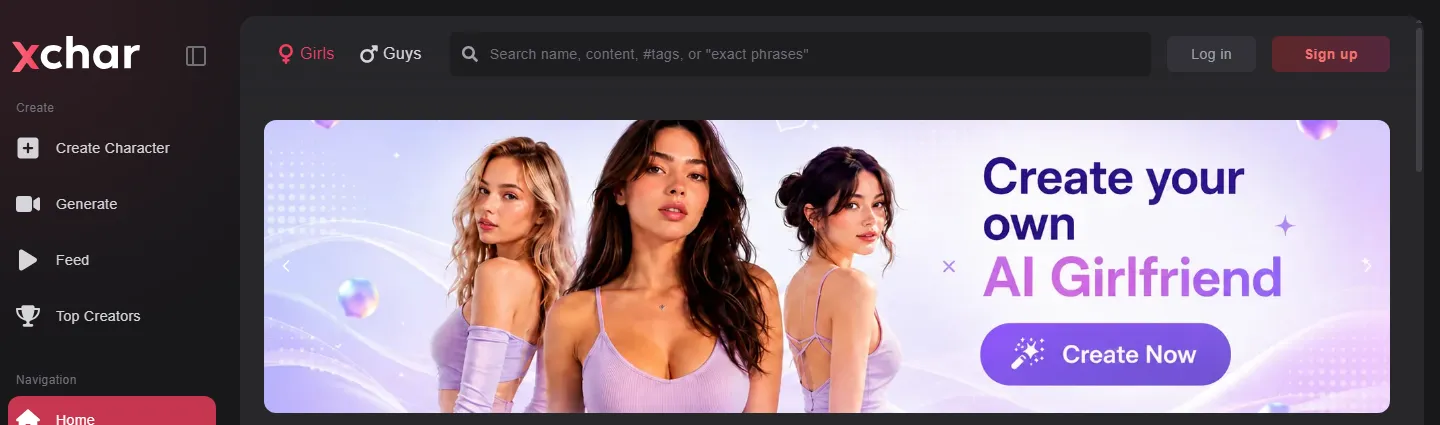
The home page: create, generate, feed and creator tools in the sidebar.
The positioning is explicit: “Start Your Free Chat With AI Girlfriend For Unlimited Messages”, “We built the ultra realistic free AI girlfriend you will crave”, “You can request hot pictures from your AI girlfriend, including custom poses and outfits”. The page promises no scripts, no safe mode, no stiff replies, and a character creator that controls face, body, hair, personality, outfits, voice and “how clever she acts”.
The catalogue has real volume. The character I opened, Leia Sierra, showed 77,056 chats, 758 likes and 75 posts. Each character page has Chat, Feed, Media and About tabs, a feed of unlockable image collections at 100 credits each, and a long generated biography. The design is competent and the content density is high — this is a site that has been running and accumulating characters.
One content observation belongs in the review because it affects who should use the site. Leia’s card reads ”💕 Teases boundaries where family whispers turn to moans”, and her conversation panel lists “Relationship: Step Sibling”. That is an incest premise presented as a default character attribute, not a hidden niche. xchar’s terms prohibit illegal content and require 18+, but the catalogue’s flagship example leans into family-taboo roleplay. Buyers should know that before they judge the brand by its homepage.
The surrounding product is more developed than the home page suggests. Each character has four tabs — Chat, Feed, Media and About — and the Media tab lists individual posts with image counts, likes and “Unlock Collection for 100 Credits” buttons. The Feed is a scrollable timeline of those collections, blurred with “NSFW — Unlock to view” overlays. Top Creators and My Characters imply a creator ecosystem; the Affiliate page sits in the main navigation; Earn Credits advertises tasks, referrals and “25 free credits each day” with a claim of up to 10,000 credits; the buy-credits page even links out to Trustpilot for social proof. This is a platform with a growth loop, not a single-character demo.
That breadth is why the access failure is so costly. A product with a feed, creator rankings, personas and a credit-earning layer expects returning users. A free account that can’t send a first message breaks the exact behaviour the product is designed to reward.
The funnel: register, verify, log in, and find zero credits
This section decides the score, so it is worth being precise about what worked, what did not, and what I couldn’t pin down.
Step 1 — the chat gate. Opening a character’s conversation shows the full chat UI: a message box, persona, memory and image-suggestion buttons (each labelled “requires login”), and the character’s opening message. Typing and pressing send does not send. A pop-up appears offering “325 free credits for signing up”, with Google, Discord or Email, and an “Already have an account? Sign in” link.
That is a normal registration gate. It contradicts the home page’s “Start Your Free Chat … For Unlimited Messages”, but the promise of 325 credits at least suggests a real free allowance.
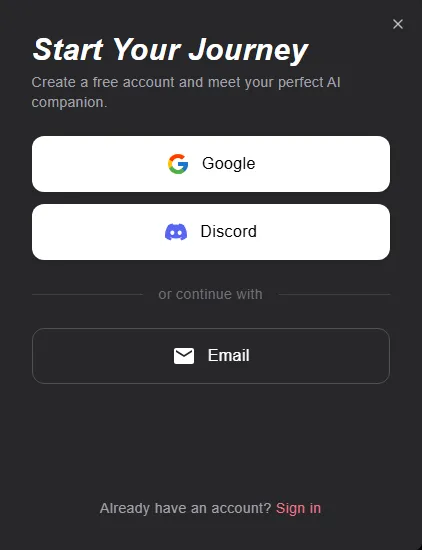
The sign-up pop-up after the first message. The “325 free credits” badge sits on the image beside it.
Step 2 — registration. Email and password, with live strength rules (8+ characters, upper, lower, number, special). A reCAPTCHA Enterprise check runs in the background without showing a challenge. Registration went through and the pop-up moved to a six-digit email code screen. The email arrived from [email protected] within a minute, with the code in the subject line.
Step 3 — verification. The code screen has six boxes, “Open Gmail” and “Open Outlook” shortcuts, and “Resend verification code”. Typing the sixth digit submits the code on its own: the button changes to “Verifying…”. I didn’t stay on that screen until it finished, so I never saw what follows it and can’t say whether verification completed. That matters for step 6.
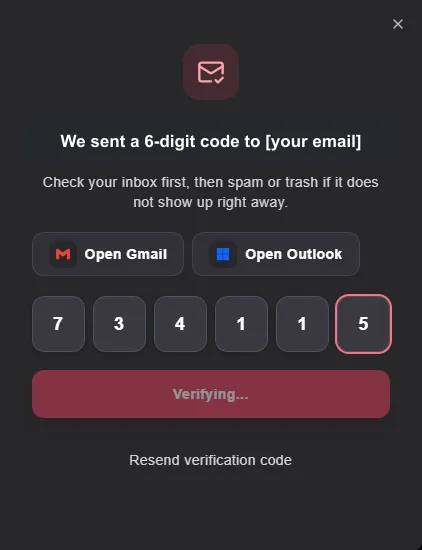
The code screen submitting on its own: “Verifying…”. Email covered.
Step 4 — the login path. The pop-up has two different “Sign in” controls. The small “Already have an account? Sign in” link and a separate “Sign in” button lead to different screens, and the email forms behind them look almost identical. On my first attempts I typed my login details into the sign-up form without noticing and got “An account with this email already exists. Please sign in instead.” The path that works is the Sign in button, then Email, then the login form. That went straight to a terms page: “Welcome to xchar! — I am at least 18 years old and agree to the Terms of Service, Privacy Policy, and Guidelines — I would like to receive discounts and updates — Accept and Continue / Decline and Return to Login”. Ticking the first box and accepting took me back to the character page, signed in.
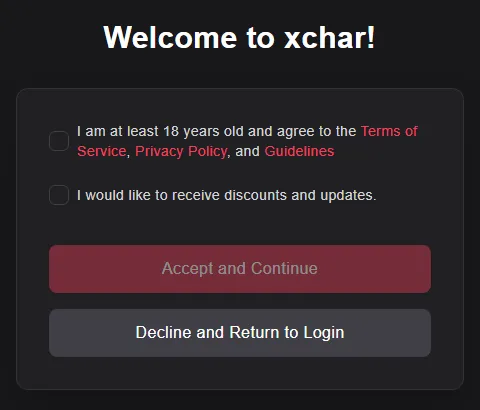
The terms page that appears after the first login.
So login works. The problem is that it is hard to find: two “Sign in” controls with different behaviour, two email forms that look alike, and an “already exists” error that doesn’t say which control to use.
Step 5 — the session didn’t survive a reload. Signed in, the chat opened normally from the in-page Chat tab. After I reloaded the conversation page and tried to send, the Create Account pop-up came back and I had to sign in again. If that happens to every account, bookmarks, refreshes and email links are unreliable; it may also be tied to the unfinished verification.
Step 6 — the credits. Signed in, the chat header showed “0 credits”. Sending a message brought back “You don’t have enough credits to send more messages” and an “Upgrade to Unlock — Unlimited Messages” pop-up.
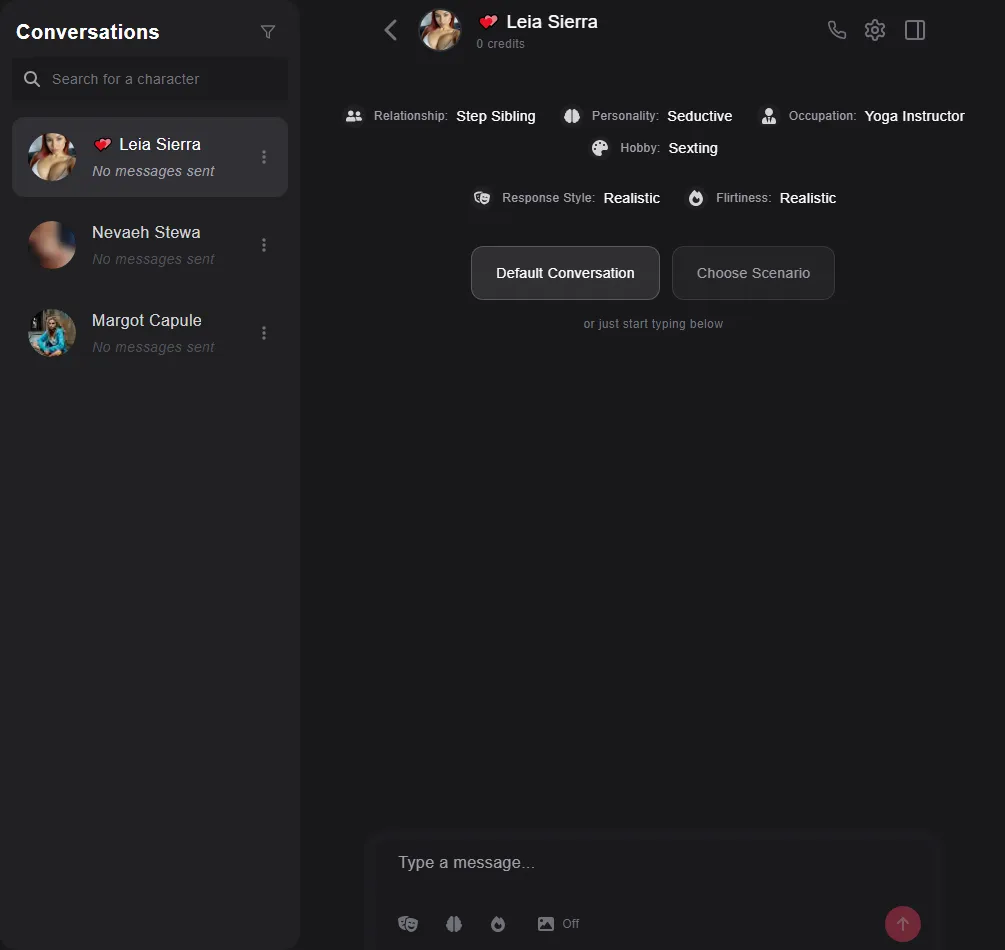
Signed in, with “0 credits” under the character’s name and no messages sent.
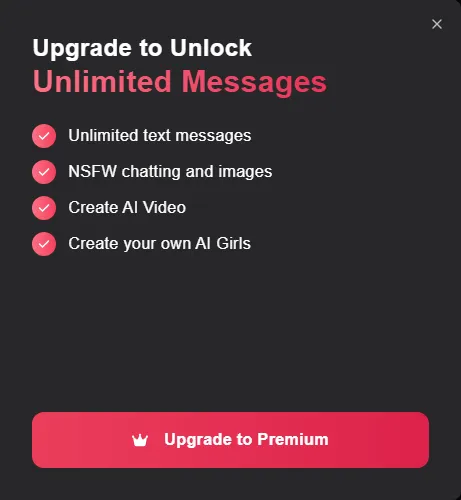
The first message refused: “Upgrade to Unlock — Unlimited Messages”.
The sign-up pop-up had promised 325 free credits. Two caveats before reading this as a broken promise. My email verification was interrupted at “Verifying…”, and many sites grant sign-up credits only once the email is confirmed. This was also the third account created from the same browser and connection in a day, which is exactly what anti-abuse rules look for. A first-time user who finishes verification may well get the 325 credits; I couldn’t confirm it. What I can say is that the route from “325 free credits” to a first reply is fragile, and when it fails the site says nothing about why. It just says “upgrade”.
With no credits, everything after this point — chat quality, memory, media — was out of reach, and the refusal came before the model produced anything.
Chat quality: judged at the door
I never received a reply. The score here is therefore based on the visible material, and it is deliberately conservative.
What is visible is good. Character intros are long, specific and in voice. Leia’s opening paragraph is purple but coherent: a yoga instructor who “thrive[s] on the pulse of unspoken yearnings”, guiding “inner fire through every deliberate breath and curve”. The attributes panel is detailed — Body: Slim, Ethnicity: Hispanic, Personality: Seductive, Response Style: Realistic, Flirtiness: Realistic. The chat UI offers Real chat versus Roleplay (visible as “Short, natural messages” vs “the story with you. Scenes, actions, longer replies”), plus persona selection, memory editing and image suggestions. Those are the controls of a mature product.
The interface details suggest a considered build. The message box is a rounded, auto-growing textarea with a placeholder and a send arrow; the toolbar has separate buttons for persona, memory and image suggestions, each with an explicit “requires login” label rather than a silent failure. The character panel carries a relationship label, personality, occupation, hobby and a “Flirtiness” setting, which reads like a slider the user is meant to tune. The opening message is delivered as a scenario card with “Previous slide / Next slide” navigation, so a new conversation begins with a scene rather than a blank box. Even the media counts — 75 posts, 758 likes, 77,056 chats — are formatted the way a social product formats them.
None of that tells us how the model writes. A long intro can be canned; the attributes can be decorative. The honest position is that xchar presents like a 7.5 chat product and has produced zero evidence of chat. The 4.5 is a placeholder for “unknown”, weighted down because the failure to reach a first reply is itself a product failure.
The trade-off is that the same screen shows the first-message gate and a sidebar of locked features. A new user’s first impression is not the character’s prose; it is a modal asking for an account.
I also cannot verify the “unlimited messages” claim, the 6K/12K/18K token memory claims, the response speed, or the quality of the model behind the tier names (the Ultra plan mentions “Ultra language models (30 messages/day, then use credits)”). A 4.5 reflects strong presentation with zero conversational evidence — the error bar is wide in both directions.
Memory: documented, not demonstrated
The pricing page states memory in tokens: 6K on Premium, 12K on Deluxe, 18K on Ultra. The terms explain the credit side: “Credits remain valid until used, while Monthly Credits reset each month and do not roll over to the next month.” The memory claim is a context window, not a persistent memory profile, and there is no lorebook or inspectable memory screen in the navigation.
Because the first message was refused, none of this could be tested. The privacy policy does at least say the right thing: “We do not use your conversations with AI characters for training or improvement purposes. Your conversations remain private.” That is a stronger default than Secrets.ai (trains, no opt-out) and matches HeyGF. It is dated 19 March 2025 while the terms are dated 14 June 2026, so the privacy document is older than the contract — a small governance smell, but not a contradiction.
Credits and media: 100 credits before you see anything
The media economy is visible even without an account. Each character’s Media tab lists collections with “Unlock Collection for 100 Credits” buttons, and the feed shows NSFW posts with “Unlock to view” overlays. The homepage’s promise of custom poses and outfits sits behind those unlocks.
The credit structure, per the pricing page and FAQ:
- 325 free credits advertised on sign-up. The account I signed in with showed 0 (see the caveats above).
- 8,000 / 18,000 / 36,000 credits per 30 days on Premium / Deluxe / Ultra.
- Credit packs are “available with an active subscription” — you cannot top up on the free tier.
- Subscription credits reset monthly; separately purchased credits never expire.
- Earn-credits page: tasks and referrals, “get 25 free credits each day”, up to 10,000 credits.
- Crypto accepted (Bitcoin, USDT, Ethereum, Tron); no PayPal.
Because the balance was zero, none of the free-credit maths could be exercised. On paper, at 100 credits per collection, the advertised 325 would buy three collections. A Premium month’s 8,000 credits buy 80 collections if spent only on unlocks, before any custom image generation, which is not priced on the page. That is a reasonable-looking ratio, but it is unverifiable without an account, and the “packs require a subscription” rule means the free tier is capped at what it was given.
The earn-credits layer changes the maths for patient users. “25 free credits each day” is 9,125 credits a year, roughly one Premium month’s grant, and the page claims up to 10,000 credits from tasks and referrals. If the daily claim works, a free user can accumulate a collection every four days without paying. That is a more generous loop than either Secrets’ Moments or Kupid’s expiring coins, and it is the strongest argument that xchar is trying to build a habit rather than extract a single purchase.
Two caveats. The daily figure is marketing copy, not something I could test, and the FAQ says credit packs require an active subscription — so a free user cannot accelerate with money even if they want to. The whole economy points at subscription conversion, with earning as a retention hook rather than a genuine free tier.
There is also a currency trap familiar from other apps in this series: the “credits” are not money, have no stated cash value, and the only published price is per collection, not per image or per generation. A user who spends 100 credits on a “collection” of five images is paying a different unit price from one who spends 100 on a single custom generation, and the site does not tell you which you are buying until you are inside.
Pricing: the best-presented grid in the series
xchar’s pricing page is the clearest I have reviewed. Three tiers, three terms, and the savings stated in dollars rather than vague percentages.
| Plan | Monthly | Yearly (50% off) | Credits / 30 days | Memory |
|---|---|---|---|---|
| Premium | $14.95 | $7.45/mo, $89.40/yr | 8,000 | 6K tokens |
| Deluxe | $29.95 | $14.95/mo, $179.40/yr | 18,000 | 12K tokens |
| Ultra | $49.95 | $24.95/mo, $299.40/yr | 36,000 | 18K tokens |
Quarterly is also offered at “Save 20%”. The yearly toggle changes the displayed price and billing line cleanly: “Saved 50% or $90.00 / $7.45 / Billed $89.40 every 365 days”. The maths is honest — 50% of $14.95 is $7.475, and $89.40 is twelve months at $7.45. The Ultra tier adds “Ultra language models (30 messages/day, then use credits)” and “Priority performance”.
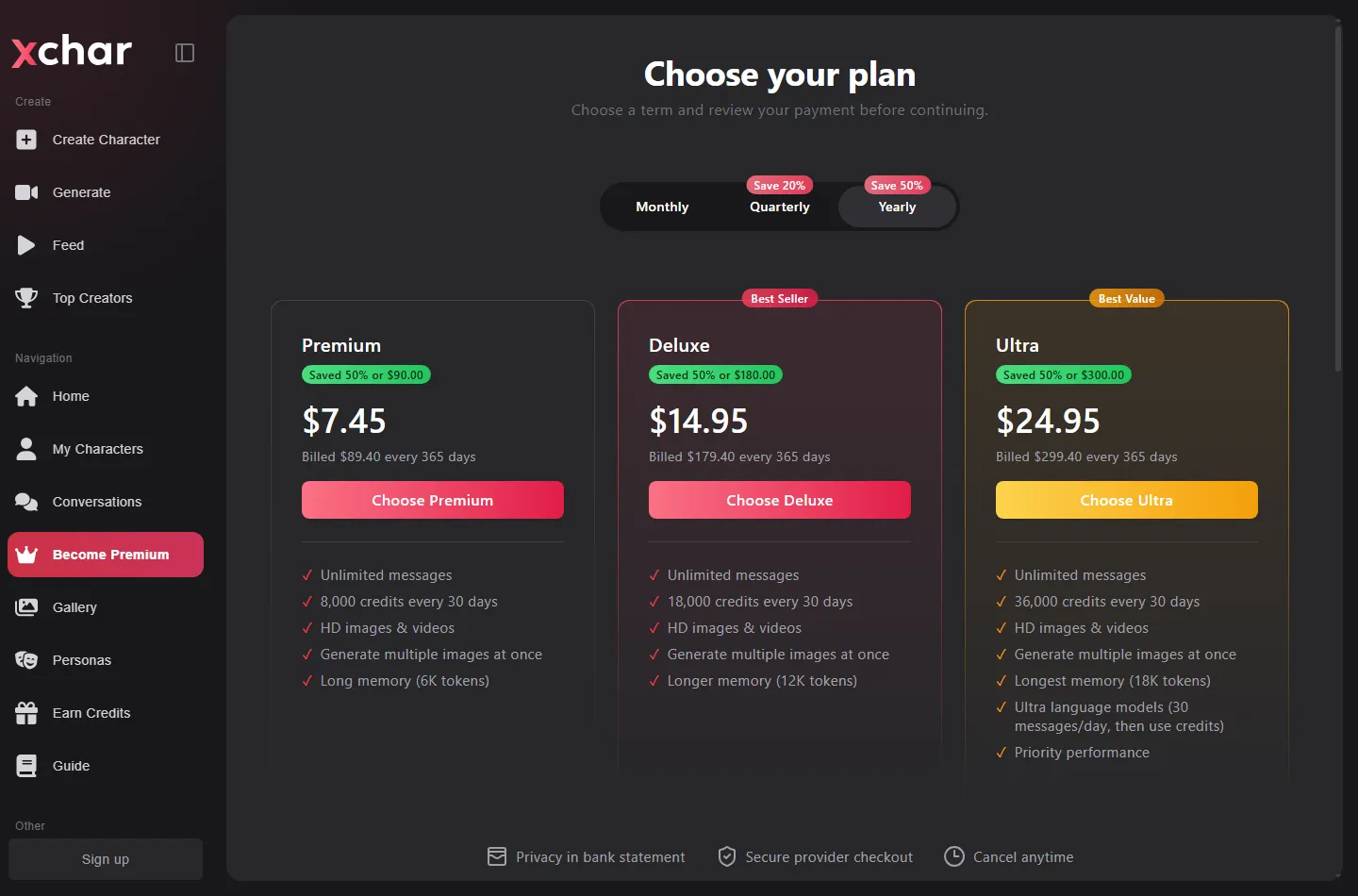
The yearly view: “Saved 50% or $90.00”, $7.45 a month, “Billed $89.40 every 365 days”.
The FAQ is unusually direct: no PayPal; crypto yes; credits land immediately; cancel anytime and keep access to the end of the period; upgrades are prorated; downgrades require cancelling first; monthly credits do not roll over; purchased credits do. Those are the answers a buyer actually needs, and most competitors bury them.
Per credit, the tiers make sense. Premium yearly is $89.40 for 96,000 credits a year — about 0.093 cents per credit. Premium monthly is $14.95 for 8,000, about 0.187 cents. Ultra yearly is $299.40 for 432,000, about 0.069 cents. Paying annually halves the cost per credit and doubles the allowance per dollar, which is a familiar and defensible ladder. At 100 credits per collection, Ultra yearly works out to roughly 14 cents per collection-page unlock; Premium monthly to about 19 cents. For a media product, those are sane unit economics.
Quarterly sits between the two: “Save 20%” against monthly, with no explicit per-month price on the default view. The page asks you to “Choose a term and review your payment before continuing”, so the final quarterly figure appears at checkout. That is a small transparency gap in an otherwise clear grid.
The weaknesses are the absence of any per-image or per-video credit price (the same gap as HeyGF), the fact that credit packs require a subscription, and the lack of a cheap starter tier — the entry price is $14.95/month, with no $4.99 trial equivalent. A $2.99 one-week pass would answer the “is the chat any good?” question that the site currently refuses to answer without a card.
Terms and trust: a real US company with a real withdrawal right
The Terms are dated 14 June 2026 and are drafted as a licence agreement. Key points:
- Entity: Always is Now Inc., Las Vegas, Nevada.
- Law: Nevada. Disputes are subject to “binding arbitration in accordance with the laws of the State of Nevada”, seated in Clark County, conducted in English, with a fallback to the courts of Clark County.
- Withdrawal: “A User, who is a consumer, has the right to withdraw from the online purchase within 14 days without giving any reason, provided that no Credits have been used.” That is a genuine EU-style cooling-off right, and it is better than Kupid’s blanket no-refunds and Secrets’ “except where required by law”.
- Refunds on termination: if the account is deleted for breach, “the User is not entitled to a refund of Credits or Monthly Credits.”
- Credits: monthly credits reset; purchased credits persist; no cash value implied.
- Age: 18+; access may be refused below that age.
The privacy policy adds no-sale, no-training, deletion from the profile page, encryption in transit and at rest, and session plus persistent cookies. For a category where most policies are boilerplate, this one is short and specific.
The licence grant is narrow in the usual way: “a limited, non-exclusive, non-transferable, worldwide, and non-sublicensable license to use the Platform and the Service” for personal purposes. Termination for breach is immediate, with no refund of credits — a clause that is standard but worth pairing with the withdrawal right above: you can change your mind within 14 days if you have not spent anything, and after that the credits are yours to lose. The terms also allow the licensor to refuse access to under-18 users and to bar terminated users from creating new accounts.
The interplay between the 14-day withdrawal and the credit system is the part to watch. Because monthly credits are granted at purchase and reset monthly, a user who buys and immediately spends has waived the withdrawal route by using the service; a user who buys and waits has 14 days to reverse. That is a reasonable consumer posture, but it puts the burden on the buyer to know the rule before they start chatting — and since chat cannot start at all, the practical effect for this reviewer was moot.
The trust deductions are for the incest-premise catalogue (see above), the arbitration seat in Nevada for a global user base, and the older privacy date. On balance, 4.5 is fair: the paperwork is better than the product experience.
Reliability: an empty wallet and a fragile session
Four reliability problems, in order of severity:
- No credits to chat with. Our account showed 0 credits and the first message was refused with an upgrade pop-up and no explanation. Whether that was a failed grant, an anti-abuse rule or the unfinished verification, a new user would see the same thing.
- The session didn’t survive a reload. After a reload, sending a message brought back the Create Account pop-up, and I had to sign in again.
- Two “Sign in” controls. The link and the button lead to different screens, and the forms behind them look alike, so it is easy to submit the sign-up form when you meant to log in.
- An unhelpful duplicate-account error. “An account with this email already exists. Please sign in instead.” is accurate but doesn’t say which of the two Sign in controls to use.
Support is a link in the navigation plus a feedback page. I did not contact it. The Discord community may be the fastest route for a stuck user, which is itself a signal about the state of first-line support.
For anyone contacting support, the useful details are specific: the chat header shows 0 credits straight after sign-up, the first message returns “You don’t have enough credits to send more messages”, and the sign-up pop-up advertises 325 credits. Each of those is easy to show in a screenshot.
Comparisons
Against Kupid.ai (5.3) and Secrets.ai (6.1): all three put an account before a real conversation. Secrets lets guests send five messages first and Kupid allows one; xchar allows none, and our signed-in account couldn’t send one either.
Against HeyGF (6.8): HeyGF is the benchmark for a working funnel: email code, visible guest counter, 3–4 second replies. xchar’s pricing page is better; its access is far worse.
Against Nomi (7.0) and Replika (5.8): both are simpler, but both let you talk. In this category, access beats features. Nomi’s single $15.99 tier also avoids the credit ledger entirely, which matters if you dislike doing arithmetic with your subscription.
Against Candy.ai (5.8): Candy has a similar credit economy and gallery gating, but a new account can send messages. xchar’s presentation is stronger and its legal terms are friendlier; it still loses on the thing that matters.
Against Nastia (6.3): Nastia is the opposite case: free text chat after sign-up, with selfies locked. xchar’s pricing is clearer; Nastia’s free tier actually talks.
Against JoyLand, Chai and other semi-free apps: those products trade ads and daily caps for access. xchar’s no-ads, credits-and-subscription model is cleaner in theory and worse in practice, because a free user on those apps can at least chat.
Who should buy
Check your balance before you pay. If your new account shows 325 credits and the first message goes through, the free tier works for you. If it shows 0, as ours did, ask support why before you enter a card. The paid tiers may well work; the pricing page is coherent.
If you do subscribe: Ultra yearly at $24.95/month is the best value in the grid for heavy users (36,000 credits, 18K memory, priority). Premium monthly at $14.95 is a fair entry price, but there is no trial tier, and the 325 free credits only cover three collections. Deluxe is the awkward middle: 18,000 credits and 12K memory for twice Premium, with no feature that Premium lacks except capacity.
Do not buy if: you want a no-account trial, you object to incest-premise characters being front and centre, you need PayPal, or you want per-image prices before committing.
Scorecard
| Dimension | Weight | Score | Weighted |
|---|---|---|---|
| Chat quality | 25% | 4.5 | 1.125 |
| Memory | 15% | 4.5 | 0.675 |
| Onboarding | 10% | 3.5 | 0.35 |
| Media & credits | 10% | 3.5 | 0.35 |
| Pricing | 15% | 5.0 | 0.75 |
| Trust & legal | 15% | 4.5 | 0.675 |
| Reliability | 10% | 3.5 | 0.35 |
| Total | 100% | 4.275 → 4.3 |
The maths: 1.125 + 0.675 + 0.35 + 0.35 + 0.75 + 0.675 + 0.35 = 4.275.
This score is dominated by the fact that I couldn’t get a reply. The pricing page alone would score 7, the terms 7.5, and the catalogue 7. Because chat and memory together carry 40% of the weight and could not be tested, the total lands at 4.3. If a verified first-time account does get its 325 credits and the chat is good, this could be a high-sixes product; that is the first thing to re-test.
Appendix: what was verified, and how
Verified by direct use:
- Home page, navigation, catalogue, character page, feed and media unlock pricing (100 credits per collection).
- Chat gate: typing and sending opens the Create Account pop-up; no guest message is delivered.
- Registration: email and password with live strength rules, reCAPTCHA Enterprise running in the background, registration accepted, six-digit verification emails received from [email protected].
- Verification: the six-digit code was entered and the screen showed “Verifying…”; the result was not captured.
- Duplicate registration: “An account with this email already exists. Please sign in instead.”
- Login: Sign in button → Email → login form → terms page → Accept and Continue → signed in.
- Account state: “0 credits” in the chat header; the first message was refused with “You don’t have enough credits to send more messages” and “Upgrade to Unlock — Unlimited Messages”.
- Session: after reloading the conversation page, sending reopened the Create Account pop-up.
- Pricing: monthly, quarterly and yearly grid, all three tiers, savings stated in dollars, FAQ answers on credits, crypto and cancellation.
Verified from published documents:
- Terms of Service (14 June 2026): Always is Now Inc. (Las Vegas, NV), Nevada law, Clark County arbitration, 14-day withdrawal if no credits used, no refunds on deletion, monthly credit reset.
- Privacy Policy (19 March 2025): no sale, no training on conversations, deletion from profile, encryption.
- Character metadata and content, including “Relationship: Step Sibling”.
Not verified:
- Whether a fully verified, first-time account receives the 325 sign-up credits.
- Any chat reply, latency, memory behaviour, persona or roleplay mode (the first message was refused before generation).
- Image, video or voice generation; credit spending; subscription purchase; cancellation; refunds.
- Earn-credits mechanics (25/day claim), affiliate programme, mobile apps, support response times.
Method notes: Three accounts were created from the same browser and connection during testing; the credit balance was checked on the third. No CAPTCHA challenge appeared. Prices are as displayed on 21 November 2026.
xchar.ai FAQ
Is xchar.ai free?
Not in our test. There's no guest chat, and the sign-up pop-up promises 325 free credits, but the account we signed in with showed 0 credits and the first message was refused with an upgrade prompt. We couldn't confirm whether a fully verified first-time account gets the credits.
How much does xchar.ai cost?
Premium is $14.95 a month, Deluxe $29.95 and Ultra $49.95. Yearly billing halves that: $89.40, $179.40 or $299.40 a year. Quarterly saves 20%.
How do I log in to xchar.ai?
Use the separate Sign in button in the pop-up, then Email, then the login form. The small "Already have an account? Sign in" link and the sign-up form look similar and are easy to confuse.
Does xchar.ai use my chats for training?
Its privacy policy says conversations with AI characters are not used for training or improvement.
Who runs xchar.ai?
Always is Now Inc. in Las Vegas, Nevada. Its terms use Nevada law and binding arbitration in Clark County, with a 14-day right to withdraw from a purchase if no credits have been used.